Best B2B Lead Generation Tools for Startups
Start with your ICP and sales channel before choosing any lead generation tool.
Google "best B2B lead generation tools" and you'll get a feature comparison table with forty rows and a recommendation for whatever platform paid for the sponsored placement. Most founders pick the tool with the most reviews, sign a contract, and burn three months of runway automating a motion they haven't validated yet. This piece skips the checklist and starts where it should: your stage and your ICP, because the tool question only makes sense once those two things are answered.
The decision that has to happen before you open any tool comparison
ICP is not a vibe. It's not "mid-market companies who care about efficiency." For B2B, it means firmographic specifics: industry, company size, tech stack, buying process, and the trigger event that makes someone ready to buy right now instead of someday.
Gusto launched with six tightly defined ICP attributes. Six. Not a broad swing at "small businesses everywhere." That narrowness felt limiting at the time, probably, but it's a lot easier to widen a narrow ICP later than to focus a broad one after you've already burned the ad spend testing it on everybody.
Here's the part that trips people up: B2B deals aren't decided by one person nodding at a demo. Forrester puts the modern buying committee at six to ten stakeholders per deal. A tool that only surfaces the VP whose title matches "economic buyer" is showing you one person in a room of ten. You're missing the security reviewer, the end user who'll actually complain if the product's clunky, and the finance person quietly deciding if this fits the budget.
Channel choice follows a sequence, and most founders ignore it. Outbound and direct founder-led sales tend to work first, because you can control the message and iterate fast. Content and SEO compound, but only after months of consistent output. Partnerships come later, once you have proof points worth partnering around. Pick tools for where you actually are in that sequence, not where you hope to be in eighteen months.
This is where the two-channel rule earns its keep: choose one or two channels you can go deep on given your current headcount, and let tool selection follow from that choice. Trying to run outbound, content, paid, and partnerships simultaneously with a three-person team doesn't produce four data points. It produces four inconclusive ones. All-in-one platforms feel like a safety net here, promising to cover every motion under one roof. In practice they spread a small team thin across too many half-built plays, and narrow positioning (in your product and your tooling) tends to win on close rate and sales cycle length anyway.
How to think about the four categories of B2B lead generation tools
Strip away the marketing copy and every lead gen tool falls into one of four buckets.
Prospecting and data tools help you find and qualify the right companies and contacts. Think Apollo.io, Clay, ZoomInfo, LinkedIn Sales Navigator. Outbound sequencing tools automate and personalize cold outreach across email and LinkedIn. Instantly, Lemlist, Salesloft, Outreach live here. Inbound and content capture tools turn website visitors, content readers, and ad clicks into pipeline: HubSpot, Clearbit (now Breeze), RB2B, Unbounce. Intent and enrichment tools surface accounts showing buying signals before they've raised a hand, which is where 6sense, Bombora, and G2 Buyer Intent sit.
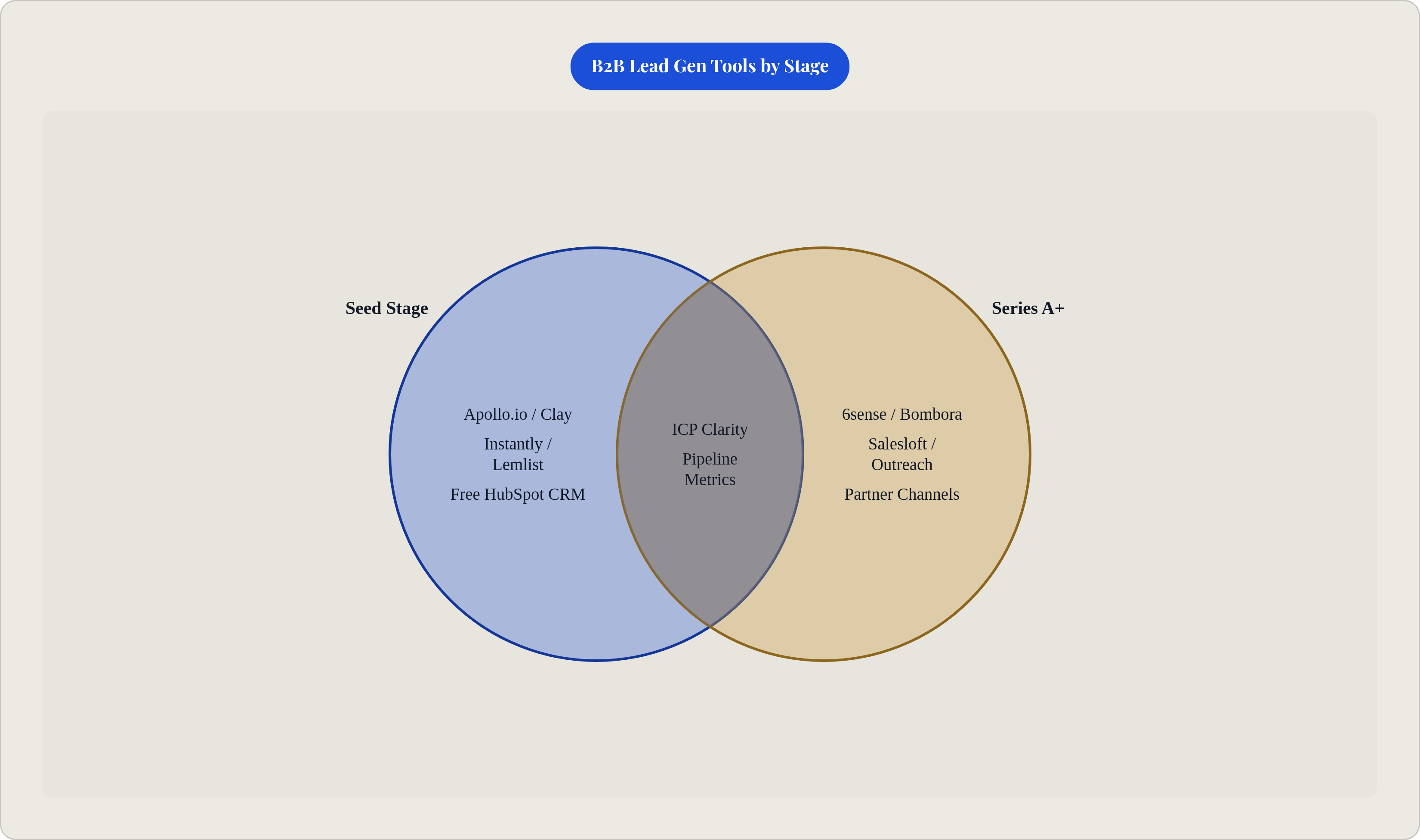
Most seed-stage startups need exactly one tool from the first category and one from the second. That's it. Everything else is premature, and buying ahead of your stage doesn't buy you speed, it buys you a subscription you'll forget to cancel.
Intent data needs enough web traffic and a defined total addressable market to produce a signal worth acting on. Before Series A, most companies don't have either. And here's the trap nobody warns you about: buying a sequencing tool before you've validated your ICP just means you're automating noise at scale. You'll flood inboxes faster, sure, but you're flooding them with the wrong message to the wrong people, efficiently.
Prospecting and data tools worth considering at the seed stage
Apollo.io combines a contact database with a sequencing layer, and the free tier is generous enough that it's the most accessible starting point for a founder doing outbound solo, no SDR required. Filter by firmographics, tech stack, or recent job changes to get a tight ICP match. The tradeoff: data freshness varies by segment, so layer in manual verification for your highest-value accounts before you hit send.
Clay pulls from dozens of data sources at once and runs AI enrichment on top, built for founders who want deeply personalized outbound without hiring a data team to support it. It has a steeper learning curve and a higher ceiling. Clay shines once your ICP is validated and you want to build lists around triggers: a funding round, a new VP hire, a tech stack change that signals someone's shopping.
LinkedIn Sales Navigator remains the gold standard for reaching senior buyers, especially in enterprise and mid-market segments where decision-makers actually live on the platform. Treat it as your sourcing layer, not your outreach channel; pair it with a separate sequencing tool. It's a real cost for an early-stage budget, so it earns its place only when your ICP is clearly LinkedIn-reachable.
ZoomInfo is broad, accurate, and expensive, generally more database than a seed-stage team needs. Worth a look if your ICP is enterprise and data quality is a hard constraint, but the annual contract structure makes it a tough sell pre-Series A.
None of these wins on database size alone. The right pick depends on whether your ICP is clear and whether you're running high-volume outbound or a tighter account-based motion.
Outbound sequencing tools and when they actually add value
Sequencing tools automate multi-step outreach across email and sometimes LinkedIn, track opens and replies, and manage follow-ups so you're not manually re-sending the same email fifty times a week.
Instantly is built for high-volume cold email at low cost, with strong deliverability tooling: inbox rotation, warmup, the plumbing that keeps you out of spam folders. It's the right fit for testing an email-first motion against a well-defined list at volume. It is not the tool for a highly personalized, account-based play; that's not what it's built for, and forcing it will just frustrate you.
Lemlist adds image and video personalization into the sequence, which suits lower-volume, higher-touch outreach where a little personal flair actually moves the reply rate. LinkedIn steps come built in, useful if your ICP checks email and LinkedIn both.
Salesloft and Outreach are enterprise-grade, with revenue intelligence layered on top of sequencing. They're priced and built for teams with dedicated SDRs running structured cadences across dozens of reps. For most seed-stage founders, the setup and admin overhead outweighs the return when volume is still low and the team is still small. Save these for later.
Here's the trap that catches nearly everyone at some point: automating outreach before you've found message-market fit produces fast, negative data. You get a flooded inbox of silence, and it looks like your ICP is wrong when really your message is the problem. The fix is boring but it works. Validate the message manually with twenty or thirty prospects first. Then automate what's already working, not what you're hoping will work once it hits scale.
Inbound capture tools for founders building content or paid channels
Inbound tools only make sense once there's something to capture: a content program, paid ads, or enough organic traffic to be worth catching. Buying inbound tooling before the traffic exists is putting the cart so far before the horse the horse can't even see it.
HubSpot bundles a CRM, landing pages, forms, email, and basic automation into one place, and the free CRM tier is genuinely useful, which is why it's the most common starting point for seed-stage inbound. It grows with you. The risk is over-configuring HubSpot before the marketing motion it's meant to support has actually been validated; don't build the cathedral before you know anyone's coming to pray in it. It's the right call once you have a content program running and need one place to track contact history and nurture sequences.
RB2B and Clearbit (rebranded as Breeze) identify anonymous website visitors and surface them as leads. Worth adding once you have meaningful traffic, several hundred monthly visitors at minimum, from a defined ICP. RB2B in particular pushes individual-level U.S. visitor identity straight to Slack in real time, which is high-signal for a founder who wants to jump on a warm visitor while they're still on the site.
Unbounce and Webflow are landing page builders for testing paid acquisition without looping in an engineer every time you want to change a headline. This is where ICP clarity either pays off publicly or fails publicly; the landing page is the moment of truth for whether your message lands.
Content marketing tends to generate meaningfully more leads than traditional outbound while costing less per lead, but that payoff shows up after six to twelve months of consistent production. It's a compounding strategy, not a short-runway one, so don't reach for it if you need pipeline next quarter.
Where intent data tools fit — and why most seed-stage startups should wait
Intent tools aggregate behavioral signals, content consumption, review site visits, competitor research, to flag accounts that are already in an active buying cycle before they ever fill out a form. 6sense, Bombora, and G2 Buyer Intent lead this category. 6sense uses AI to predict pipeline and time outreach to buying windows. Bombora aggregates third-party content consumption data across the web. G2 Buyer Intent flags accounts actively researching your category on G2's review pages.
All three need a defined TAM, enough historical deal data to calibrate against, and enough web traffic to validate the signal in the first place. That's the structural problem at seed stage: intent data is only as good as the baseline it's measured against, and with a small customer base and modest traffic, the signal-to-noise ratio is too high to act on with any confidence.
Revisit this category once pipeline is consistent, your ICP is validated, and you have the capacity to run account-based plays, typically around Series A or later. Buying 6sense at seed stage is a common mistake, usually driven by FOMO about how sophisticated the competitor's stack looks on LinkedIn. But the platform cost and the operational lift required to actually act on intent signals both exceed what a two-person team can absorb. Save it. It'll still be there.
How to build a tool stack that matches your actual stage
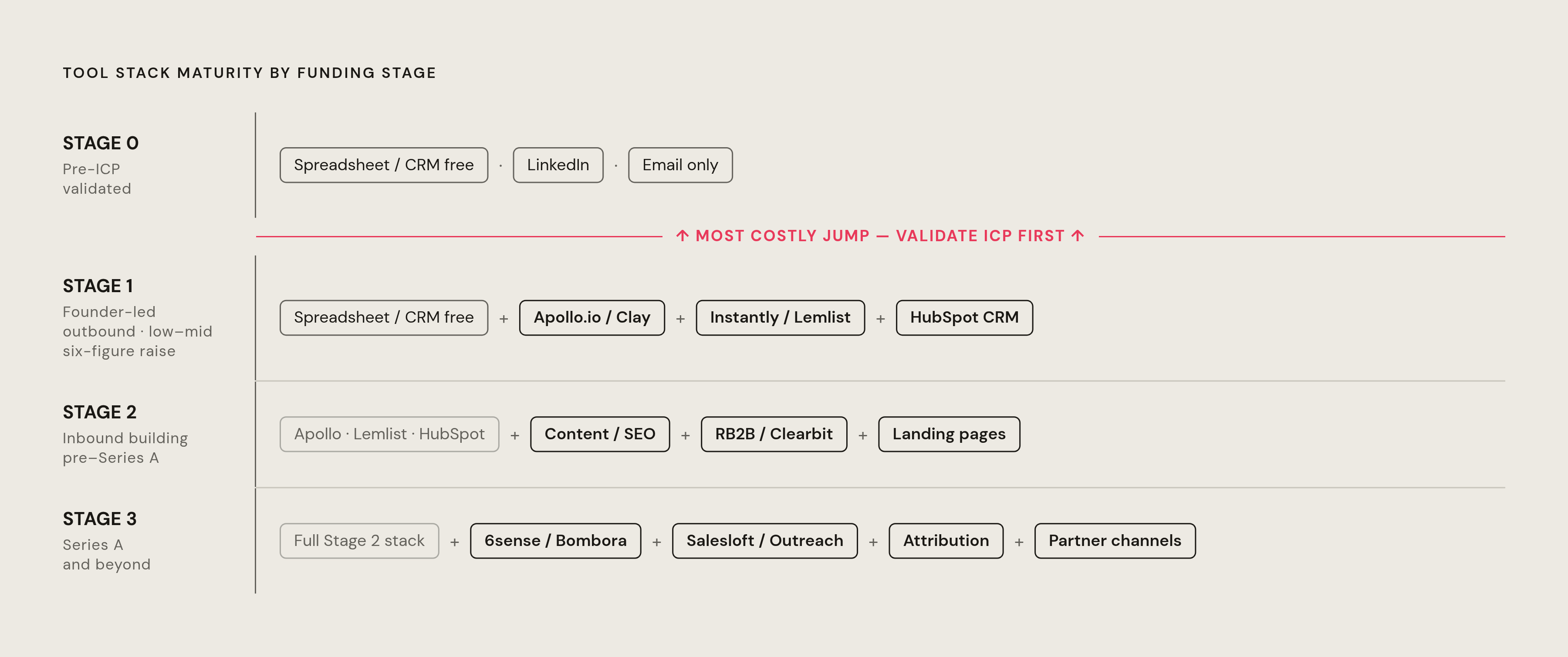
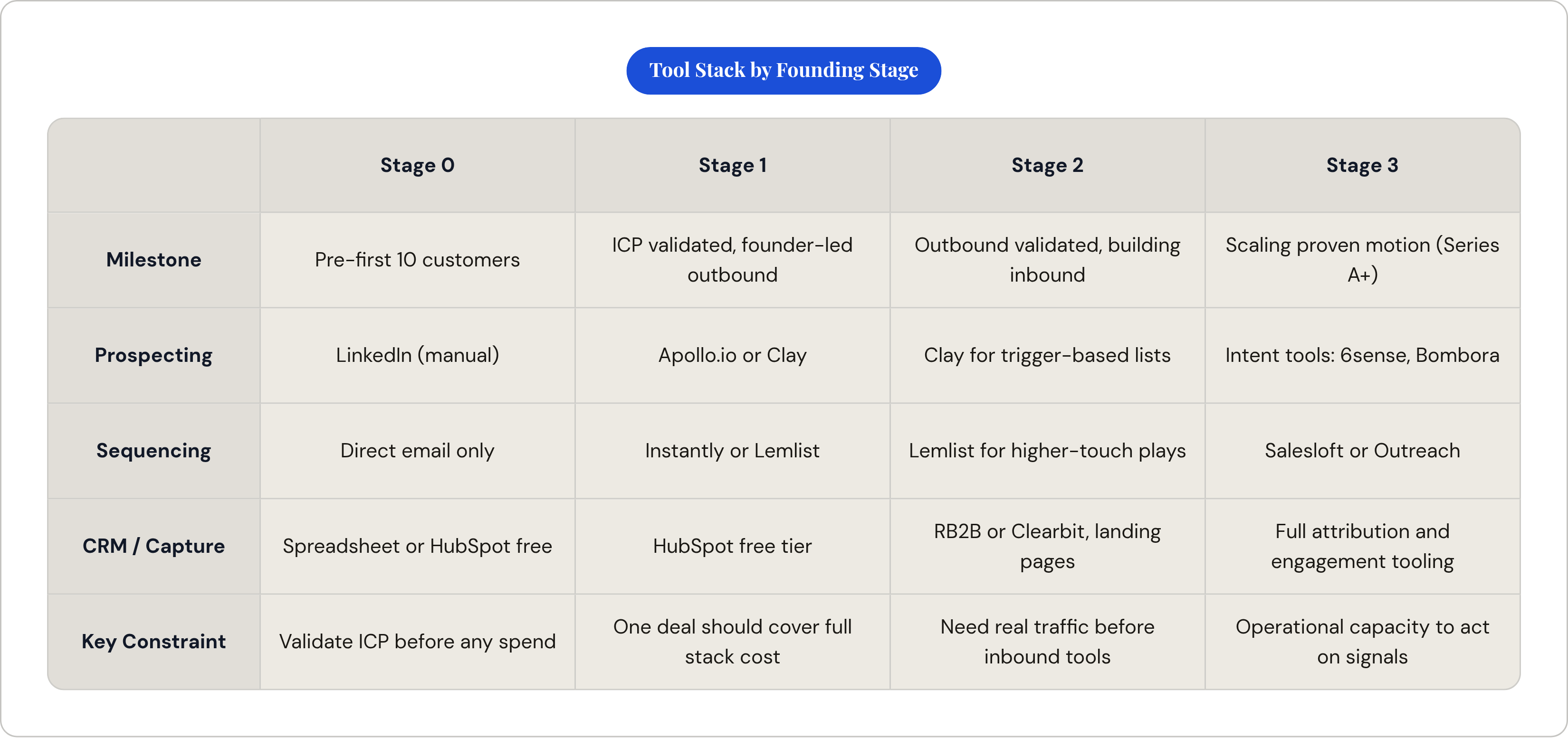
Stage 0, ICP not yet validated (pre-first-10-customers): keep it minimal. A CRM (HubSpot's free tier, or honestly even a spreadsheet), LinkedIn for manual outreach, and an email account. Spending on sequencing or intent tools here just accelerates the wrong motion faster.
Stage 1, ICP validated, founder-led outbound (roughly some hundreds of thousands to a few million raised, 12 to 18 months of runway): the core stack is Apollo.io or Clay for prospecting, Instantly or Lemlist for sequencing, and HubSpot for the CRM. Keep total monthly spend low enough that closing one deal covers the whole stack for the year.
Stage 2, outbound validated, building inbound (approaching Series A): add a content program with SEO infrastructure, RB2B or Clearbit for visitor identification, and landing page tooling for paid experiments. This is also where investor-ready metrics start mattering in earnest: CAC payback under 12 to 15 months, pipeline velocity you can actually see in the CRM, and MQL-to-customer conversion tracked from day one instead of backfilled later.
Stage 3, scaling what's already working (Series A and beyond): layer in intent data, sales engagement platforms like Salesloft or Outreach, and attribution tooling. This is also when partner channels start to matter. According to ICONIQ, partner channels account for as much as 20% of medium-sized SaaS revenue in 2025, which is a big enough number that ignoring the channel entirely starts to look like leaving money on the table.
The principle holds across every stage: tool selection follows ICP clarity and channel commitment. It never precedes them, no matter how good the demo looked.
The metrics that tell you whether your tool stack is working
Tools don't generate traction. Motions do. A tool only matters to the extent that it produces numbers you can trust and improve on.
Track these from day one, regardless of what's in your stack. Pipeline velocity: how fast a qualified opportunity moves from first touch to close. CAC payback: the benchmark has compressed to 12 to 15 months, and SMB-focused SaaS should be aiming under 12. MQL-to-customer conversion: this is where tool quality actually shows up, because bad data and sloppy sequencing inflate your MQL count while your conversion rate quietly collapses underneath it. NRR: above 110% tells you the ICP is right and the product delivers on its promise; below 100%, and no tool purchase on earth fixes what's actually a product or fit problem.
Context matters here too. Median ARR at Series A hit $2.5 million in 2025, roughly 75% higher than 2021 benchmarks according to CRV. The bar for what "traction" even means has moved substantially, and it's not moving back.
Investors aren't evaluating your tool stack. They're evaluating whether your CAC, your NRR, and your pipeline velocity add up to a coherent story about a motion that repeats. The right stack is the one that makes those numbers visible, honest, and improvable. Not the one with the flashiest dashboard in the demo.