CRM Selection for Early-Stage B2B Startups
Picking the right CRM early means designing for how you sell now, not the team you hope to become.

Picking a CRM at seed stage is really a data integrity problem wearing a software costume. Most founders don't clock that until a Series A investor asks their pipeline a question it can't answer, and the silence that follows is its own kind of answer.
What founder-led sales actually looks like in practice, and why it breaks most CRM assumptions
You're the founder. You're also the AE, the SDR, the support line, and the person drafting the board update at 11pm because that's apparently when the words show up. One person, four job titles, zero org chart. Most CRM products assume a division of labor that doesn't exist at this stage: a rep whose whole job is selling and logging activity, plus a manager somewhere checking dashboards and nodding.
That mismatch is where things go sideways. Logging a call feels like paperwork, not selling, so it gets skipped. Updating a deal stage feels like admin, so that gets skipped too, and skipping compounds fast, the way small debts do.
The cost shows up later, usually at the worst time. You lose a reliable pipeline view, even for yourself, the one person who's supposed to know exactly where every deal sits. Then you lose historical deal data, so when someone asks if you have a repeatable pattern, you're guessing out loud, and you lose any real basis for forecasting when an investor leans in and asks what the next 90 days looks like.
The fallback is usually a spreadsheet or a Notion doc. Understandable, and quietly destructive. A spreadsheet holds names and emails fine, but it doesn't hold motion. It has no idea a deal sat in "evaluation" for six weeks before going dark, because nothing in a spreadsheet timestamps itself. It's a phone book pretending to be a pipeline.
What actually works is picking a CRM that bends around how you sell today, not one built by a VP of Sales for a twelve-person team you don't have yet and might never need.
The metrics a Series A investor will pull from your pipeline before anything else
Investors don't care what your CRM looks like in a demo. Nobody's grading your color scheme. They care what it produces: a record they can trust, going back months, that shows how deals actually moved.
Every serious Series A conversation lands on the same handful of numbers eventually. Pipeline velocity (how fast deals move from first contact to closed-won). Stage conversion rates (where deals stall or die, and whether that's improved). CAC and CAC payback (what a customer cost you and how long it takes to earn that back). Source attribution (which channels produce deals that close, not just leads that pile up). Win/loss patterns, which tell you what your best customers have in common, and what your losses say about a positioning problem you haven't noticed yet.
None of that comes out of a spreadsheet. It needs a system that timestamps every stage change, keeps lost deals instead of quietly deleting them out of embarrassment, and ties every contact back to its source.
A CRM used inconsistently produces data nobody can trust. And an investor who spots one inconsistency, a deal that skipped three stages overnight, a close date that doesn't match the email thread, starts discounting the whole traction story. One bad data point taints the rest of the deck; that's just how skepticism works once it's triggered.
Set yourself a simple bar early: you should be able to pull a pipeline progression chart for any 90-day window, back to your very first deal, without reconstructing anything from memory.
How to think about CRM complexity relative to where you actually are in the sales process
Pre-product-market-fit is its own animal. You're still figuring out who buys, why they buy, and what your sales process even is, and the stages that'll make sense six months from now probably aren't the stages that make sense today. Honestly, they might not exist yet.
A rigid pipeline schema punishes you for that uncertainty. Your process will shift, more than once, and a rigid tool fights you every time it does.
So test it before you commit: can you rename stages, add a custom field, restructure the whole pipeline yourself, without filing a support ticket or hiring someone to do it for you? If the answer's no, keep looking.
Team size changes the math too. A solo founder closing deals alone needs something different than a founder with an SDR and a first sales hire. Ask yourself, honestly, whether the person logging activity will actually open the tool every day or treat it like homework. Then ask whether the default view shows what matters for how you sell right now, or needs a week of setup before it's worth anything. And ask what happens to the pricing if your team doubles next year; does it punish growth, or just track it?
The overbuilding trap catches a lot of smart people. They buy the tool built for the company they hope to become, not the one they are. That's how you end up on an enterprise-tier CRM that needs a dedicated admin to keep functioning, when your actual headcount is one person and a laptop.
Setting up a CRM should take a week, tops. Import contacts, build three to five pipeline stages, connect email, start using it. Almost nobody actually starts there, which is a little baffling given how simple the instructions are.
The leading CRM options for seed-stage B2B startups and what actually differentiates them
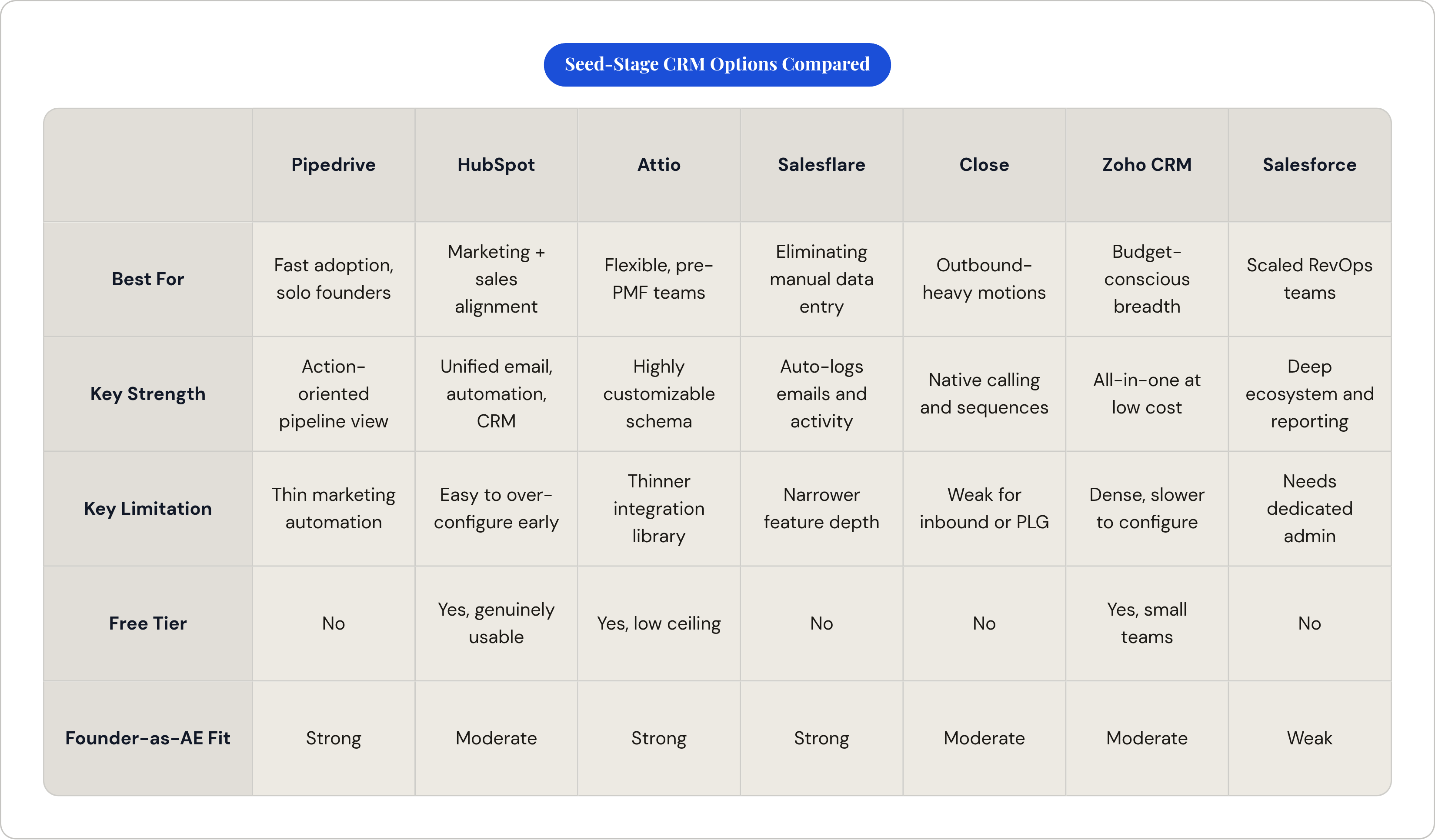
No single tool wins across the board. Fit depends on your selling motion, your team size, and where you're headed over the next year.
Pipedrive is built for speed of adoption. The pipeline view is action-oriented, built around what you need to do today rather than a reporting hierarchy for a sales manager who doesn't exist yet, and you can have it running within a few hours. Marketing automation is thin, though, so if you're running nurture sequences alongside sales, expect to bolt something else onto it eventually.
HubSpot makes sense once marketing and sales need to share a system. The free tier is real, genuinely usable, but most B2B startups outgrow it within a year as contact volume climbs. The upgrade path ties email sequences, automation, and CRM together, which cuts down on tool sprawl. The AI features, branded Breeze, sit behind higher-tier plans, so don't get excited before checking the price tag. The bigger risk is HubSpot's sheer breadth: it's easy to burn weeks configuring a platform for a sales process you haven't stabilized yet.
Attio suits founders who want flexibility and one shared view across a small team. It behaves less like a pipeline tool and more like a relationship database that happens to track deals on the side. The schema bends easily, which is exactly what pre-PMF founders need when stages are still a moving target. There's a free tier, though the ceiling is low, and Attio's newer to the market, so its integration library is thinner than the older names on this list.
Salesflare runs on one idea: the CRM should fill itself in. It pulls contact data, logs your emails, tracks activity automatically, no manual field-updating required. If your biggest adoption problem is the data entry itself, this one's worth a real look, since pipeline management and contact enrichment live in the same place.
Close is built for outbound. Calling, texting, email sequences, all native, including a power dialer running on Twilio, so you skip bolting on a separate calling tool. That focus is also its ceiling: it's a weaker fit if your motion is inbound-led or product-led rather than outbound-heavy.
Zoho CRM wins on cost and built-in breadth. Pipeline tracking, analytics, basic marketing automation, all under one roof, at a price that doesn't punish you for adding headcount. There's a free edition for small teams. The tradeoff is a denser interface; you'll spend more time configuring it than you would with Pipedrive.
Salesforce is the market default, and there's a real case for it: deep ecosystem, strong reporting, and it's the tool most enterprise buyers already know how to work inside. The honest cost picture includes licensing, implementation, and ongoing admin, all three scaling with headcount in ways none of the tools above do. Without a dedicated admin, that maintenance falls on you, on top of everything else. Salesforce makes sense once you've got a RevOps function, but it's a genuinely demanding choice when the founder is also the AE.
Choosing the tool is step one. The value shows up once it's wired into ICP tracking, attribution, and pipeline reporting from day one, since that's the connective tissue turning raw CRM data into a traction record investors can actually read.
AI capabilities inside CRMs: what's actually useful at the seed stage versus what's a distraction
Nearly every CRM bolted AI onto itself sometime between 2024 and 2025. The real question is whether it's baked into the core product or locked behind a pricing tier you haven't earned yet.
What actually saves time: automatic activity logging, so emails and calls get captured without you touching a keyboard. Contact and company enrichment, so firmographic details fill in instead of eating your afternoon. Next-step nudges that flag a deal gone quiet before it dies of neglect, which happens more than anyone wants to admit.
What sounds impressive but rarely earns its keep this early: generative email drafting at scale matters when you're sending hundreds of emails a week, not ten you're writing yourself anyway. Predictive deal scoring needs real history to mean anything, and at seed stage your dataset's too thin to produce a signal worth trusting. Revenue forecasting AI is only as good as the pipeline data underneath it, which loops you right back to the adoption problem you were trying to fix in the first place.
Fix data hygiene first, since AI compounds on top of that, not instead of it. If you're eyeing something AI-forward like Salesflare or Attio, test whether the automation solves your actual friction point, not whether the feature list reads well on a landing page.
Connecting CRM data to the ICP work that makes pipeline metrics credible to investors
A pipeline stuffed with the wrong deals makes every metric look worse than it needs to. Win rate drops. Cycles stretch, and retention suffers because customers who were never a great fit churn out within a year, right on schedule.
ICP precision fixes this from the inside out. A tight ICP shortens your sales cycle, since the buyer already knows they have the problem you solve. It lifts stage conversion, because the deals sitting in your pipeline are actually winnable instead of hopeful. And it drags CAC down, because you're not burning weeks chasing prospects who were never going to buy in the first place.
The practical move: build ICP attributes into your CRM as actual fields (industry, company size, tech stack, buying trigger) so your win/loss analysis shows exactly which segments close and which ones just eat your calendar.
That's what turns "we have a good pipeline" into something an investor can underwrite: here's the exact customer profile that closes fastest, expands the most, costs the least to land. Evidence, not a vibe.
Worth planning for: your ICP will probably shift at least once in year one, as you learn who actually buys versus who you assumed would buy. Your CRM's fields need to flex with that, which is one more reason a rigid, enterprise-grade setup is a rough fit this early. The startups that get this right tend to start with a narrow, almost stubborn ICP, then widen it as real deal data comes in. The CRM is where all of that learning gets written down, assuming anyone bothers to write it down.
Building the traction narrative investors actually want from the pipeline data you've captured
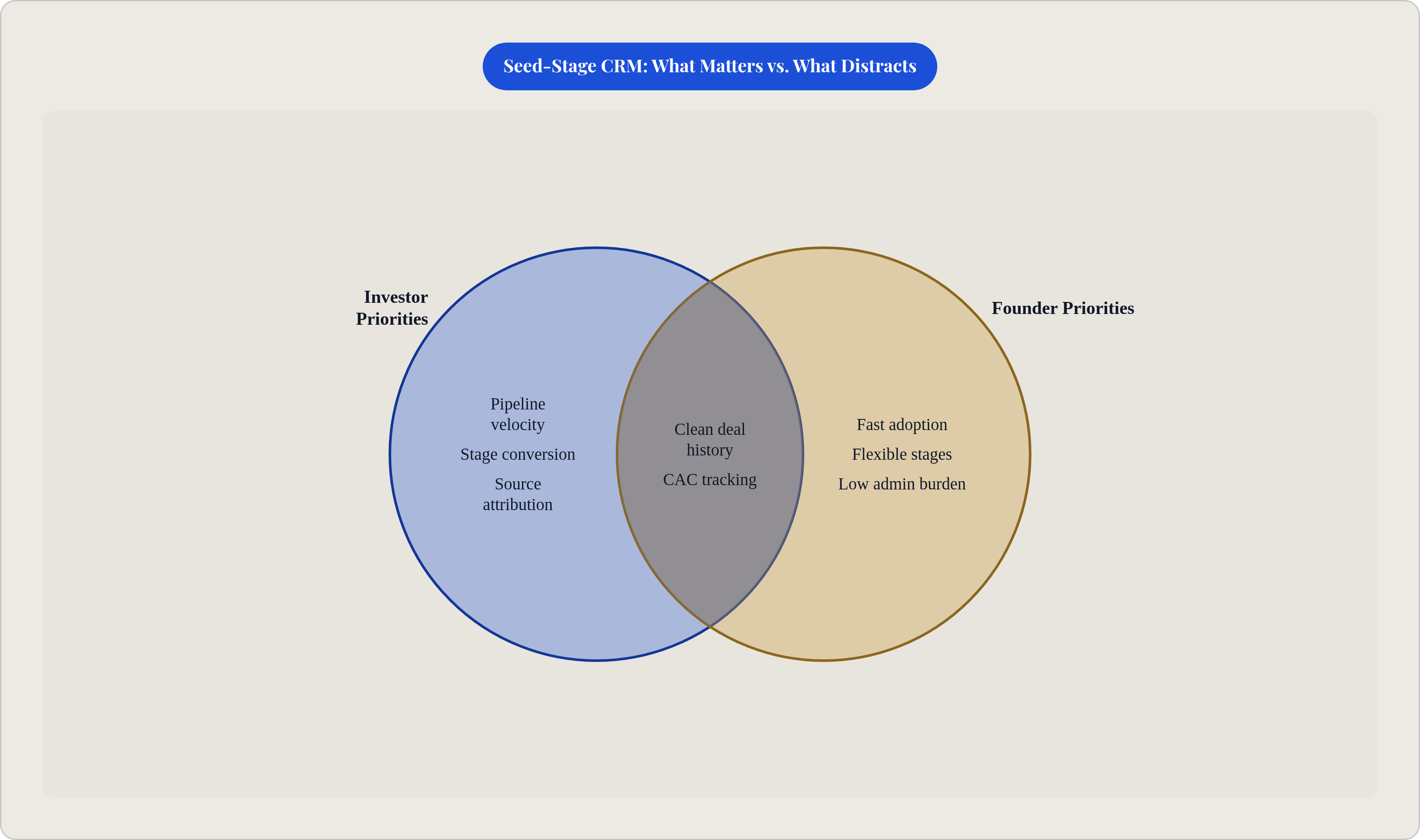
Investors don't read your ARR like a photograph. They read it like a movie: is the pipeline getting more efficient, is the ICP getting sharper, is this turning into something repeatable, or is it still one founder charming one prospect at a time across a series of increasingly desperate coffee meetings.
A CRM that's actually been maintained hands you the receipts. A velocity chart showing deals closing faster quarter over quarter. Stage conversion data showing exactly where the funnel used to leak and what patched it. Source attribution showing which channels produce real, closeable pipeline instead of noise in a spreadsheet. A CAC trend line heading down as the motion matures.
Every investor is quietly running the same test: can this team show a repeatable process, or are they still winning deals on founder charisma alone. Your CRM data answers that whether you want it to or not.
Skip the CRM and founders end up reconstructing the story from memory, old email threads, and whatever survived in a spreadsheet somewhere. It's slow, full of holes, and those holes are exactly where an investor's confidence quietly leaks out.
A CRM started the week you close your seed round, kept up through the runway that follows, tied to ICP tracking from day one, hands you twelve to eighteen months of clean traction data. That's precisely the window every Series A investor is going to put under a microscope, so it might as well hold up.
Setting up the CRM takes a week. The evidence record it produces takes a year, with no backfilling it after the fact once that year's gone.