Building an Outbound Lead Gen Motion from Scratch
Skip the list-buying and start with a narrow ICP that actually converts at seed stage.

Outbound at seed stage isn't an SDR team, and it isn't a sequencing platform blasting five thousand touches into the void, hoping something sticks. It's you, or maybe you and one other person, reaching out to specific accounts you picked on purpose, with messages you actually wrote (or heavily edited).
The goal isn't volume. Repeat that to yourself before you open Apollo. The goal is signal: figuring out which message lands with which person at which company, and under what conditions. You're running discovery research that happens to have a commercial angle bolted on.
Here's the thing that separates outbound from inbound: you control who gets reached. That's not a small detail, it's the whole point. Inbound fails quietly and slowly, a trickle of form fills that dries up over months and nobody notices until the board meeting. Outbound fails loudly, in real time, and it burns the one resource you can't get back at seed stage: time.
And compared to paid acquisition? Outbound is almost free to test. A list, a message, a channel, that's the whole rig. You can run five experiments in the time it takes a paid campaign to get through ad review. Success in week one doesn't look like closed deals. It looks like replies. Objections. A prospect asking "wait, how did you know we just hired a VP of Ops?" That's the win. Write it down.
Starting with ICP, not with a list
The single most common mistake, and I mean the one I've watched founders make over and over: buying a list before they know who belongs on it. That's like hiring a caterer before you've picked a wedding date. Backwards, expensive, and someone's going home hungry.
ICP is a hypothesis: this person has the pain, this person has the budget, this person can say yes, and you can actually reach them before your runway clock hits zero. A real ICP has four layers to it.
- Firmographic: industry, headcount, revenue, geography, funding stage
- Technographic: what's in their stack already, what they're integrated with, how mature their data setup is
- Trigger: the event that makes them actively shopping right now (a raise, a new VP hire, a product launch, new regulation)
- Stakeholder: who feels the pain, who owns the budget, who can quietly kill the deal in a Slack thread you'll never see
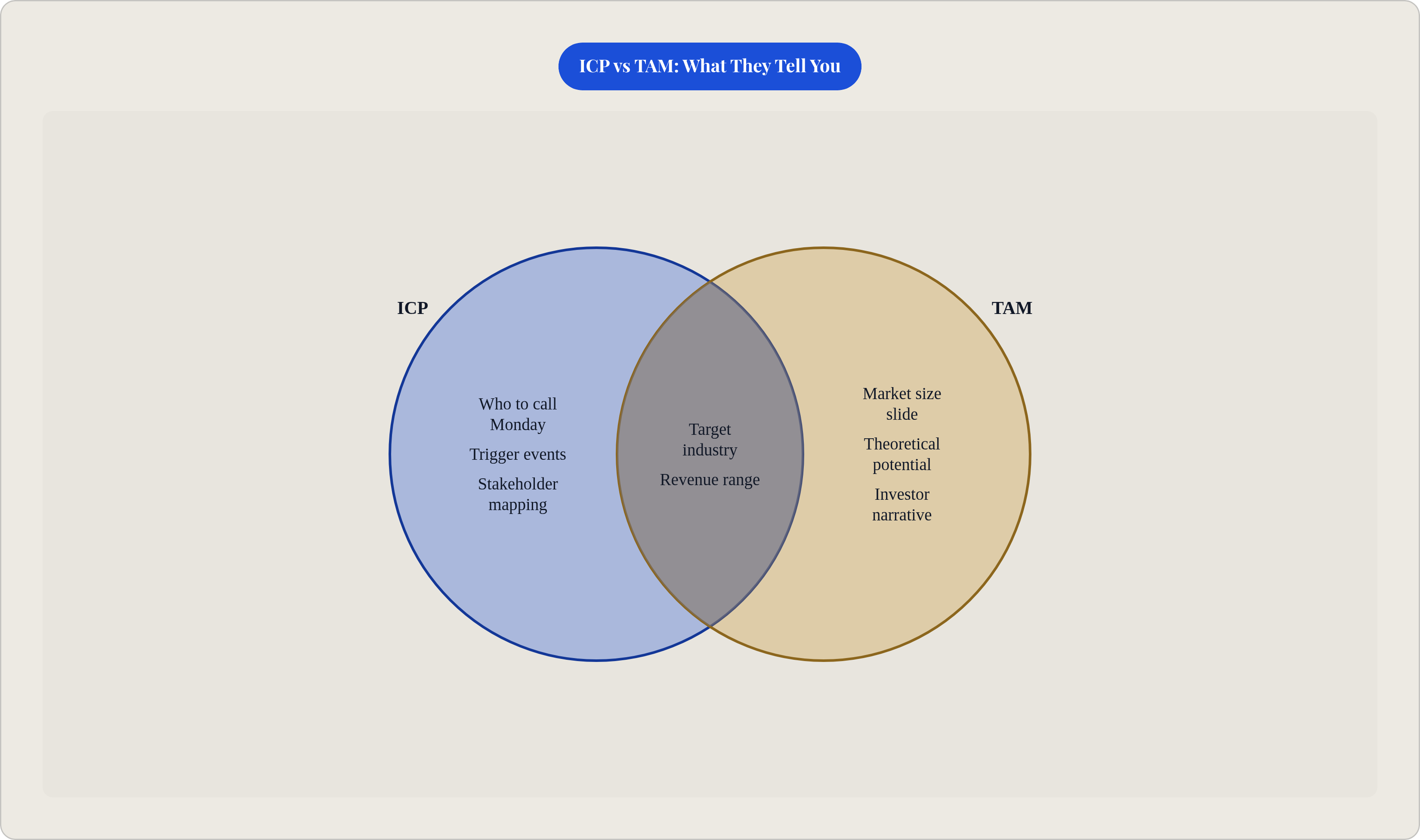
People confuse TAM with ICP constantly, and it kills pipelines before they start. TAM tells you what's theoretically possible in a market slide. ICP tells you who to call Monday morning. Those are different documents solving different problems.
Narrow beats broad, every time, at this stage. HubSpot's early ICP wasn't "any business that wants marketing software." It was a specific title, a specific company size, a specific use case. That narrowness is what built their product roadmap, their content, their pricing. A startup with a sharp, boring, narrow ICP will out-convert a startup chasing a huge fuzzy TAM, because focus does something breadth never does: it lets you get good at one conversation instead of mediocre at ten.
Treat your ICP like a hypothesis you're trying to disprove, not a plaque on the wall. It'll change. Here's a useful gut check: who are the five to ten customers you already have that generate the least friction and the most value? Reverse-engineer your ICP from them. It's faster than staring at a whiteboard.
Building a prospect list that earns the right to reach out
A good list is a filtered set of bets. Every single account on it should have a reason it's there, one you could explain out loud without shrugging. If you can't say why a company made the cut, it shouldn't have.
Building it means layering a few inputs. Firmographic filters through tools like Apollo, Clay, or LinkedIn Sales Navigator get you the base layer. On top of that, you want trigger signals: funding announcements, a fresh VP hire in the relevant function, job postings that hint at budget, tech stack changes picked up by tools that track that stuff. Intent data, where you can get it, adds a third layer, telling you a company is actively researching your category right now, not six months from now.
Timing matters more than people give it credit for. Reaching a newly appointed VP of RevOps in their first ninety days is a completely different conversation than reaching the same person after two years in seat. The new hire wants wins. The two-year veteran has already built their toolkit and doesn't want to hear from you.
At seed stage, smaller and researched crushes larger and generic. A hundred accounts where you've got a documented trigger and a real personalization hook will out-convert five thousand cold names by a wide margin. Not everyone on the list deserves the same effort either, so tier it:
- Tier 1: high fit, strong trigger signal, gets full research and a fully personalized note
- Tier 2: high fit, weaker signal, gets a semi-personalized message built off a pattern
- Tier 3: directionally interesting, unconfirmed, gets a lighter touch mostly to generate signal
Data quality isn't a nice-to-have you get to later. A list full of stale titles and dead emails doesn't just underperform, it corrupts the signal you're trying to read. You'll think your message failed when actually you emailed someone who left the company eight months ago.
Writing outbound messaging that earns a reply, not just an open
Most cold outreach dies at the message, not the channel. You can have the most surgically targeted list on earth and still get ignored if your opener reads like every other "quick question" email clogging that inbox.
A message that earns a reply follows a shape. Start with a relevance signal, one sentence that proves you actually know something about this person or their company. Skip the flattery, skip "I came across your profile," and get specific: a launch, a hire, a comment they made on a panel. Then name the pain, in their words, not your product's marketing copy. You're going for the "wait, how did you know that" reaction. After that, connect to your solution in a sentence, maybe two, without pitching a demo. Then close with one low-friction ask, a fifteen minute call or a direct question they can answer in one line back, rather than a calendar link dropped cold with zero context, like handing someone a form to fill out before you've even said hello.
Think of it like the StoryBrand framing: the prospect is the hero, their problem is the villain, and you're the guide standing off to the side with a map. Too many cold emails cast the founder as the hero and the prospect as an audience member. Flip it.
Personalization at scale is a real tension, and there's no getting around it. Tier 1 accounts get full research, referencing a specific blog post or job listing. Tier 2 gets a variable first line stitched onto a consistent core message built around a pain cluster. AI drafting tools are fine here, genuinely, they're a legitimate production tool. But every message that goes out needs a human set of eyes on it before it ships. AI gives you volume. A person gives you judgment, and judgment is the thing that keeps you from sounding like the fortieth SaaS founder who emailed this person today.
Test the opening line first. It's the highest-leverage variable you've got, more than the offer, more than the CTA. Run two versions of the relevance signal before you touch anything else.
Common ways this goes sideways: leading with features nobody asked about, a first email that reads like a term paper, a CTA that asks for thirty minutes with "the team" instead of fifteen with you, and messaging that's indistinguishable from every other B2B SaaS cold email in your category. If your email could've been sent by your closest competitor with the logo swapped out, rewrite it.
Choosing and sequencing outbound channels without spreading thin
Here's the wrong instinct, and it's tempting: running email, LinkedIn, cold calls, and ads all at once before any single one has told you anything. It's noise with a budget attached.
Pick one channel, maybe two. Get signal. Optimize. Then, and only then, layer in a second channel to reinforce what's working.
Cold email is usually the right starting point. Cheap, fast to test, easy to iterate on. Deliverability has gotten tougher as inboxes fill up, so the personalization bar keeps rising, but it's still the highest-leverage place to start. LinkedIn works well for founder-led outreach, especially when title and seniority are easy to filter for; an active founder presence on LinkedIn also does something subtle but real, it lets a prospect check you out and confirm you're a real person before they reply to your cold note. Cold calling gets skipped by a lot of product-minded founders who'd rather write code than dial a phone, but it works best layered on top of email. A call that follows a warm thread converts way better than a call that starts cold. Direct mail and gifting are niche, but in categories where email and LinkedIn are saturated for a specific buyer, showing up in a mailbox instead of an inbox can cut through.
Sequence it as a short, deliberate series of touches, not a bombardment. A simple version: email on day one, a LinkedIn connection request on day three, a follow-up email referencing something new on day seven, then a short final touch on day fourteen. Four to six touches over two weeks gets you signal without torching the relationship.
Channel choice should follow your ICP, not your personal comfort zone. If you're targeting a VP of Engineering, email and developer communities probably beat LinkedIn. If you're targeting a Chief Revenue Officer, LinkedIn and direct mail might be the better play. And hold off on paid outbound, programmatic ads, retargeting, until your message is already converting organically. Otherwise you're just paying to amplify something that doesn't work yet.
Running outbound as a structured experiment, not a continuous campaign
A campaign runs until the budget's gone. An experiment has a hypothesis, a success condition, and a date on the calendar when you sit down and actually read the results. Treating outbound like a campaign is how founders end up saying "we tried outbound, it doesn't work" after burning a month.
Structure each wave like a real test. Write the hypothesis down: something like "VPs of Operations at Series A logistics SaaS companies will respond to a message framed around compliance risk." Decide your minimum sample size before you send anything, usually a few dozen per variable at this stage, not five emails and not five thousand. Set your success condition in advance too: a reply rate threshold, a meeting-booked rate, or even a specific objection that tells you the message actually landed with the right pain.
Change one variable at a time. Test ICP, message, and channel all together and you'll have no idea which one broke. If nothing works, that's not proof outbound is dead, it's proof you owe yourself a diagnosis: wrong ICP, wrong message, wrong channel, or wrong timing.
Positive signal isn't just meetings booked. Replies count, even the negative ones. Referrals to a better contact count. Objections that reveal real buying criteria count, because now you know what actually matters to this buyer. Negative signal matters just as much, silence, immediate unsubscribes, "wrong person" forwards, as long as you're logging it consistently instead of just feeling vaguely bad about it.
Review weekly. Not monthly. A month spent testing the wrong hypothesis at seed stage is a month of runway you don't get returned to you. After three or four waves, most founders land on the ICP segment, pain point, and message combination that actually converts, because each wave builds on what the last one taught.
The metrics that tell you the outbound system is actually working
Open rates and LinkedIn impressions feel productive to track. They measure delivery, not conversion. Your message got seen. Great. Did anyone care?
Track reply rate by segment, not in one blended number that hides where things are actually working. Track meeting-booked rate, which is basically your landing page conversion rate for outbound. Track meeting-to-qualified-opportunity rate too, because a meeting with someone who has no budget and no authority isn't pipeline, it's a nice chat. Track CAC from outbound against your other channels, even roughly, because investors will ask you to put a number on this before Series A conversations start. And watch time-to-first-reply: shorter reply cycles usually mean you hit real urgency on the trigger event, not just a polite audience.
None of this matters if it's living in a spreadsheet only you understand. Get it into a CRM early, even a lightweight one like HubSpot or Attio. Series A investors in 2025 are looking for a repeatable GTM engine behind your revenue line, not just the number itself. Consistent CAC, improving conversion across waves, and a defined ICP that actually closes, that's the story that makes the ARR number believable instead of lucky.
Don't optimize for volume sent, list size, or "pipeline coverage" made up of accounts that have never once replied to you. That's activity theater. It looks like progress in a slide deck and means nothing in a bank account.
When to hand the outbound motion off and what to hand off
Founder-led outbound isn't meant to last forever, and treating it like a permanent job is its own kind of mistake. It's the right vehicle early on because only the founder can validate ICP and messaging in real time, feeling out objections firsthand instead of reading them secondhand in a CRM note some rep typed in a hurry.
The handoff point comes once the system's actually a system: you know your ICP, you know which message converts, you know which channel and sequence produces meetings that turn into real pipeline. At that point you're handing off a playbook with the guesswork already removed, the exact ICP layers, tiered lists, message templates by tier, sequence cadence, and the metrics that define success. That's what makes a first SDR or growth hire productive in week two instead of week twelve, because they're not starting the experiment over. They're running a machine you already built and already trust.