Building an Outbound Lead Gen Process for B2B Startups
A five-layer system beats effort: ICP, list, message, sequence, and measurement.
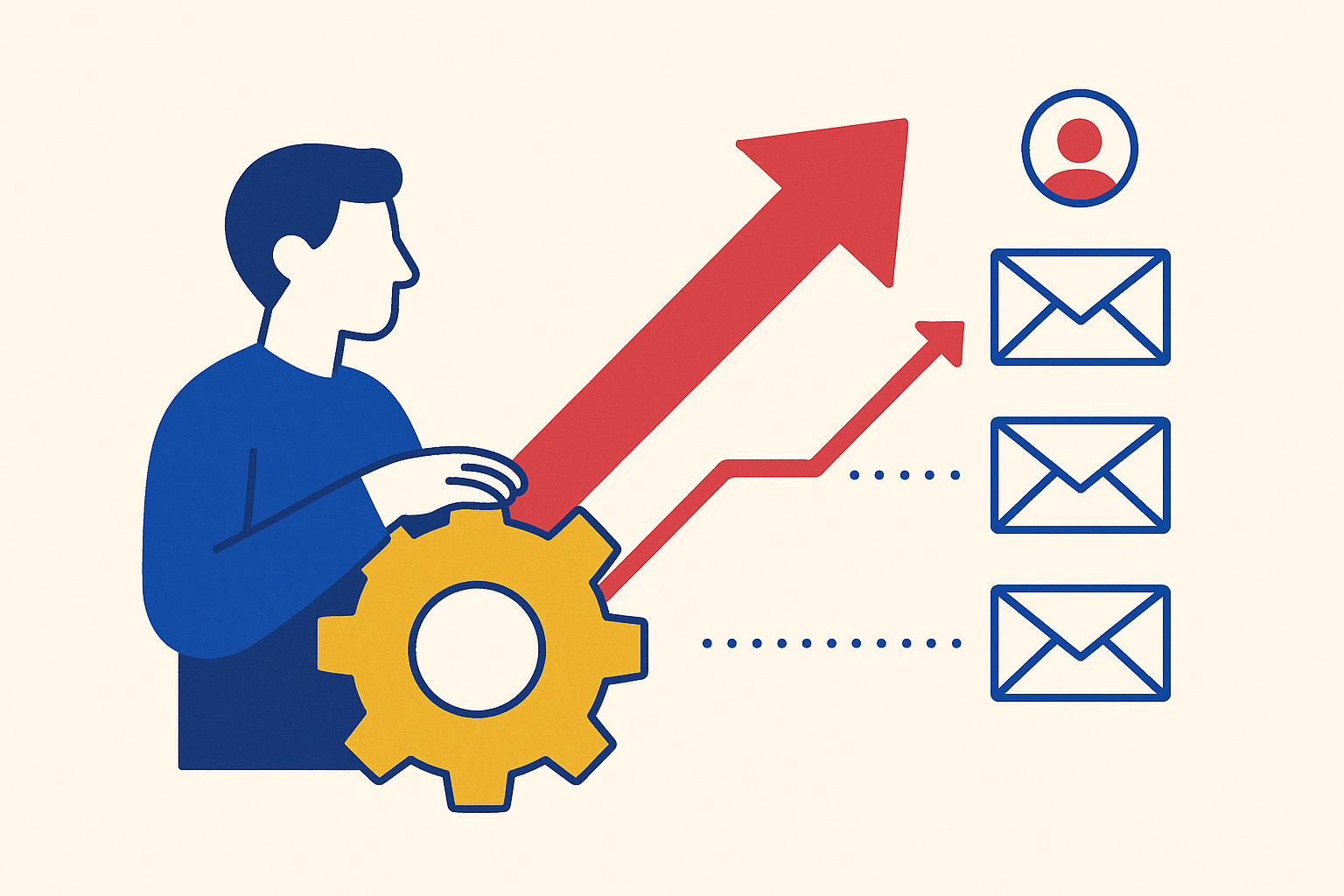
Most B2B startups struggle with outbound because their systems are broken, not their effort. The emails get sent, the calls get made, the CRM fills up with activity, and pipeline still shows up like weather: unpredictable, occasionally violent, mostly disappointing. This piece is about the fix, and the fix requires more than trying harder at cold email. It means building the five-layer machine that turns outbound into something you can actually count on.
What a repeatable outbound system actually looks like before you build one
Every outbound motion that actually works has five layers stacked on top of each other. Skip one, and the whole thing wobbles like a table with a short leg.
Layer one is your ICP, a working filter rather than a persona slide with a stock photo of "Marketing Mary" on it. Layer two is a list sourced and qualified against that filter, distinct from contacts scraped in bulk from some database that sells the same 40,000 contacts to everyone in your category. Layer three is message architecture built around the buyer's actual problem, a real alternative to a features list dressed up as a pitch. Layer four is a sequence with real logic connecting each touch. Layer five is measurement that tracks what's happening at every single stage, going well beyond whether someone opened your email.
Here's the part founders skip past: these layers depend on each other in order. A weak ICP produces a bad list no matter how good your sourcing tool is. A good list with a lazy message wastes all the targeting work you just did. A great message with no sequence behind it leaves most of your pipeline on the table, since most replies come after multiple touches, not the first one. And if you've got all four of those working but no measurement layer, you're flying blind. You'll never know if it's the list, the message, or the timing that's broken.
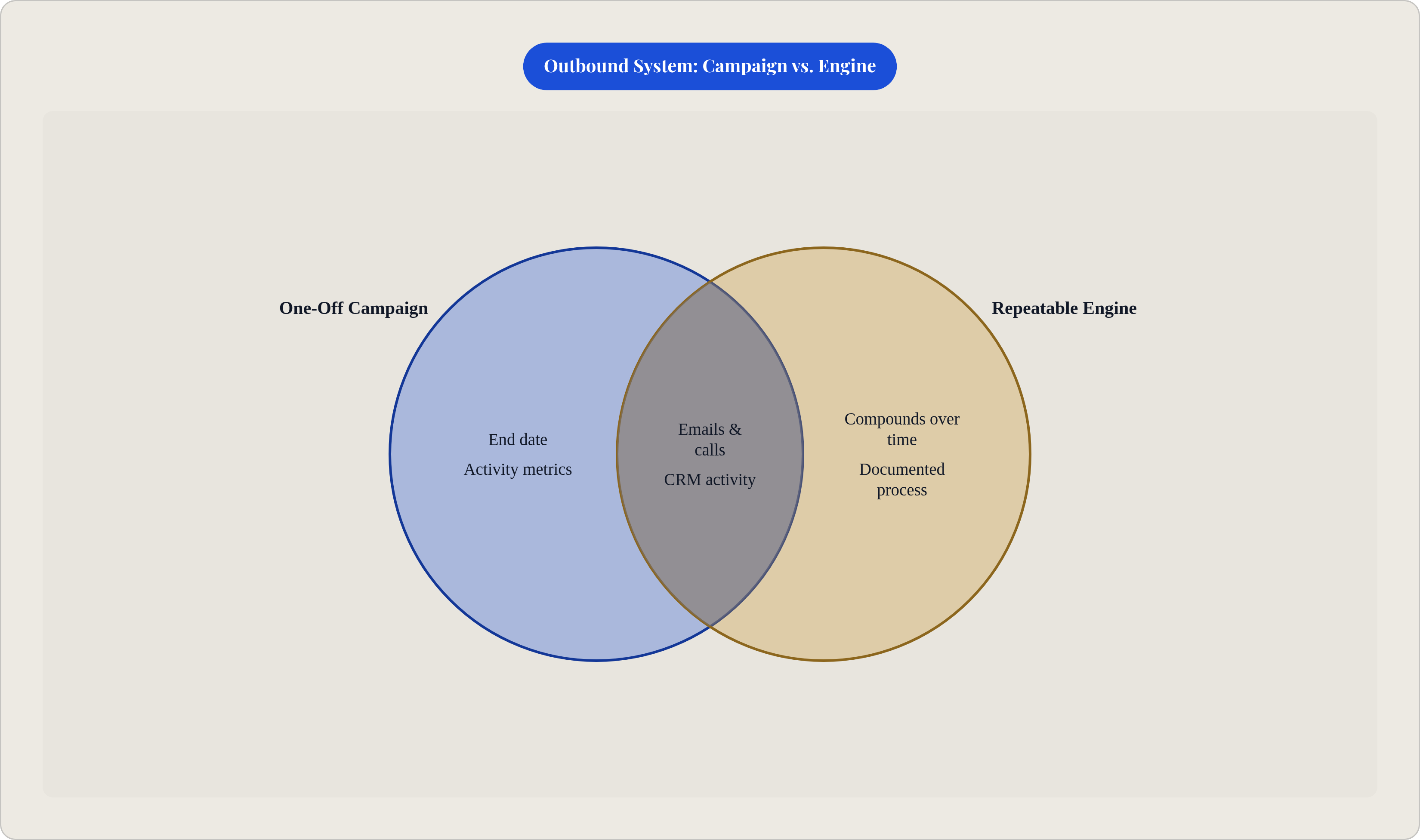
A campaign has an end date. An engine doesn't. That's the actual difference between running an outbound push last quarter and having outbound produce 30% of your pipeline every month. One gets turned off. The other compounds, gets documented, gets handed to a new SDR without three weeks of shadowing the founder first.
At seed stage, you're still the pilot. Fine. But the plane needs instruments. Flying on feel works right up until it doesn't, and you never see the mountain coming.
Defining your ICP precisely enough to build a list from it
Founders confuse TAM and ICP constantly, and it's an expensive mix-up. TAM is everyone who could theoretically buy your product. ICP is who you should be selling to right now, given what your product actually does today and how many people you have to sell it. Targeting the whole TAM feels ambitious, but it produces diluted messaging pointed at accounts that were never going to close this year anyway.
A working ICP filter has three layers, and if you're missing any of them, you have a guess with good formatting rather than an actual ICP.
The firmographic layer is the boring stuff: company size, industry, geography, revenue band or funding stage. These are literally the dropdown filters in your prospecting tool. Then there's the trigger layer, which is the part most people skip: what's actually happening at this company right now that makes them likely to buy? A funding round, a new VP hire, a tech migration, a regulatory change. And underneath both of those sits the macro layer, the structural reason this whole segment has the problem you solve, and why the urgency is real right now instead of theoretical.
Run the "why now" test on your own ICP. If you can describe the buyer but not what's happening in their world this month that makes your timing right, you don't have an ICP yet. You have a demographic.
Stress test it three ways. Can you name one company that fits and one that clearly doesn't, and explain exactly where that line sits? Do your best current customers actually cluster inside your ICP definition, or did you write the definition first and hope reality would match it later? And could you hand this definition to someone building a list and get back names that look right without you correcting half of them?
Broad ICPs are the number one root cause of outbound that just doesn't work, more than bad copywriting or the wrong tool. A definition so wide it could describe half the internet drags everything else down with it. Narrower targeting wins more, closes faster, and produces pipeline that actually makes sense when you look at it. At seed stage there's a bonus too: a tight ICP turns every single sales conversation into a data point about whether your definition is even right.
Building a list that earns the right to reach out
Bought lists feel efficient and almost never are. They're built against loose categories that approximate your ICP, not your actual filter, so you end up emailing people who technically fit "VP of Ops at a 200-person SaaS company" and have nothing to do with the actual problem you solve. Add in stale contact data (people change jobs constantly) and you're bouncing emails and torching your domain's sender reputation before you've booked a single meeting. And here's the kicker: everyone else buying from that same data provider is hitting the same inboxes. You're the fifth cold email that person got this week from a company selling roughly the same thing, not an outreach reaching an underserved contact.
Better sourcing looks like this. Intent and trigger data, meaning you go find accounts actively showing buying signals: job postings for roles your product supports, funding announcements, public statements about a new initiative. LinkedIn Sales Navigator with filters actually scoped to your ICP, more specific than "everyone with 'growth' in their title." Tech stack data through tools like BuiltWith or Clearbit, to find companies already running the adjacent tools your best customers tend to run. And for narrower verticals, conference attendee lists and industry association directories still work, unglamorous as they sound.
At the contact level, get specific about who you're actually targeting. The economic buyer and the operational champion are usually two different people, and outbound that only reaches one misses the whole buying committee dynamic that's about to decide your deal's fate. Verify contact data before the sequence goes live, because deliverability problems compound fast and a flagged domain is a slow, annoying death. And keep your list sized to how much you can actually personalize. A tight list of 200 well-researched contacts beats 5,000 you know nothing about, every time.
The trigger event thing is underrated. Reaching a new VP of Sales a week into their new job, or a company two weeks after their Series A, carries a different kind of relevance than a cold email with no timing behind it at all. It's the difference between showing up at the right party and showing up at someone's house at 3 a.m.
Writing outbound messages that survive a skeptical inbox
Most cold outbound copy has the same three problems. It leads with the product instead of the buyer's actual pain. It claims some differentiation that every competitor in the space also claims in their own cold email. And it asks for too much too soon, a 30-minute discovery call from a stranger who hasn't earned 30 seconds yet, let alone 30 minutes.
Here's a useful filter: if explaining what your product does takes more than one sentence, you've already lost most of the inbox. The messages that work have one audience, one problem, one outcome, built around the buyer rather than a features list with bullet points pretending to be a pitch. And there's a standard I'd hold every message to: it should survive being forwarded by one stakeholder to four other people who've never heard of your company. If your positioning falls apart the moment it leaves your hands, it was never really positioning.
Personalization gets faked constantly, and buyers can smell it instantly. Surface-level personalization is dropping in the company name or complimenting someone's LinkedIn post about "leadership." Genuine personalization is referencing the actual trigger event or business context that makes you relevant this week, to this person, for this reason. It's slower to write. It's also the difference between a reply rate that's a rounding error and one that actually moves the needle.
A cold email that works usually follows a loose structure. Open with a specific relevance signal, more useful than "Hope you're well." Name the pain in one sentence, without immediately jumping to your solution. Drop in a proof fragment, one real outcome a similar company got, with an actual number or workflow change attached, more convincing than a vague "customers love us" line. Close with a low-friction ask, a question or a small next step, easier to say yes to than a calendar link shoved in someone's face on touch one.
Email, LinkedIn, and phone each carry a different expected depth, a different response window, and tend to reach a different kind of buyer. And cold calling isn't dead, especially for senior buyers; plenty of C-level folks still prefer picking up the phone over reading another email. The bar for relevance is just even higher when you've got someone live on the line.
Structuring a sequence so follow-up does the heavy lifting
The first email almost never closes the loop, and treating it like it should is where most single-touch outbound dies quietly. Most replies come from later touches, not the opener. Silence after touch one usually isn't rejection. It's someone buried in their inbox, dealing with a fire that has nothing to do with you, or catching your message at the exact wrong moment.
A well-built sequence runs five to eight touches over two to four weeks. Enough to actually get noticed, short enough to exit gracefully before you become the annoying name in someone's inbox. Mix channels across it, email, LinkedIn, maybe a call, because you're trying to reach the buyer wherever they actually pay attention, not wherever's easiest for you to automate. Every touch needs to add something new: an insight, a relevant case study, a sharper question. "Just following up" carries no value proposition; it reads as a confession that you didn't have anything else to say.
Spacing matters too. Tighter in week one, then spreading out, which roughly mirrors how attention actually decays in a real inbox.
The breakup message deserves its own mention because it's genuinely counterintuitive: the final "I'll stop reaching out" touch often gets the highest reply rate in the entire sequence. Turns out telling someone you're about to leave them alone is more compelling than five polite nudges. Function of scarcity, maybe, or just relief. Either way, it works consistently enough that skipping it is leaving free replies on the table.
Sequences should branch, too. If the economic buyer goes quiet, the champion track keeps running on its own. If someone replies but they're clearly not the decision-maker, shift the sequence to help them build the internal case instead of pushing them toward a call they can't say yes to anyway.
Tools like Apollo, Outreach, Salesloft, and Instantly handle the scheduling and channel-switching at scale, and they're genuinely useful for that. But automation should execute a strategy someone else invented. AI-assisted personalization still needs a human deciding what the message logic actually is and catching where it's clearly missing the mark. The real risk with automation is that it makes sending volume so easy, people skip the discipline part entirely, and burn through their list and their domain reputation in the same motion.
The metrics that tell you whether the system is working or just running
There's a real difference between activity metrics and system health metrics, and most dashboards only show you the first kind. Emails sent, calls made, connection requests, these measure effort. They tell you the team is busy. They tell you nothing about whether the busy is working.
System health metrics are the ones that actually matter: reply rate by sequence and by segment, meeting booked rate, opportunity conversion rate, and how much pipeline outbound is actually sourcing. Instrument the whole funnel, starting from the first touch. Contact-to-reply rate tells you if your list and message are landing with the right people at all. Reply-to-meeting rate tells you if the conversation is converting into real qualified interest. Meeting-to-opportunity rate tells you whether meetings are turning into pipeline or just filling calendars. Opportunity-to-close rate by ICP segment tells you which slice of your ICP is actually buying, which is often narrower than founders expect.
This isn't just internal hygiene. Investors evaluating a Series A aren't just looking at revenue, they're looking at whether the pipeline machine behind it is repeatable. CAC by channel, pipeline velocity, outbound-sourced revenue as a share of total pipeline, these are the numbers that signal a scalable go-to-market rather than a lucky run of three deals. A founder who can walk through a conversion funnel that's steadily improving is telling investors a very different story than one who can only point at a revenue total and shrug.
When something breaks, the metrics tell you where to look, if you actually read them right. Low contact-to-reply rate means a list or message problem, and no amount of sequence tweaking fixes it. High reply rate paired with low meeting rate usually means the message is interesting but the ask isn't landing. High meeting rate with low opportunity rate usually means you're booking meetings with people who were never going to be able to say yes in the first place.
Build the measurement in from day one and you get a trend line. Bolt it on later and all you get is a snapshot, basically a photo of a car crash after it already happened.
Iterating the system without breaking what works
The biggest testing mistake is changing three things at once and then wondering which one actually moved the needle. New ICP, new message, new channel mix, all in the same week, and now you've got a result you can't explain. That's noise generation dressed up as iteration.
Change one layer at a time. If reply rates are low, test the message before you touch the ICP. If meetings aren't converting, look at qualification before you rewrite the whole sequence from scratch. Give each change enough volume to actually mean something, too; a dozen emails is a guess with a spreadsheet attached, not a test.
And hold onto what's already working while you experiment elsewhere. It's tempting to blow up the whole system every time growth slows down, but the founders who build durable outbound engines are the ones who protect the parts producing results and isolate their experiments to the parts that aren't. The system doesn't need a revolution every quarter. It needs someone paying close enough attention to know exactly which bolt is loose, and the discipline to only turn that one.