B2B Intent Data Tools for Early-Stage Startups
Discover which intent data tools actually work for founders running lean GTM teams.
91% of B2B marketers use intent data, yet only 24% call the ROI exceptional, according to DemandScience's State of Performance Marketing report. That gap should stop you in your tracks: almost everyone's buying the signal, almost nobody's turning it into revenue. This piece is about why that happens and what a seed-stage founder should actually do about it.
The gap isn't about data quality. Bombora's co-op model, 6sense's predictive scoring, and ZoomInfo's contact graphs are all built by smart people solving a hard problem, and they mostly work. The failure happens after the signal lands. A company visits your pricing page three times in a week, the tool flags it, and then nothing happens. It sits in a spreadsheet. It rots in a CRM nobody's cleaned since the seed round, and it shows up in a tool that has no idea how to talk to your outreach sequence.
For a two-person GTM team running founder-led sales, this problem gets sharper, not softer. There's no RevOps person to route the signal, no SDR bench to work it, and no ABM playbook already humming in the background. You get an alert, and you're the one who has to do something with it, probably between a customer call and writing that investor update you've been putting off.
So the real question isn't "which tool has the best data." It's "which tier of tool matches where my pipeline actually is right now, and what do I do with the signal on Monday morning."
What intent signals actually are and where they come from
Intent data comes in three layers, and they behave differently.
First-party signals come from your own site and content. This is the highest-fidelity stuff you'll get, and it's usually the cheapest, but there's a catch: most of that traffic is anonymous. Without a deanonymization layer sitting on top, you're staring at a wall of "Visitor from Ohio" entries that tell you nothing.
Second-party signals come from review sites like G2 and TrustRadius. Someone reading reviews of your category is deep in an evaluation, so the commercial intent here runs hot. The limitation: this only captures buyers who already know your category exists. If you're creating a new category, this layer is mostly quiet.
Third-party signals come from data co-ops, the model Bombora built its business on. These pull from thousands of B2B sites and give you broad reach, but the data lands at the account level. You know that Acme Corp is researching your category, but you don't know who at Acme Corp is doing the researching, which means reaching an actual human usually requires bolting on a second, contact-level tool.
That account-versus-contact distinction trips people up constantly. Most providers report at the account level and stop there; getting to the buyer costs more and adds another piece to your stack.
And here's the scale of what these signals are trying to catch: 6sense's 2025 Buyer Experience Report, surveying over 4,000 buyers, found that 94% of B2B buying groups have already ranked their preferred vendors before they ever talk to sales. They consume an average of 13 pieces of content getting there, mostly anonymously. That's the iceberg. Intent data is the sonar trying to find it before it sinks your deal.
No single layer gives you the whole picture on its own. The tier of tool you need depends less on budget and more on which layer you can realistically act on given your current team.
How the market consolidated in 2025 and what that means for a startup buyer
Two deals reshaped this category in 2025. HG Insights acquired TrustRadius in June, folding review-based second-party intent together with technographic data into one offering. HubSpot absorbed Clearbit into what's now called Breeze Intelligence, so standalone enrichment quietly disappeared into a suite plenty of seed-stage founders were already paying for anyway.
At the same time, the category started shifting from dashboards to agents. 6sense launched RevvyAI, and ZoomInfo shipped Copilot. Signals now trigger recommended actions automatically instead of sitting in a report waiting for someone to open it on a Tuesday.
Here's the catch for a lean team: these tools are increasingly built assuming a RevOps function exists to configure and babysit them. The Forrester Wave for Intent Data Providers (Q1 2025) named Bombora, 6sense, Intentsify, Informa TechTarget, and Demandbase as Leaders, with Intentsify posting the highest Current Offering score. These are excellent products, but they are also enterprise reference points, not starting lines for a founder still closing deals on Zoom with her camera slightly too close to her face.
Fewer standalone tools, more bundled suites. That cuts two ways. If you're already living inside HubSpot, the per-tool cost drops. But it gets harder to judge the intent capability on its own merits when it's wrapped inside a platform you bought for six other reasons.
Why enterprise-tier tools are the wrong starting point for most seed-stage founders
Pricing across this category runs from roughly tens of thousands to $150,000-plus a year, according to Martal's 2026 B2B Data Industry Report. The number that looks cheapest on the invoice is often the most expensive once you tally what you need to buy around it to make it work.
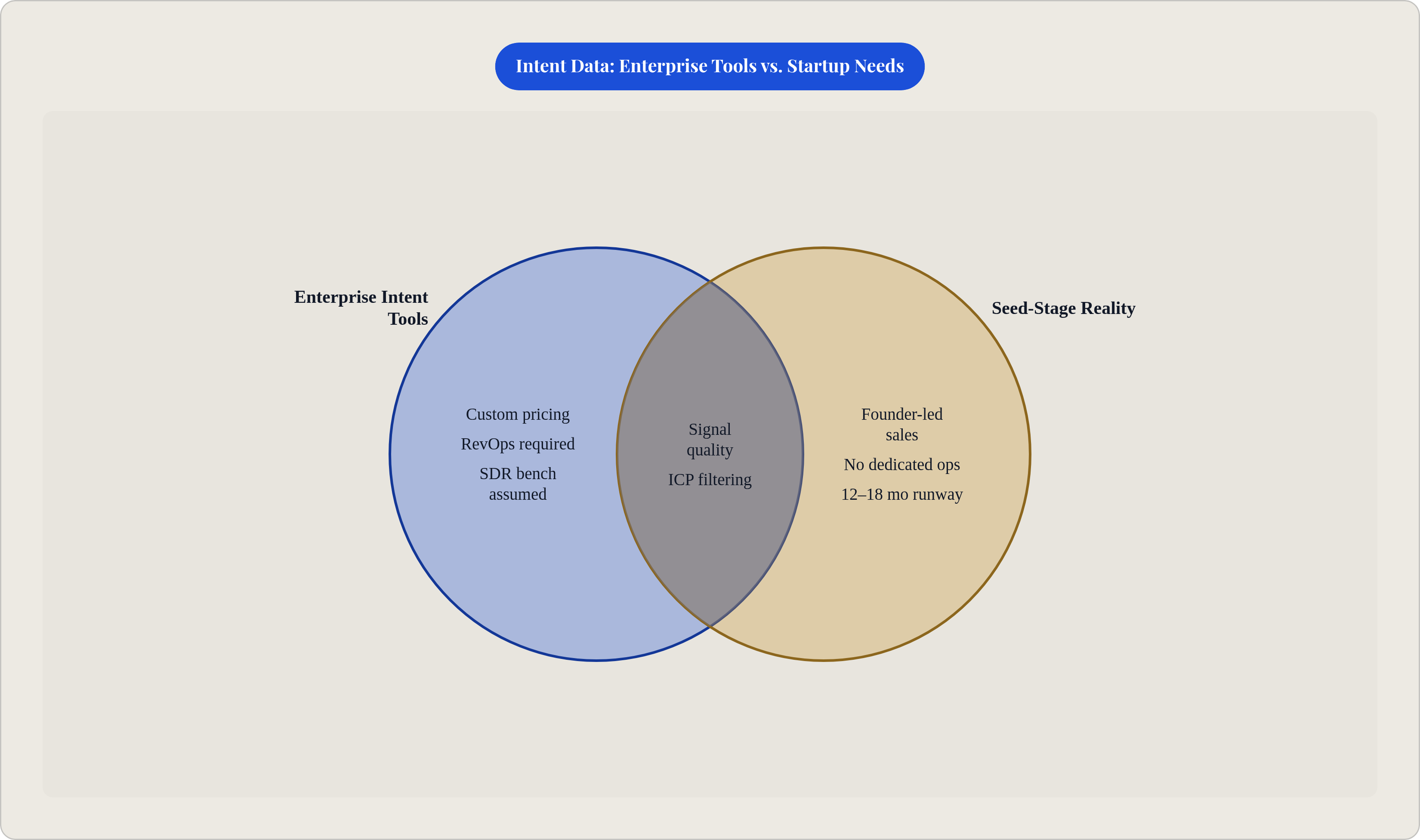
Demandbase is the clearest case of mismatch. It's a genuinely strong platform, with custom pricing, no self-serve tier, and a learning curve steep enough that you basically need a dedicated RevOps hire just to turn it on. That's not a knock on the product; it's a mismatch of audience, since this tool was built for a team that doesn't exist yet at your company.
ZoomInfo's intent add-ons run somewhere in the tens of thousands of dollars a year. ZoomInfo has earned it, too, a Gartner Magic Quadrant Leader for ABM Platforms in both 2024 and 2025, with a 4.7 out of 5.0 rating in Gartner's Voice of the Customer 2025. The quality is real, but the infrastructure assumption underneath it, clean CRM, SDR bench, ops person maintaining integrations, is not a seed-stage reality for almost anyone.
So the right question shifts. Not "what's the best intent data tool," but "what's the lightest tool that gives me a signal I can actually follow up on this week." Buying more data than your workflow can absorb isn't a smart hedge, it's runway waste. You've got 12 to 18 months to prove traction, and every month spent paying for signals nobody acts on is a month you're not getting back.
A three-tier framework for matching intent tools to pipeline stage
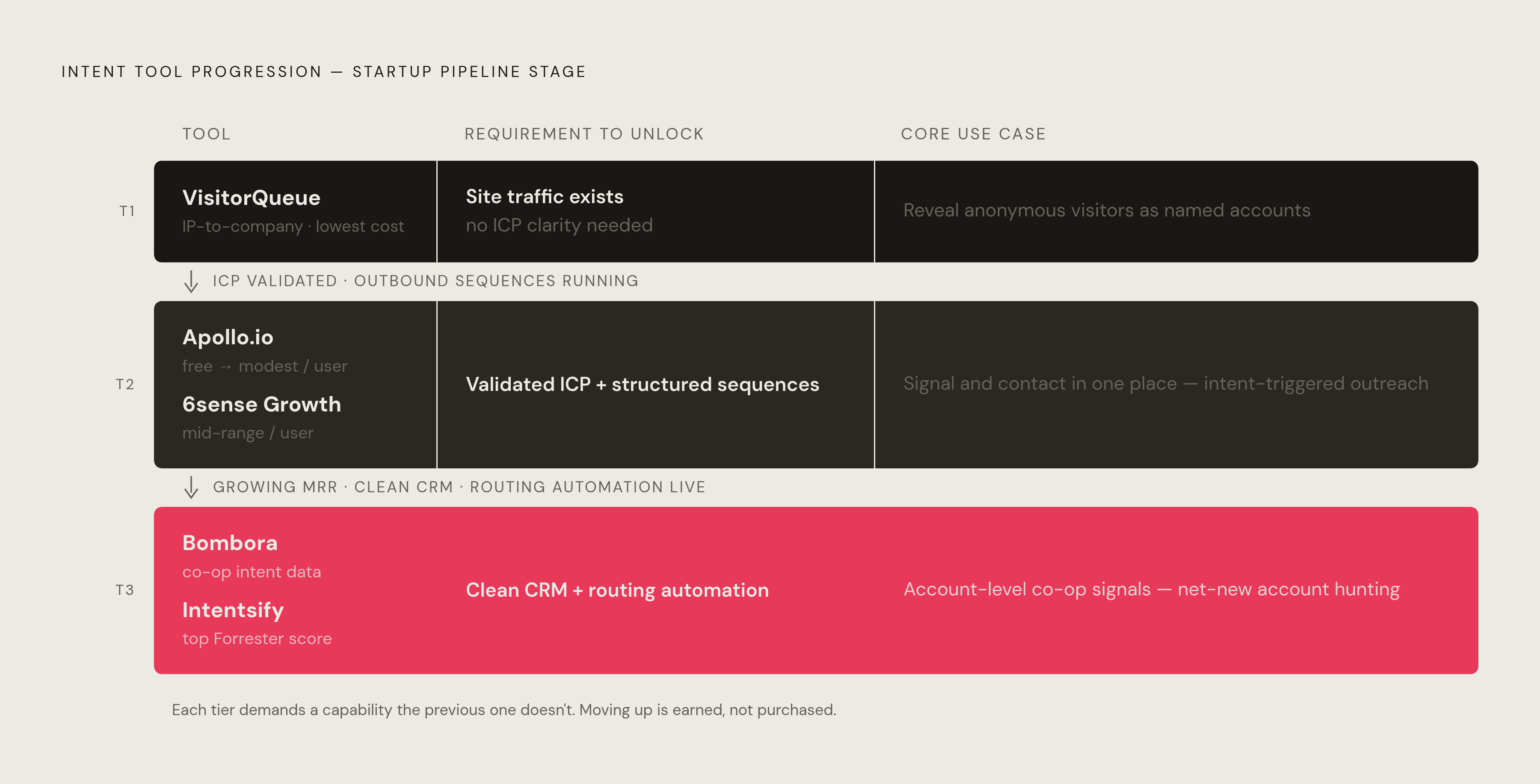
Tier 1: First-party deanonymization. This is for founders who get site traffic but have no idea who's actually showing up. VisitorQueue does IP-to-company matching, surfacing firmographics and visit behavior for traffic that would otherwise stay anonymous, with Slack alerts and CRM hookups built in. Pricing starts at a low monthly rate and scales with unique company volume. The activation lift here is almost nothing: a Slack ping fires when a target-fit company hits your site, and you follow up yourself. Good fit if you're already running active outbound and just want to know which accounts are warming up.
Tier 2: Lightweight intent plus contact data. This is for founders who need the signal and the person to email, bundled together. Apollo.io gives you a contact database with outreach tooling built in, and intent as a supplementary layer on top; there's a free plan, and paid tiers start at a modest per-user monthly fee with intent unlocked higher up. The intent data itself is less mature than what you'd get from a dedicated provider like Bombora or 6sense, but that's not really the point, the value is having signal and contact living in one place. On the more robust end, 6sense offers a free tier and a paid Growth tier at a mid-range per-user monthly price, which includes contact data, buying-stage insight, and predictive scoring, an unusually accessible entry point from a provider that's normally an enterprise name. This tier fits founders who've already validated their ICP and are running a structured sequence, and just need help deciding who to call first.
Tier 3: Dedicated third-party intent. This is for founders with a clean CRM, a working outreach motion, and a need to find net-new accounts beyond whoever happens to visit their site. Bombora runs the co-op model with account-level topic surge data; Intentsify posted the top Current Offering score in that Forrester Wave. These tools assume something is routing signals into sequences automatically. Without that something, the data just piles up, unread, like unopened mail. This tier makes sense once MRR is growing and your constraint has shifted from converting known accounts to finding new ones.
Moving up a tier isn't automatic, and it shouldn't be a status symbol either. Move up when you're fully using what the current tier gives you, not because the next tool has a shinier dashboard.
Building the lightweight activation workflow that makes any tier work
Every tier runs on the same four-step chain: receive the signal, qualify it against your ICP, route it to outreach, track the outcome back to the signal. Skip any one of these and the tool becomes decoration.
ICP qualification comes first, and it's non-negotiable. A signal from a large enterprise means nothing if your ICP is 50-person fintech teams. Without that filter, intent tools just generate noise, and noise burns the one resource a founder can't buy back: time.
Here's the uncomfortable part. Most ICP documents describe the market a founder wishes they served, not the segment that's actually converting. Intent data doesn't fix that error, it amplifies it. If your ICP hasn't been stress-tested against deals you've actually closed, feeding it more signal just means you'll chase the wrong accounts faster.
Routing, for a lean team, isn't a workflow tool; it's a Slack alert with enough context, company name, pages visited, a fit score, that you can write a genuine first line and hit send in under 15 minutes. That's the whole system.
Tracking matters more than it sounds like it should. Every signal that turns into an outreach attempt needs a tag in the CRM, not for tidy reporting, but because 60 days from now you need to know which signal tier is actually producing conversations, not just email opens that mean nothing.
AI-assisted personalization can multiply your output here, feeding page-visit and topic data into a generated first line. But someone who actually knows the product and how buyers talk needs to read it before it goes out, or you'll send something that reads like a robot guessed your name.
Write the whole thing down as a one-page SOP from day one, and not for the sake of having a process document sitting in a Notion page nobody opens. You'll eventually want to hand this off to a fractional SDR or an agency, and rebuilding it from memory at that point is a waste of everyone's time.
How intent signals connect to the investor traction story
Fundraising got harder in 2025. The seed-to-Series-A conversion rate has dropped from roughly 50% to 38%, and investors are underwriting to capital efficiency and a real path to profitability, not growth for its own sake.
At seed stage, investors want to see a few specific things. A repeatable pipeline motion, meaning the outreach-to-meeting-to-close cycle can be systematized rather than a handful of one-off logos you got lucky with. CAC payback under 18 months, because past that point it's a deal-breaker at Series A no matter how fast you're growing. And an MRR growth trajectory in the 15% to 25% month-over-month range at seed, tapering to 10% to 15% by Series A.
Tracked properly, intent-driven outreach feeds all three of these directly. It shortens the sales cycle, which improves pipeline velocity. It concentrates spend on accounts already showing buying behavior, which improves CAC. And it leaves behind a documented, repeatable sourcing method, which is exactly what "repeatable" means to an investor.
There's a narrative difference between a founder who says "we got some customers" and one who says "we identify accounts showing research behavior in our category, reach them within 48 hours, and our conversion rate on intent-sourced outreach is X." The second founder is describing a machine. The first is describing a lucky streak.
Investors have gotten good at discounting weak signals: waitlists, a Twitter follower spike, a Product Hunt launch that trended for a day. None of that proves the pipeline is instrumented. Intent-sourced pipeline with tracked outcomes does. Even a small cohort, 10 to 20 accounts contacted via signal, meetings booked, deals closed, is a credible proof point once you've got the receipts.
What to do before buying any intent data tool
Answer four questions before you sign anything.
Is your ICP tight enough to filter signals on sight? If you can't immediately tell whether a visiting company fits or not, the tool will generate meetings with the wrong people, and you'll burn weeks figuring that out the expensive way.
Is your CRM clean enough to track signal-to-outcome? Intent data that doesn't connect to a trackable record teaches you nothing; it just becomes another tab you open and close.
Can you act on a signal within 48 hours? If it sits unread for a week, the data quality is irrelevant, because the value of intent data has a short half-life.
What's the minimum viable tier that gives you something useful this week? Start there, run it 60 to 90 days, and then figure out honestly whether your bottleneck is data coverage or your own follow-up.
Here's the sequencing that actually matters: ICP and positioning come before tool selection, not after. A tool bought before your ICP is validated gets reconfigured or abandoned the moment your ICP shifts, and that happens to roughly 40% of startups at least once before they land on the positioning that actually works. Buying the tool first is like buying hiking boots before you know if you're going up a mountain or to the beach.
Stack simplicity is a feature, not a compromise. One tool your team reliably acts on beats three tools producing a dashboard nobody's opened since the free trial started. If you're still deep in founder-led sales and haven't instrumented your pipeline yet, the smartest first investment is often just getting your positioning and ICP sharp. The intent data layer works best when it's compounding on top of that foundation, not standing in for it.