Sales Intelligence Platforms for Early-Stage B2B Startups
Focus on intent data and contact freshness to avoid wasting money on the wrong platform.
Most seed-stage founders buy a sales intelligence platform before they know what they're buying it for. The result is a tool that costs real money, generates a lot of activity, and closes very few deals. This article is about how to avoid that.
Sales intelligence is a system of discovery. It surfaces who to sell to and when, using data your CRM doesn't have. There are four types of data that define the category: firmographic (company size, industry, revenue), technographic (what tools a company uses), behavioral (how they engage with content), and intent (what they're actively researching). Your CRM stores what already happened. A sales intelligence platform surfaces what's about to happen. For a founder doing everything at once, that difference is enormous. Without external signal data, prospecting defaults to guesswork. You're working a list, not working a market — like fishing in a pond you stocked yourself and calling it the open sea.
One honest caveat before anything else: these tools do not solve for positioning, messaging, or pipeline process. A platform gives you a list of accounts. It does not tell you what to say or why those accounts should care. That part is still on you.
Why B2B Contact Data Degrades Faster Than Most Founders Expect
People change jobs constantly. Companies pivot. Titles shift. B2B contact data decays at a significant rate year over year, which means a big database is only valuable if it's also a current one.
Database size is a vanity metric. What actually determines whether your outreach lands or bounces is the refresh cadence and how seriously the platform takes verification.
For a small team, a high bounce rate is more than a nuisance. It damages your sender reputation and tanks deliverability for every email you send after that. One batch of outreach to stale contacts can hurt you for months.
So before you compare price or count features, ask these questions:
- How does the platform verify its data?
- How recently was a given contact confirmed?
- Does the platform refund credits when emails bounce?
That last one matters. A platform willing to refund bad data is telling you something about how confident it is in the data. Use that as a filter.
The Signal Shift That Changed Which Features Actually Matter
A few years ago, the main thing buyers compared was database size. Who has the most contacts? That was the headline stat.
That comparison has shifted. What matters now is buying signals. Specifically: which accounts are actively in-market right now?
Intent data is the mechanism. It's behavioral signal collected across the web that tells you a company is researching a problem your product solves. They're visiting review sites, reading articles in your category, comparing vendors. That activity leaves a trail.
For a small team, timing is everything. A seed-stage founder can't run a high-volume spray campaign and just wait for something to stick. Reaching out to an account that's already in-market is a force multiplier when your outreach capacity is limited. Think of it like surfing: intent data doesn't create the wave, but it tells you exactly when to paddle.
The risk, though, is using intent data without a sharp ICP. An in-market signal from the wrong company type is noise, not signal. Intent data accelerates an already focused ICP. It doesn't replace one.
There's also a buying committee reality worth naming. Modern B2B purchases involve multiple internal stakeholders. Platforms that map relationships and internal influence, not just a single contact, are increasingly relevant as deal complexity goes up.
How Many Tools a Seed-Stage Team Actually Needs
The honest answer, across practitioners who've actually done this: not many. Most teams need a data provider, an engagement layer, a CRM, and possibly an enrichment tool. That's it.
Tool sprawl is a real tax. Every additional platform creates switching costs, data sync problems, and maintenance work that cancels out the time it was supposed to save.
For a founder-led sales team at seed, the math is stark. Every hour spent managing integrations is an hour you're not in front of a prospect.
Before buying anything, ask one question: does this replace something I'm already doing manually, or does it add a whole new category of work?
The practical starting principle: pick one platform with solid data and basic engagement capability. Use it until you hit its ceiling. Then add a layer. Don't build the full stack before you have pipeline to justify it.
Building a marketing and outbound engine before validating the ICP is one of the most common seed-stage mistakes. Tools should follow strategy. Not substitute for it.
Apollo.io as the Natural Starting Point for Budget-Constrained Teams
Apollo is where most budget-constrained founders should start. Here's why: it has a free tier that makes experimentation genuinely frictionless, a large B2B contact database, and built-in engagement tools that combine prospecting and outreach in one workflow. You can go from finding a contact to sending an email without leaving the platform.
Coverage skews toward tech and enterprise. If your ICP is local businesses, e-commerce shops, or non-tech SMBs, Apollo will frustrate you. Know that going in.
On data quality: the email verification process is multi-step, and Apollo refunds credits for emails that bounce when you send through the platform. That's a meaningful commitment relative to what you're paying.
The honest ceiling: bounce rates can still be a real issue at scale, and Apollo doesn't grow cleanly with a large team. It's a tool that earns its place early and gets reassessed later.
Best fit: a founder in a tech-adjacent ICP who needs to move fast, has limited budget, and wants to test outbound before committing to a heavier platform.
ZoomInfo's Capabilities and Why the Price-to-Value Equation Rarely Works at Seed
ZoomInfo has the largest B2B contact database in the category. Verified phone numbers and emails at scale. A data layer that connects B2B records with CRM signals and behavioral data. The intent infrastructure is genuinely sophisticated, processing an enormous volume of data points daily to surface in-market accounts, and the platform has earned consistent recognition from major analyst firms for years.
The constraint for seed-stage founders: the annual data cost alone, before any engagement or workflow tooling, is a material line item in a seed budget. You often need to negotiate just to get a number.
The honest stage-fit read: if your ICP is large enterprise, your ACV is high, and you need the deepest possible data coverage, ZoomInfo's cost can be justified. But most seed-stage teams aren't there yet.
The risk of buying too early is real. You end up paying enterprise prices to run experiments that a cheaper tool could handle at a fraction of the cost.
LinkedIn Sales Navigator as the Relationship and Warm-Signal Layer
What makes Sales Navigator different from every other platform: the underlying data is member-updated. People update their own LinkedIn profiles when they change jobs, get promoted, or shift roles. That means the contact information stays current in a way that scraped databases often don't.
The advanced search and filtering lets you get precise with ICP targeting. AI-powered lead recommendations surface accounts that match your current best customers. Buyer Intent signals identify accounts showing research behavior through LinkedIn activity, which is a different signal source than third-party intent data and one that's native to where a lot of B2B buyers actually spend time.
The relationship mapping feature is genuinely useful. Seeing who in your network knows someone at a target account creates warm introduction paths that cold outbound can't replicate.
Best use case at seed: founders doing high-touch outbound in markets where relationships and warm signals matter more than volume. Professional services, enterprise SaaS, consulting-adjacent sales. These are the contexts where Sales Navigator earns its place.
The limitation worth knowing: Sales Navigator surfaces signal and contact context. It's not a full engagement platform. Outreach still happens elsewhere.
Cognism for Teams Selling Into European Markets or Needing GDPR Coverage
Cognism's core differentiation is international database coverage and built-in compliance infrastructure for GDPR and equivalent privacy regulations.
If you're selling into European markets, compliance isn't a feature to weigh against price. It's a requirement. Outbound that ignores consent rules creates legal exposure that wipes out any pipeline gain.
The practical implication: if your ICP is US-only, Cognism's compliance features don't justify switching from Apollo. If Europe is a real motion, the compliance infrastructure alone is worth evaluating seriously. This is a narrow but important decision filter.
6sense and Demandbase as Intent Platforms Built for a Stage Most Seed Teams Haven't Reached Yet
Both platforms do the same core thing: aggregate intent signals across a large keyword universe to identify accounts actively researching solutions in your category, then layer in predictive scoring to rank them by buying stage.
6sense identifies in-market accounts and maps multi-stakeholder buying processes. Demandbase tracks a very large number of intent keywords across the web to surface accounts at various stages of the buying journey.
The stage-fit problem: both platforms assume you already know your ICP well. Predictive scoring only works when the model has enough data on your best customers to train against. At seed, most teams have too few closed deals to generate a meaningful training set.
Intent platforms surface signal most efficiently when there's an established customer pattern to match against. Without that pattern, the platform is guessing on your behalf.
The right time to evaluate these: after enough closed-won deals to see patterns, when your ICP is locked, and when the team has the capacity to act on the volume of accounts the platform surfaces.
Clay and the Enrichment Workflow Layer as a Force Multiplier (Once You Have the Fundamentals)
Clay pulls data from multiple sources and uses AI to synthesize it. It can summarize a company's product from their website, identify trigger events, and build personalized outreach context at scale. The AI-powered enrichment steps generate written context from raw data, which makes personalization at volume genuinely achievable for a small team. That's not a small thing.
It's been named by a number of GTM operators as a likely next-generation piece of outbound infrastructure. The enthusiasm is earned.
But here's the honest caveat: Clay amplifies research and personalization workflow. It still requires the underlying data provider, the ICP definition, and the outreach strategy to already be in place. Clay without those things is like a high-powered amplifier with no signal going in — technically impressive, producing nothing useful.
Best-fit profile at seed: a founder or first marketing hire who is already running outbound and wants to increase personalization quality without proportionally increasing research time. That's the moment Clay actually pays off.
What AI Sales Tooling Actually Saves — and Where It Still Can't Substitute for Judgment
Across platforms, AI is being applied to prospect research, email drafting, lead scoring, meeting summarization, and signal prioritization.
The productivity claims are real. Salesforce's State of Sales data shows that sellers using AI tools report meaningful reductions in time spent on research and drafting, and quota attainment rates are materially higher among AI-tool users.
What AI does not replace:
- The judgment call on whether an account actually fits the ICP
- The positioning decision behind the message
- The relationship intelligence that makes a cold email feel warm
The failure mode for founders is using AI-generated outreach before nailing brand voice and ICP precision. Automation at scale makes a bad message reach more people faster. That's a problem, not an advantage.
Fathom is worth naming as a concrete, low-cost AI tool that solves a real founder pain point: meeting recording, transcription, and summary without adding complexity or cost. It's a practical entry point to AI-assisted sales workflow with a very low downside.
The principle that applies across all of this: AI is a force multiplier for people who understand strategy. It's a liability for teams that haven't yet defined what they're trying to multiply.
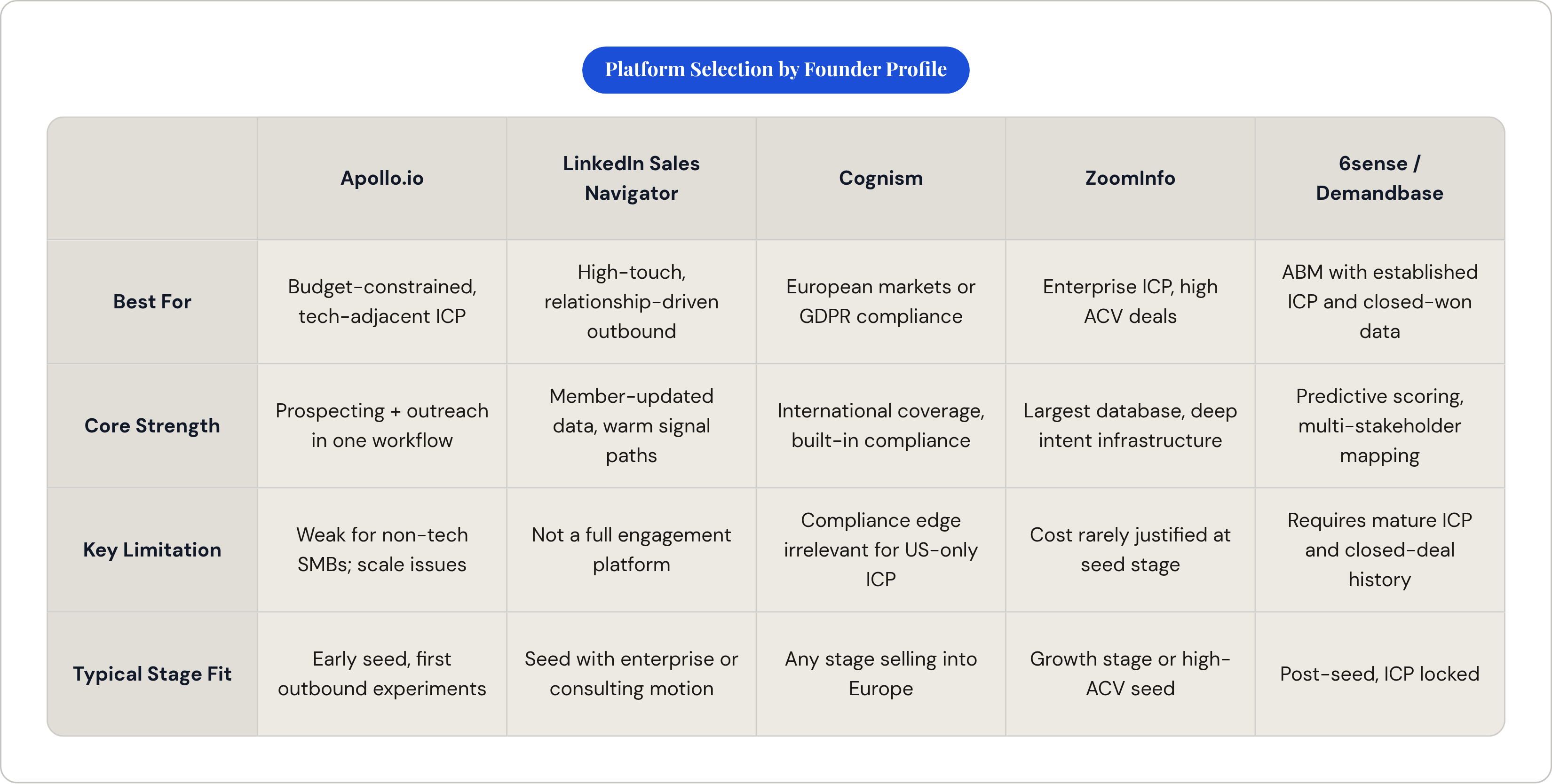
Matching Platform Choice to ICP Geography, Deal Complexity, and Outbound Volume
Three variables should drive platform selection at seed:
- ICP geography. US-only versus European or international. This determines whether compliance infrastructure is a feature or a non-issue.
- Deal complexity. Transactional and high-volume versus multi-stakeholder enterprise. This determines how much relationship mapping and intent data you actually need.
- Outbound volume. High-touch and low-volume versus low-touch and high-volume. This determines whether database breadth or signal precision is the higher-value feature.
Simple decision logic by profile:
- US ICP, tech-adjacent, moderate volume, limited budget: Apollo as the foundation, Sales Navigator as the relationship layer
- European ICP or compliance requirement: Cognism replaces or supplements Apollo
- High-touch enterprise, relationship-driven: Sales Navigator as primary, Clay for personalization depth
- ABM motion with an established ICP: 6sense or Demandbase, but only after enough closed-won data to make predictive scoring meaningful
- Enterprise scale, highest data quality requirement, high ACV: ZoomInfo, when the deal economics justify the cost
The through-line: no platform choice is permanent. Start with what matches your current stage and ICP. Measure whether it's generating pipeline. Upgrade when the ceiling is real. Not when the demo is compelling.
Why ICP Clarity Has to Come Before Any Platform Decision
A sales intelligence platform is only as useful as the ICP it's pointed at. A broad or vague ICP means even the best data surfaces accounts that will never close.
ICP is not a demographic sketch. It's a precise definition of the company most likely to buy, retain, and expand. Built from firmographic specifics, tech stack, buying triggers, and deal patterns in existing customers. The detail matters.
Here's a useful exercise: look at the top fraction of current customers generating most of your revenue. They share common traits. Those traits are your ICP, and they often differ from the assumed one.
Specificity is what makes outreach feel relevant rather than generic. Knowing not just the title but the specific workflow pain that title carries in companies of a specific size and growth stage. That precision is what gets replies.
For founders who haven't closed enough deals to run that analysis yet: ICP construction starts with a founder hypothesis plus direct customer conversations, then gets refined as data comes in. Treat it as an operational input, not a slide-deck artifact.
ICP scoring has matured significantly. The best teams feed fit scores into outreach prioritization in real time, not in a spreadsheet they refresh quarterly.
How to Evaluate Whether a Sales Intelligence Platform Is Working at Your Stage
A few concrete things to track:
- Email deliverability and bounce rate. If bounce rate is climbing, data quality is failing you.
- Reply rate on cold outreach. Not open rate. Reply rate. Opens are inflated by bots and preview loading.
- Meetings booked per hundred contacts touched. This is the conversion metric that actually matters at seed.
- Time from first touch to first meeting. If the platform's intent signals are working, this should compress.
- Credits used versus pipeline generated. If you're burning through a plan and can't trace meetings back to it, the tool isn't working.
The evaluation window should be at least 60 days before drawing conclusions. Outbound takes time to season, and sender reputation builds (or erodes) gradually.
The final check: are you getting better data, or just more data? Volume is easy to generate. Precision is what closes deals. A platform that gives you 10,000 contacts and three meetings is worse than one that gives you 500 contacts and eight meetings.
That's the number that matters.