Intent Data Tools for B2B Startups
Buyers decide before reaching out—catch them earlier with the right signals.

By the time a lead fills out your form, the deal is basically decided. 94% of B2B buying groups have already ranked their preferred vendors before they talk to a single salesperson (6sense's 2025 Buyer Experience Report, 4,000+ buyers surveyed). Buyers read an average of 13 pieces of content before that, almost all of it anonymous, and knock out roughly 60% of the purchase decision before anyone from sales even knows they exist. With buying committees now running 8 to 12 people deep, there's no single "hand raiser" left to catch. Intent data is the industry's answer to this problem: a way to spot the research happening in the dark before your competitor does.
What intent data actually is and what it can and cannot tell you
Intent data is a behavioral signal. Somebody, somewhere, is Googling, downloading, comparing, or lurking around a topic your product solves, and a tool caught them doing it. That's the whole concept. The nuance is in where the signal comes from and how much you can trust it.
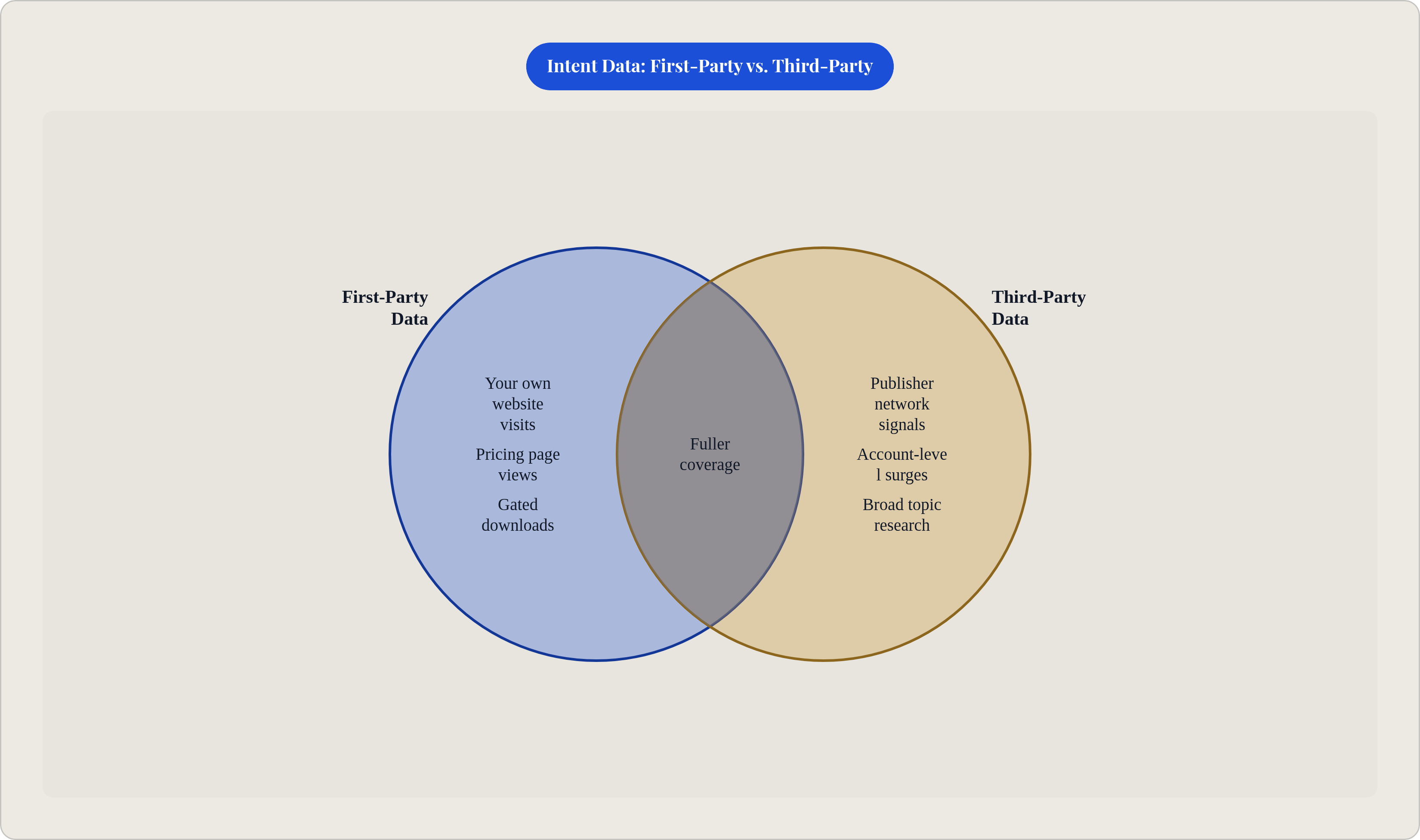
There are three layers. First-party is your own data: website visits, pricing page views, content downloads, webinar sign-ups. It's the most accurate because these are people who already found you, but it's also the smallest pool, limited to folks already on your radar. Second-party comes from review platforms like G2 or TrustRadius, capturing people actively comparing software. High intent, but narrow: these are accounts already deep in evaluation mode. Third-party is the wide net, aggregated research behavior pulled from massive publisher networks (Bombora's co-op alone spans over 5,000 B2B sites). Reach is huge. Precision per signal is low.
There's also a split between account-level and contact-level data, and for a small team, this distinction matters more than almost anything else on this list. Account-level tells you "Acme Corp is researching this." Great for prioritizing a list, nearly useless without a bench of SDRs to chase it down. Contact-level tells you "Jane Doe at Acme Corp downloaded a whitepaper on this topic yesterday." That's a name, a hook, and a reason to email her today.
What none of this tells you: why. Maybe Jane's doing competitive research for a board deck. Maybe she's genuinely shopping. Maybe her boss told her to "look into a few options" and she'll forget by Friday. Intent data can't read minds, can't promise timing, and won't fix a product that doesn't fit the market. It just tells you where the smoke is. According to an InboxInsight study, 26% of B2B marketers rely on first-party data alone, 19% lean only on third-party, and 55% blend the two, and the blended group tends to get the fuller picture. Signal quality runs first-party, then second-party, then third-party, in that order. But first-party alone is too thin a diet for most early pipelines.
Why 91% of B2B marketers use intent data but only 24% report exceptional ROI
Here's the uncomfortable stat: 91% of B2B marketers use intent data. Only 24% call the return on it exceptional (DemandScience's State of Performance Marketing report). That's not a small gap, that's most of the industry paying for a signal and shrugging at the result.
Part of the problem is measurement. 66% of leaders admit their campaign metrics look good on a slide but don't actually move revenue. But the bigger issue, especially for smaller teams, is what happens (or doesn't happen) after the data lands. Teams buy strong signals and then let them rot in a spreadsheet nobody opens, or a CRM field nobody filters by, or a tool that was never connected to an actual outreach workflow. The signal shows up. Nothing happens next. That's the failure mode, and it's boring, and it's everywhere.
Startups add their own flavor of this mistake. Some buy enterprise-scale data volumes with no SDR team and no sequences to run them through, like ordering a firehose to water a windowsill herb garden. Others treat a third-party research signal like a buying signal and reach out too early, too generically, torching the one advantage intent data was supposed to give them. And most never define what "high intent" even means inside their own workflow, so when a signal fires, there's no next step waiting for it.
For a founder at seed stage, this ROI gap isn't a data quality problem. It's an execution problem, wearing a data-quality costume. Stack more signals on top of a workflow that has no activation path, and you just make the pile bigger; you don't make anything happen faster. Tool selection and workflow design matter more than sheer data volume, full stop.
The signals that actually matter at the seed stage
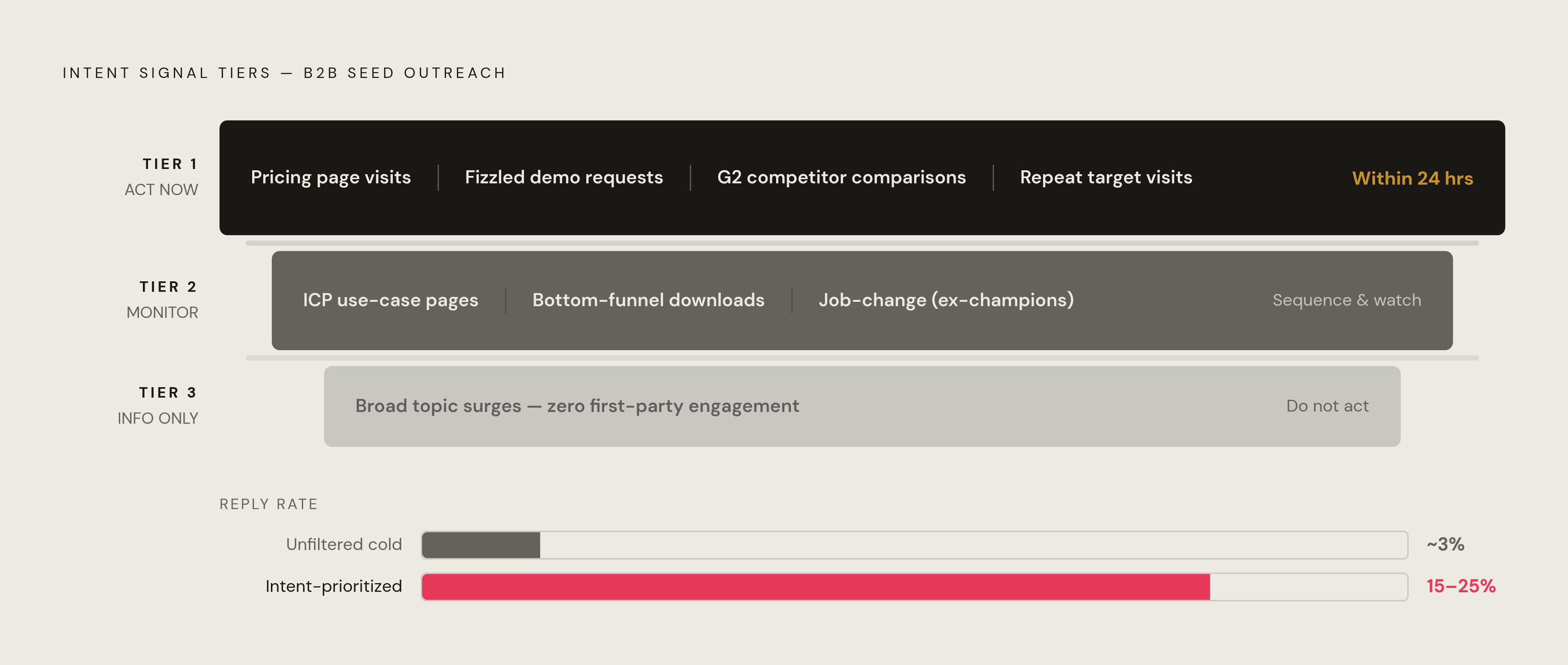
Not every signal deserves the same reaction. A founder with 12 to 18 months of runway and no dedicated sales hire needs a hierarchy, not a firehose.
Tier 1 is act-immediately territory: pricing page visits, demo requests that fizzled out, someone comparing you directly against a competitor on G2, repeat visits from a target account in a tight window. These deserve a real, human response within a day.
Tier 2 is monitor-and-sequence: ICP-fit accounts poking around your solution or use-case pages, contact-level downloads of bottom-funnel content, and job-change signals, meaning a former champion or user just landed at a new company. That last one is underrated. A person who already loved your product, now sitting in a new seat with a new budget, is one of the warmest leads available anywhere, and it costs nothing to track.
Tier 3 is informational only, at least for now: broad topic-surge signals at the account level with zero first-party engagement to back them up. Useful for building an outbound list. Not a reason to email anyone yet.
The payoff for getting this right shows up in reply rates. A cold message to an unfiltered list gets you roughly 3% back. The same message, sent to an account actively researching a solution, lands 15 to 25% reply rates. That lift is the entire value proposition of intent data, and it lives entirely in the gap between spotting the signal and acting on it. A good rule for anyone at this stage: if you can't name the action that follows a signal within 24 to 48 hours, that signal isn't worth collecting yet. It's just noise wearing a data label.
How the enterprise tools are built and why most of them are wrong-sized for startups
Forrester's Q1 2025 Wave named five leaders in B2B intent data: Intentsify (top score for current offering), 6sense, Bombora, Informa TechTarget, and Demandbase. Every one of them is built for enterprise account-based marketing, and enterprise ABM assumes things a seed-stage startup simply doesn't have: a large target account list, a dedicated SDR and marketing ops team, mature CRM infrastructure, and sales cycles that stretch across quarters.
Bombora holds roughly 18.2% of the market as of 2025, sourcing its signal from a co-op of over 5,000 B2B publisher sites. It's a serious product. It's also priced at $25,000 to $40,000 a year, which for a lot of seed startups is a meaningful chunk of the entire marketing budget for a single tool.
6sense layers AI-driven predictive scoring on top of intent signals, and its Growth tier runs $200 per user per month, with enterprise pricing custom (translation: expensive). For a team of one or two, even the "affordable" tier adds up fast. ZoomInfo's intent add-on runs $15,000 to $40,000 a year on top of its core platform, tracking 210 million IP-to-organization pairings and six trillion keyword-to-device pairings a month. That depth makes total sense for a company running large-scale outbound programs. For a founder still validating who their ICP even is, it's overkill.
G2 Buyer Intent is the one real exception in this tier: $10,000 to $25,000 a year, anchored to genuine purchase research happening on a high-traffic review platform. More accessible than the pure enterprise stacks, though still a real commitment for a seed-stage budget.
The mismatch here isn't about quality, it's about shape. Enterprise tools are built to prioritize across thousands of accounts. Startups need depth on a focused list of maybe a few hundred. Those are different problems wearing the same industry label. And the category is only consolidating further upmarket, with larger players continuing to bundle and absorb standalone tools, and the number of affordable independent options keeps shrinking as a result.
The tools that are actually right-sized for seed-stage B2B teams
The right tool for this stage has a low entry price, gives you contact-level or company-level signal without requiring a pre-existing account list the size of a phone book, and plugs into a workflow a team of one or two can actually run.
Dealfront (formerly Leadfeeder) identifies which companies are visiting your site, what pages, and how often they come back. It offers an accessible entry point for teams looking to start deanonymizing traffic. Any startup with meaningful website traffic and curiosity about who's already sniffing around should start here.
Apollo.io starts at $49 per user per month, with intent features unlocked on higher tiers, making it one of the most accessible tools that bundles contact data and intent signal together. It's built for teams that can't justify a $25,000 annual contract. One caveat worth flagging plainly: Apollo has had reported data privacy concerns. Worth a compliance gut-check before leaning on it as your primary source.
Warmly sits in the middle, offering website deanonymization with real-time alerts for tens of thousands of dollars a year, roughly the gap between "outgrew the free tier" and "not ready for enterprise pricing."
VisitorQueue starts at $39 a month for 100 identified companies, scaling up to $2,299 a month as you grow, and it's one of the cheapest ways to test whether website intent capture is even worth building around before committing real budget.
Common Room pulls signal from multiple sources into one feed. It's especially good for developer-tool startups or product-led companies where community chatter and usage patterns are the real pre-purchase tell.
Worth mentioning again here: G2 Buyer Intent, at $10,000 to $25,000 a year, gives you second-party signal tied to active category research and competitor comparisons. If your category has a strong G2 presence and you're already running a review generation motion, it's worth the spend.
Put together, a sensible starting stack looks like Dealfront or VisitorQueue for catching website traffic, plus Apollo for contact data and outreach sequencing. Total cost stays well under $10,000 a year to get moving.
How to act on intent signals without a sales team behind you
The number to chase: accounts prioritized by intent signal convert to closed opportunities at 21.3%, versus 8.4% for accounts that aren't (thestarrconspiracy.com). More than double. Those deals also close at 18% higher average contract value. That gap is real, but it only shows up if the signal actually triggers something. Sitting on good data closes zero deals by itself.
Start by writing the trigger before you buy the tool: "if [this signal fires], then [this action happens within X hours]." Doing this first forces you to be honest about what you can actually act on, and it'll quietly rule out tools you were about to overspend on.
For Tier-1 signals, the founder reaches out personally, within a day, with a short message that references the actual signal. Not a template. For Tier-2 signals, a short sequence of 3 to 5 touches referencing the specific content or page, written in a human voice rather than a marketing one, does the job. For Tier-3 signals, skip the direct outreach entirely and let paid retargeting or a LinkedIn audience do the work until a stronger signal shows up to confirm real interest.
Speed matters more than people want to admit. An intent signal has a shelf life measured in days. Respond the same day or the next, and you're catching someone mid-thought. Respond a week later, and you're just another cold email that happens to mention a whitepaper they've forgotten downloading.
For teams using AI to help draft outreach, intent signals are the best raw material available: a specific page visited or a specific asset downloaded turns a generic message into one that actually reads like it was written for that person. A human still needs to set the tone and check it before it goes out, but the signal is what makes the message worth sending in the first place.
And track this against your fundraising story, not just your pipeline. Which signal tiers actually generate real conversations, how does the MQL-to-conversation rate for intent-sourced leads compare to cold outbound, and what does CAC look like across the two? That comparison becomes part of your traction narrative, whether or not you're using the word "traction" in the deck.
Building a first-party intent foundation before adding third-party data
Most founders already have more first-party signal sitting around than they realize. It's just not captured, and it's definitely not being acted on.
The checklist is short. Set up your analytics to flag high-intent page patterns (pricing, case studies, comparison pages) as their own segment, not just a line in aggregate traffic. Install a company-identification tool, whether that's Dealfront's free tier or VisitorQueue, so you know who's actually behind those visits. Make sure your CRM is set up to cross-reference identified accounts against your ICP the moment they show up. And put one or two genuinely useful gated assets out there to start pulling contact-level data from accounts already circling.
Third-party data only starts paying off once this foundation is working. Buy it before that, and you're just paying to learn about accounts you have no way to act on, which is the exact trap that keeps that 91%-versus-24% gap wide open in the first place.