Mailchimp Alternatives for B2B Startup Email Marketing
Send fewer, smarter emails by picking a platform built for B2B nurturing instead of blasting.
Mailchimp was built for one job: blast an email to a list and watch the opens roll in. B2B pipeline nurturing, with its multi-step logic, lead scoring, and sales handoffs, is a different job entirely, and this piece walks through what actually replaces it at the seed stage, matched to where a founder's marketing engine sits right now.
The decision framework before picking a platform
Skip the feature list. Start with where you actually are, and let that answer come before anything else.
Ask yourself four things before you open a single pricing page. Is sales still just you, with no CRM in sight, or are you at the point where marketing and sales need to share a view of the same prospect? How complicated does your automation actually need to be, meaning are you fine with "wait three days, send email two," or do you need the system to notice when someone visits your pricing page twice and react accordingly? What does your list actually look like, in terms of size and how often you send, because pricing models punish different behaviors? And do you need to text people, or WhatsApp them, or chat with them live, or is email genuinely enough?
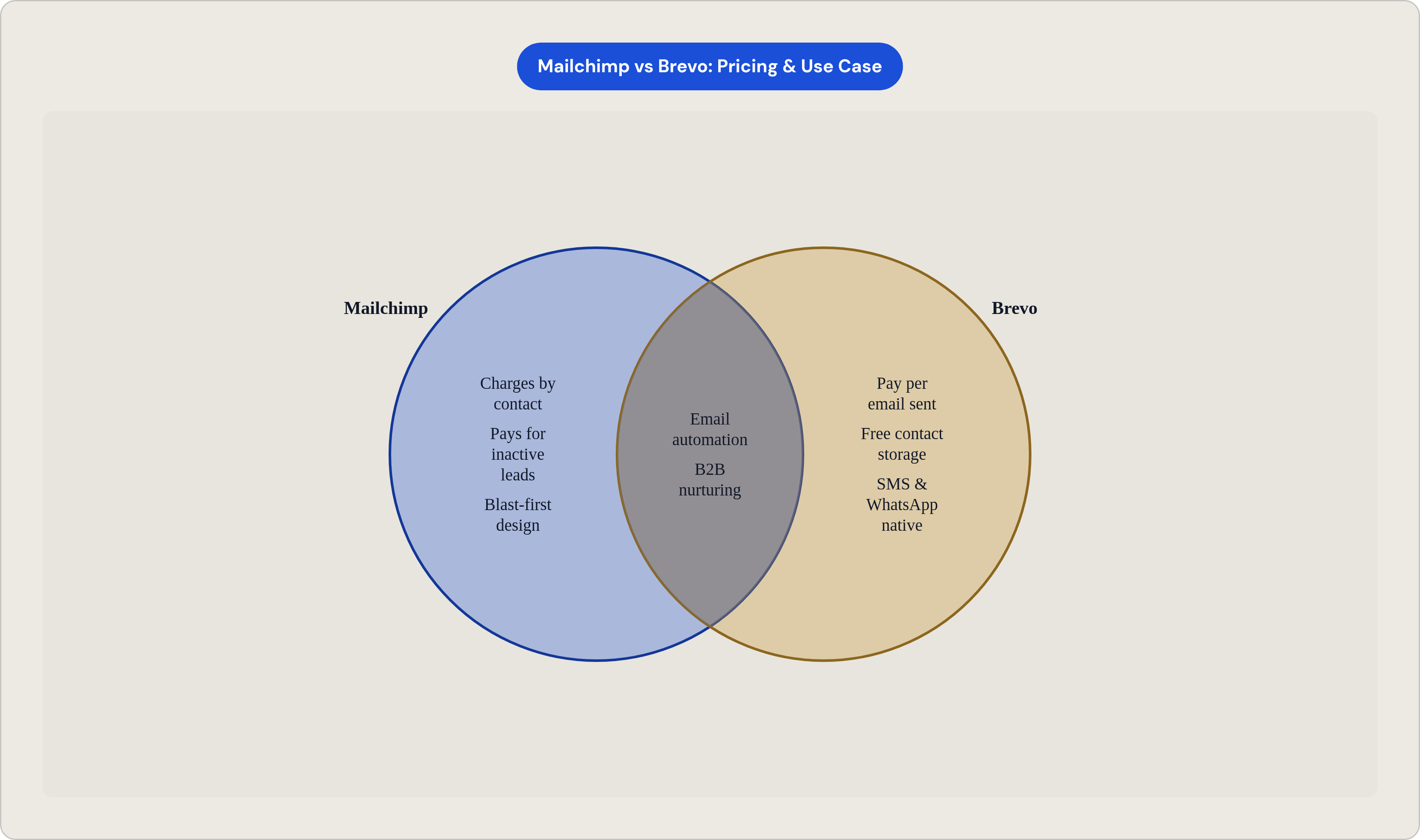
That third question matters more than founders give it credit for. There are two pricing philosophies running through this whole category, and confusing them costs money. Mailchimp charges by contact count. Your list grows to thousands of people and you're paying for all of them, whether you emailed them yesterday or six months ago. Brevo flips this: you pay for what you send, and contacts sit in your database for free. If you're a B2B founder with a slow-growing list of real prospects who you nurture over eight weeks rather than blast daily, that second model saves you real money.
One more thing before you compare features: don't buy capacity you don't need yet. Money at seed stage is better spent on getting more people onto your list and writing content that earns their trust, not on automation features sitting unused in a dashboard. Regardless of which platform you pick, some things aren't optional. SPF, DKIM, and DMARC authentication have to be set up correctly or your B2B emails land in spam, full stop, and there's no automation feature that compensates for skipping it. Keep your bounce rate and unsubscribe rate inside safe limits, since that protects your sender reputation on every platform equally. None of this is a differentiator; it's just the floor.
ActiveCampaign for founders who need deep automation logic
This is the platform for founders who've already figured out their playbook and need software smart enough to run it.
The core trick is conditional branching that goes past simple time delays. The example that shows up in every B2B conversation about this tool: if a contact viewed your pricing page twice this week and hasn't booked a demo, send them email B instead of the next email in the standard sequence. That's not a delay, that's a decision, and ActiveCampaign makes decisions like that without needing an engineer.
Lead scoring here goes deep, letting you segment and personalize with real precision instead of guessing based on who opened an email. Hundreds of pre-built automation templates cover B2B customer journeys, so you're not building from a blank canvas.
Here's the catch: this tool rewards founders who've already done the thinking. If you're still testing messaging and don't know your ideal customer profile yet, ActiveCampaign is a lot of power aimed at a target you haven't picked, and it's worth saving for once the playbook is written down. The entry-level pricing is friendly enough that you don't need to wait for a big budget, just a clear plan.
HubSpot for founders ready to unify marketing and sales in one system
HubSpot's whole pitch is that email, forms, landing pages, automation, sales activity, and customer records live in one place. No integration layer connecting three different tools, no syncing headaches.
That matters most once you're bringing on your first account executive and need the handoff from marketing to sales to actually work, not just work in theory. HubSpot serves an enormous customer base as of 2025, which means documentation, integrations, and a hiring pool of people who already know how to use it.
Now, the pricing cliff. Everyone who's shopped HubSpot knows this: the jump from Starter to Professional isn't a gentle slope, it's a wall. That's not a minor budget line item, it's a real decision point about whether you're ready for what that tier assumes you need.
The best fit here is a founder who's past founder-led sales, building something repeatable, and wants a single system of record heading toward Series A. Buy HubSpot Pro before your marketing engine actually exists, though, and you're paying rent on rooms you haven't furnished yet.
Brevo for founders with large prospect lists and tight budgets
Brevo inverts the Mailchimp math: you pay per email sent, and contact storage is unlimited. If you're building a big prospect database that you email selectively rather than constantly, this solves the exact cost problem Mailchimp creates.
Paid plans start at $9 a month, making it one of the most affordable entry points among multi-channel tools worth taking seriously. Brevo isn't email-only, either. SMS, WhatsApp, live chat, all native, which matters if your ideal customer actually responds better to a text than an email.
It's got a large customer base and solid ratings on G2, so this isn't just the cheap option winning on price alone; it's held up under real use. The tradeoff worth naming honestly: multi-channel adds operational work. Don't turn on WhatsApp automation just because it exists. Turn it on because your actual customers use WhatsApp.
Best fit: budget-tight founders with a growing list who send with intention, not volume.
MailerLite for founders who need to get moving without a learning curve
Sometimes the best tool is the one you'll actually open. MailerLite wins on simplicity, consistently, and a simpler tool you use beats a powerful one sitting half-configured because you never had time to learn it.
The free plan is more generous than Mailchimp's, both on contacts and monthly sends, which matters a lot before you've built a list worth paying to maintain. A large number of people migrating off Mailchimp land here, and the move tends to be low-friction.
Worth calling out for a lean team: MailerLite has AI features that punch above the price, including a writing assistant that works in multiple languages, send-time optimization based on subscriber behavior, and an MCP protocol that lets you automate tasks through AI tools like Claude. For a one-person marketing operation, that's not a gimmick, that's hours back in your week.
The honest read here: MailerLite is for founders still building their list and testing content, before there's a documented nurture playbook to automate. Once you need behavioral branching or a real CRM sync, MailerLite has done its job well, and it's time to graduate.
Customer.io and Loops for SaaS founders with product-connected email needs
Different problem entirely. These tools exist for founders whose email needs to react to what's happening inside the product, not just the calendar.
Customer.io is built for behavioral triggering tied to in-product events, useful when what matters more than your CRM is what a user just clicked, viewed, or ignored. Loops takes a similar starting point, assuming from day one that email and product data should be connected.
The concrete differentiator worth knowing: some tools in this category offer native Stripe integration, meaning MRR changes, plan upgrades, and failed payments sync automatically, which lets you build dunning sequences and revenue-segmented nurturing without hiring an engineer to wire it together.
What matters for comparing tools in this category isn't list size or how many templates ship out of the box. It's CRM sync, reply routing, and whether lifecycle triggers actually work the way you need. These tools are the right fit if your product already generates behavioral signals, meaning logins, feature usage, upgrade intent, and you want email responding to those signals in real time. Fair warning: setup takes more work upfront, since you need to have already mapped your user lifecycle and know which events should trigger which email, or you'll spend weeks configuring something that never fires correctly.
How to match platform to stage across the seed-stage journey
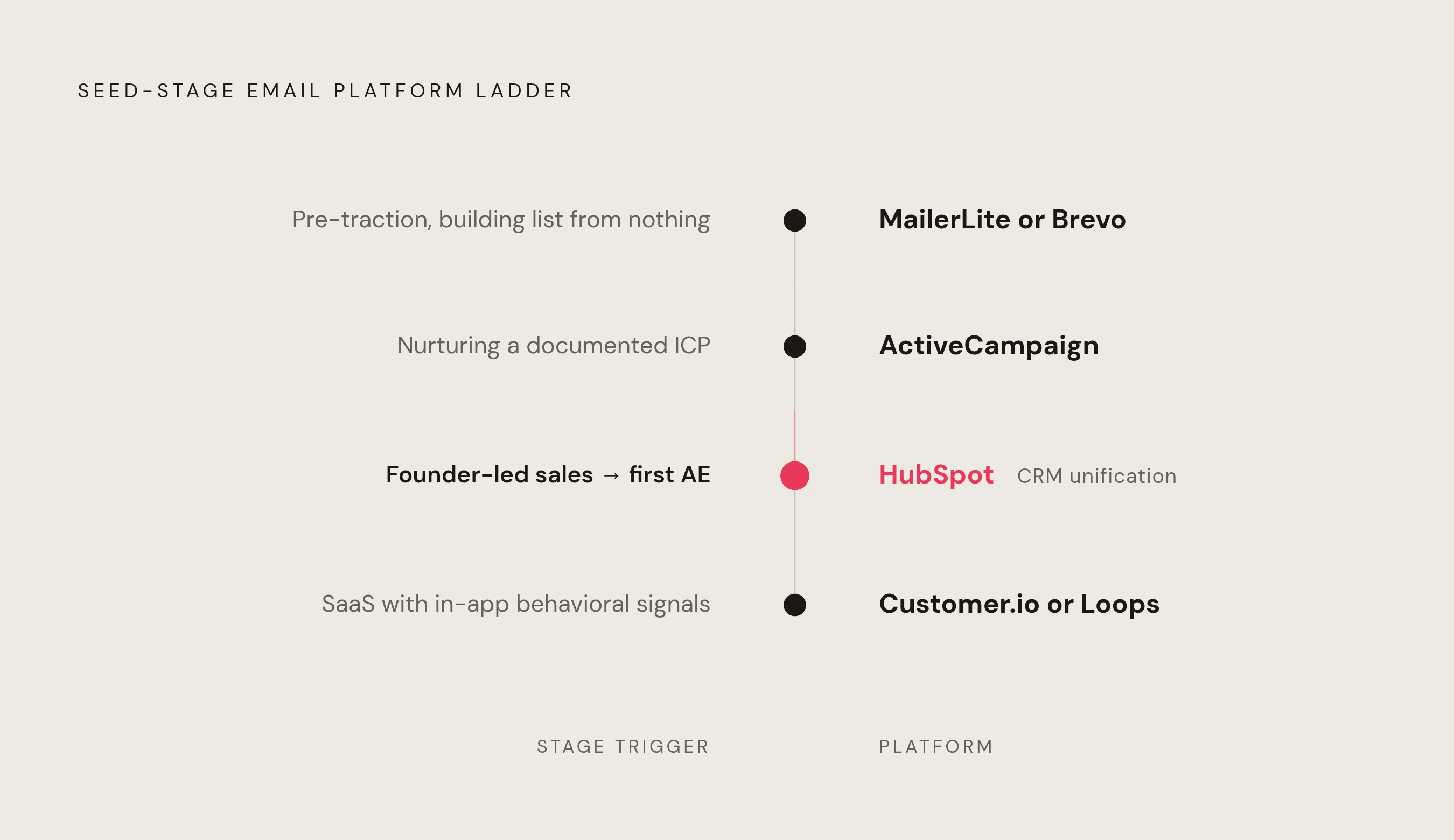
Pre-traction, building your list from nothing? MailerLite or Brevo. Deliverability, simplicity, and low cost matter more than automation depth when you don't have enough contacts to automate around yet.
Actively nurturing a documented ideal customer profile? That's ActiveCampaign territory. Behavioral branching earns its complexity once there's an actual playbook to run through it.
Moving from founder-led sales to your first account executive? HubSpot. CRM unification becomes the priority the moment handoffs start happening and investors start asking about pipeline visibility.
Running a SaaS product with real in-app behavioral signals? Customer.io or Loops, so product data drives your email logic instead of just form fills and time delays.
None of these choices are permanent. Building a marketing engine means picking the right tool for the phase you're in, configuring it properly, and tracking your numbers (CAC, pipeline velocity, MQL-to-customer conversion) from day one so the data actually compounds as you scale toward Series A. The mistakes to avoid are symmetrical: buying HubSpot Pro before the engine exists wastes money, and staying on MailerLite after you genuinely need behavioral automation wastes momentum, and both cost you something you don't get back.
What a B2B nurture sequence should actually look like inside any of these platforms
Platform aside, a good B2B nurture sequence follows a shape. It runs across several weeks, paced more like an actual relationship building than a broadcast blast, because that's closer to how B2B buying decisions get made.
The arc matters. Early emails deliver whatever you promised and build credibility, no pitch attached. Middle emails educate on the problem you solve, bring in case studies and proof that you know what you're talking about. Later emails handle the objections people are quietly having, then move into a direct ask.
Behavioral branching is the real upgrade over pure time-delay logic. A contact who visits your pricing page in the middle of a nurture sequence shouldn't keep getting the next scheduled email; they should branch into a faster track with a direct demo call-to-action, which is exactly where ActiveCampaign and Customer.io justify their cost over something simpler.
One formatting note that runs against instinct: plain text beats designed HTML in B2B nurture sequences, for trust and for deliverability both. No images, no branded header, none of it, and subject lines that name a specific problem outperform promotional ones by a meaningful margin on opens. One point, one call-to-action, per email, every time.
None of this works without the deliverability basics. SPF, DKIM, and DMARC set up correctly, a domain warmed up gradually over several weeks instead of blasted at full volume on day one, bounce and unsubscribe rates kept inside safe ranges. Skipping any of it means the best-written sequence in the world lands in spam.
Research consistently shows the average B2B buying group involves multiple stakeholders, each researching independently, and buyers are known to define their own requirements most of the time before a sales rep ever gets involved. That's the real reason nurture sequences carry so much weight now. Companies that build these sequences well end up with more sales-ready leads at lower cost, and those nurtured leads close faster and at bigger deal sizes, which is the payoff for treating this as an actual system, not an afterthought bolted onto a broadcast tool that was never built for the job.