Behavioral Trigger Emails That Drive SaaS Conversions
Behavior-triggered emails outperform calendar-based sends by 410 percent.
Most SaaS email programs still run on the calendar instead of the customer. Day 3 gets a feature tour, day 7 gets a case study, day 14 gets a discount, whether or not the person opened anything or even logged back in. That's backwards, and the data on behavioral triggers (emails that fire based on what a user actually does, not what day it is) makes the case hard to argue with. This piece covers why, and how to build sequences that respond to real signals instead of a fixed clock.
The standard drip sends "Tuesday at 10 AM" logic to everyone on the list at once. The flaw sits right in the name: the sequence fires on time elapsed, not on where the user actually stands. Someone stuck on step one of setup gets an email congratulating them on finishing step three. That's not a rare glitch. Gainsight's 2025 Product-Led Growth Survey found 67% of SaaS companies still run time-based sequences as their main approach, while only 11% had built fully behavior-triggered, multi-channel workflows. Most programs are built around the mailer's schedule, not the buyer's decision. That's the wrong order.
The gap sits in what time-based email can't see: a pricing page visit, a feature someone keeps clicking into, three days of silence after a trial signup. Those are buying signals, and a calendar can't read a single one of them. An email platform wired to product events can, and that's the entire case for behavioral triggers. Relevance stops being luck and starts being a byproduct of paying attention.
How much behavioral triggers outperform time-based and broadcast email
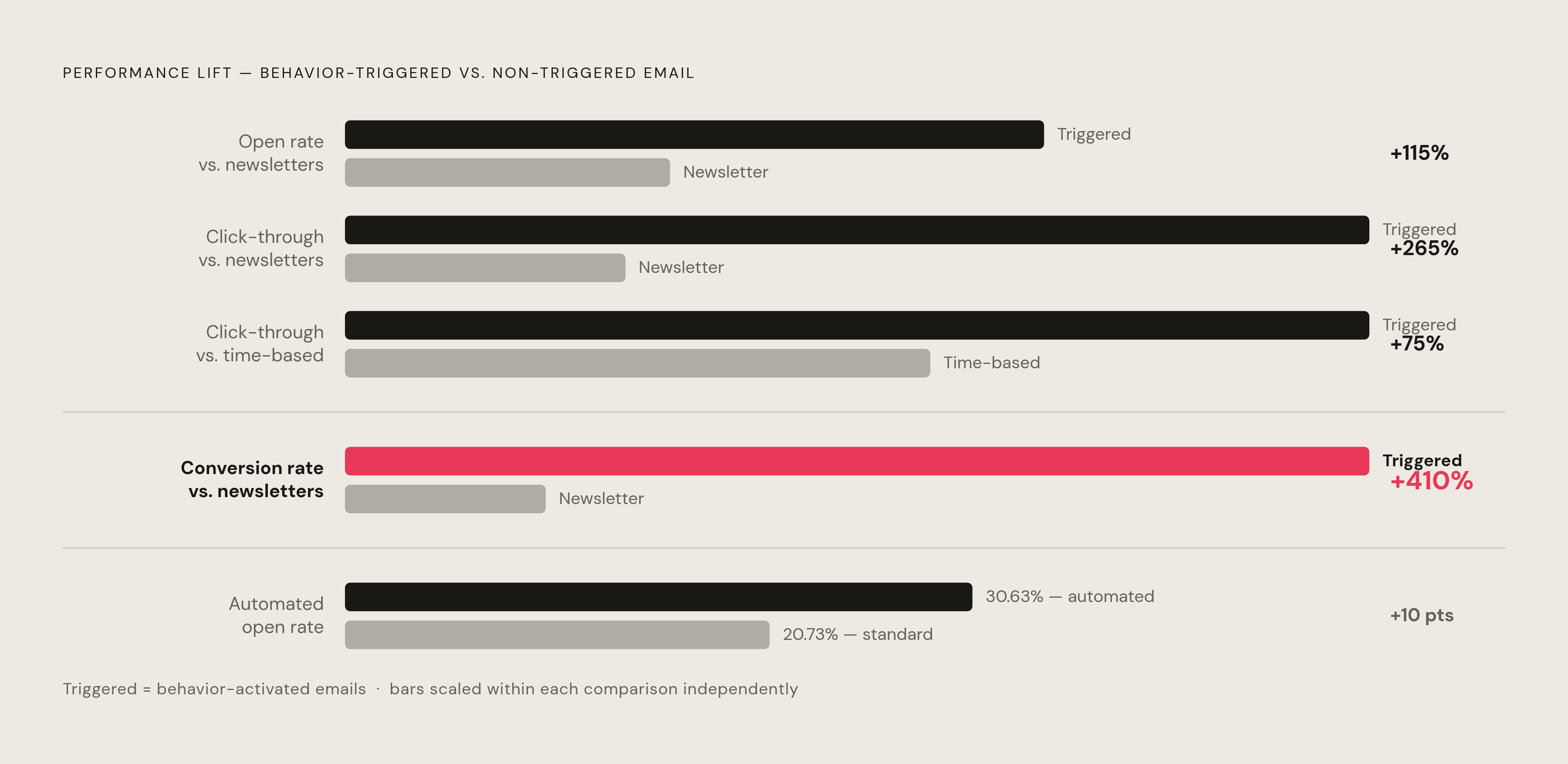
Behavior-triggered emails get 115% higher open rates than newsletters, with click-through rates running 75% above time-based sequences and 265% above newsletters. Conversion is where the argument closes: 410% higher than newsletter conversion. That's the number that turns this from a nice-to-have into a line item someone actually fights for in the budget meeting.
SalesHive's 2025 B2B benchmarks back this up from a different angle. Automated emails pulled a 30.63% open rate and 7.39% click-through rate, against 20.73% and 2.27% for standard campaign averages. The revenue-per-send gap between automated and scheduled campaigns is substantial, and it multiplies fast once a company is sending thousands of emails a month.
None of this is a small optimization. It's a structural difference in how these emails earn attention, not a slightly-better version of the same tactic.
What a behavioral trigger actually is, and what it is not
A behavioral trigger is a specific, observable thing a user does that signals intent. Visiting the pricing page. Poking around a feature for the third time this week. Going quiet after signing up for a trial. The signal is what matters. The schedule never is.
Two buckets exist here, and treating them as the same tool is where a lot of "personalized" email programs quietly fall apart. Behavioral intent triggers show where someone sits in a decision: pricing page visits, feature exploration, trial inactivity, heavy email engagement. Milestone or lifecycle triggers are more relational: time since signup, a usage threshold crossed, a renewal date coming up. Both are useful. Neither is a substitute for the other.
Here's the test: a welcome email sent 24 hours after signup, no matter what the person did in that first hour, is a time-based email wearing a behavioral costume. A date field is doing all the work. A lifecycle trigger only needs a date somewhere in the database. A true behavioral trigger needs actual event tracking piped into the email platform: in-product events like feature views, activation milestones, and idle sessions; on-site events like pricing page or docs visits; email engagement patterns like opens, clicks, and non-opens.
AI is starting to sharpen this system, not replace it. AI helps spot high-intent browsing patterns a human wouldn't flag manually and adjust send timing person by person instead of segment by segment.
The highest-leverage triggers across the SaaS funnel, mapped to email logic
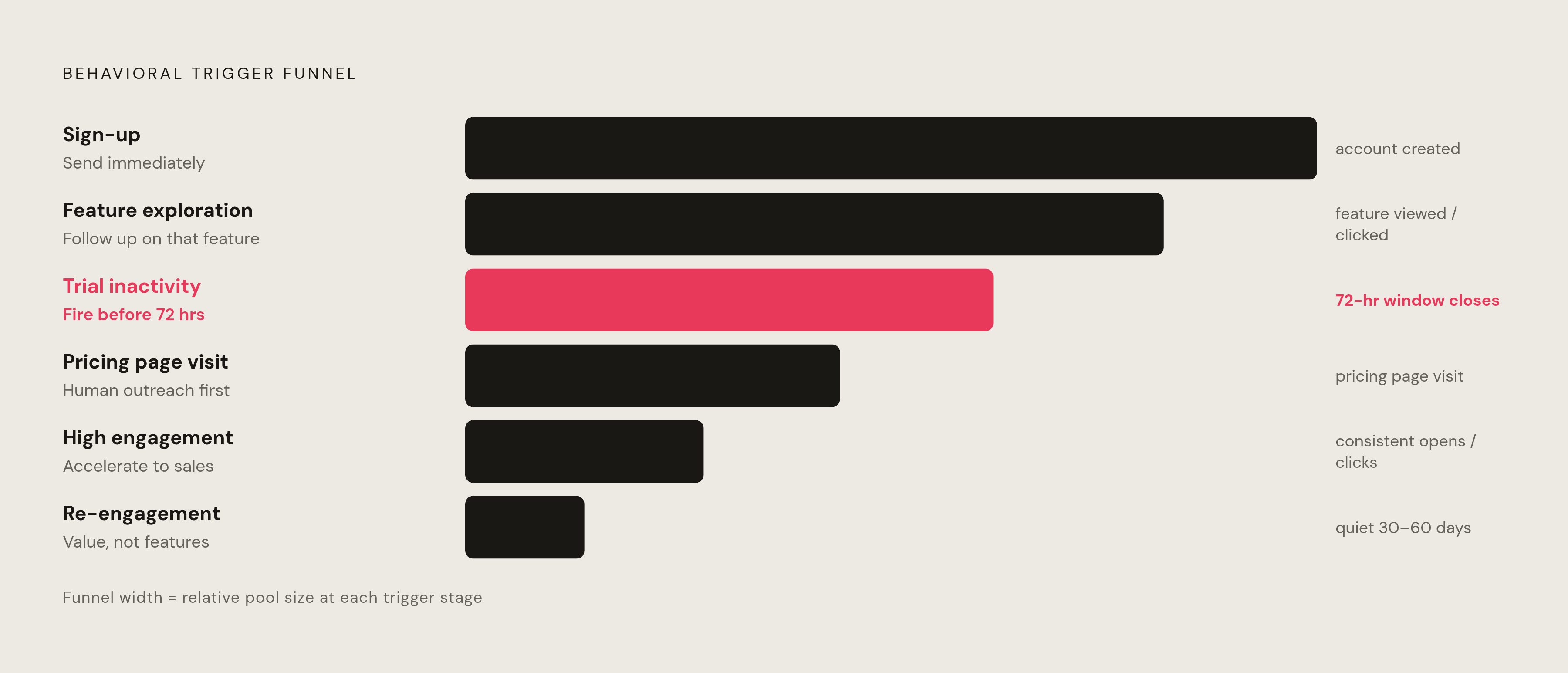
Six triggers do most of the work across a typical SaaS funnel. Each one has its own signal, its own email logic, and its own timing rule. Mixing them up is how sequences quietly underperform without anyone noticing why.
Sign-up. The signal is simple: someone creates an account. Day one is the highest-engagement moment in the entire relationship, so burning it on a generic "welcome aboard" email is close to malpractice. Every email in the welcome sequence should carry exactly one call to action, not a tour of the whole product. Send it immediately. Wait even an hour and the intent that got someone to sign up starts to cool.
Feature exploration. When a user views or clicks into a feature tied to the product's core value, that's a chance for a follow-up that goes deeper on that exact feature, not a generic tips email pulled from a template. Research points to persona-specific onboarding improving activation over generic flows, and this is exactly where that specificity pays off.
Trial inactivity. If someone hasn't come back to the product within a set window after signing up, that's a stall worth catching fast. Mixpanel's 2025 data marks the 72-hour window as the decisive stretch for activation, and by the time a human notices a stalled trial manually, that window's usually closed already. Fire a re-activation email before the 72-hour mark, built around the single action that gets a user to their "aha moment." Behavior-triggered onboarding sequences activate 3.1x more trial users to that milestone than static drip campaigns do.
Pricing page visit. This is the clearest buying signal a SaaS site generates on its own, and a direct message from an actual named person on the team beats a polished promotional email almost every time at this stage. Run a case study or an outcomes-focused email first, then follow with direct human outreach. Skip the promotional blast entirely.
High engagement. Some leads open most of the emails they get and click through consistently. That behavior alone is a proxy for sales-readiness, especially when in-product data isn't available. Speed up cadence and push toward an actual sales conversation here, because continuing to "nurture" someone who's already raising their hand just wastes the signal they're giving you.
Re-engagement and churn risk. A paid user going quiet for 30 to 60 days is the trigger. Center the sequence on the value they're not getting out of the product, not a rundown of features they've never touched. Catching the signal early buys the sequence more runway to work. And there's a hard rule worth following here: if someone stays inactive after several re-engagement attempts, pull them off the active list. Deliverability depends on list quality more than most people account for.
Trial-to-paid conversion: where behavioral triggers have the most documented impact
A ChartMogul study of 200 software products puts average free trial-to-paid conversion at 8.9% for opt-in trials with no credit card required, and 31.4% for trials that require a card upfront. Top-performing SaaS products land in the 15% to 25% range, and email sequencing gets cited repeatedly as one of the things separating that tier from the average one.
One documented case study in B2B analytics SaaS found automated, behavior-triggered onboarding sequences produced a 22% relative improvement in conversion within 90 days. Time-to-activation dropped 58% in that same case, from 5.2 days down to 2.2, once automated sequences replaced manual outreach. The timing drop and the conversion lift moved together, which tracks: the 72-hour window from the section above is doing real work here. Shrinking time-to-activation isn't a tidier number for a dashboard. It's revenue showing up faster.
Automation doesn't replace a salesperson picking up the phone, and treating it as a substitute is the mistake most teams make once the sequences start working. Gartner's 2025 B2B Buying Survey found that pairing automated nurture with timely sales contact lifts enterprise trial conversion by 41%. Automation and a human calling at the right moment aren't competing strategies. They're the same strategy running on two channels. For founders weighing whether to build this infrastructure at all, Totango's ROI figure gives a concrete anchor: $7.20 back for every $1 put into trial conversion automation.
How to build a sequence: architecture, cadence, and personalization rules
The sweet spot for a B2B nurture sequence is 5 to 7 emails spread across 2 to 4 weeks, moving a prospect from education, to social proof, to an actual ask. Keep each email short, around 50 to 125 words, and send 2 to 3 times a week. Over-emailing is a leading driver of unsubscribes in automated sequences.
Most SaaS companies land in one of two failure modes, and both are wrong for the same reason: neither one is actually reading the customer. Either every email pushes a demo request (too aggressive), or the sequence collapses into a monthly newsletter with no clear direction (too passive). Neither counts as a behavioral sequence, no matter how many merge tags are stuffed into the template.
A useful rule for personalization: keep 80% of the email body consistent across a segment, and personalize only the remaining 20% dynamically. That keeps the system manageable without losing relevance. A VP of Marketing gets messaging framed around team adoption and ROI. An engineer on the same trigger gets messaging framed around technical integration. Same trigger firing the sequence, different message depending on who's reading it.
Small mechanical changes compound here, too. Personalized subject lines lift open rates by 26%. AI-driven send-time optimization, which predicts when each individual subscriber is likely to actually check their inbox, pushes click-through rates up 41% compared to a fixed schedule for everyone. Real urgency, like a time-limited offer near trial expiration or right after a pricing page visit, can lift conversion without coming across as pushy, as long as the deadline is real and not manufactured.
A SaaS pipeline needs three distinct types of email, and blending them muddies all three. Marketing emails handle nurture and education. Lifecycle emails cover milestones and behavioral triggers. Transactional emails handle confirmations, receipts, and renewal notices. Each one has a job. None of them should be doing another one's job.
Measuring whether the triggers are actually working
For opted-in lists, industry benchmarks set reference points for sequence health: open rates, click-through rates, bounce rates, and unsubscribe rates all tell different parts of the story and should be tracked against your own historical baseline. Outbound sequences run on a different scale and warrant their own tracking separate from opted-in list benchmarks.
Four numbers actually tell you whether a sequence is healthy. Open rate by trigger type shows whether the subject line and send timing are earning attention in the first place. Click-to-open rate shows whether the message itself, once opened, earns action. Conversion rate per trigger connects the email directly to revenue, which is the number that matters most to anyone signing the checks. Unsubscribe rate by sequence is the earliest warning sign that cadence or relevance has started to slip.
Testing priorities should stay narrow: subject lines, CTA wording and placement, send timing, one variable at a time per trigger type. Behavioral triggers generate enough volume and signal to get answers faster than a broadcast campaign ever could, since the audience is already self-selected by intent.
Finding the next trigger worth building isn't guesswork. Map the actual customer journey, dig into conversion paths in the analytics tool, identify the high-intent behaviors that show up right before someone buys, and ask churned trial users directly what made them walk away. Those answers point straight at which trigger to build next.
This connects to the numbers investors actually care about: CAC, pipeline velocity, MQL-to-customer conversion. Behavioral trigger sequences move those numbers because each sequence ties to a specific stage of the funnel with a specific outcome attached. Each incremental improvement in trial-to-paid conversion compounds meaningfully at the cohort level. At the seed stage, that compounding is the difference between email sitting on the budget as a cost line and email turning into the thing that actually grows the company.