Marketing Automation Workflows Every Startup Should Build
Build workflows that prove unit economics, not vanity metrics, to impress Series A investors.
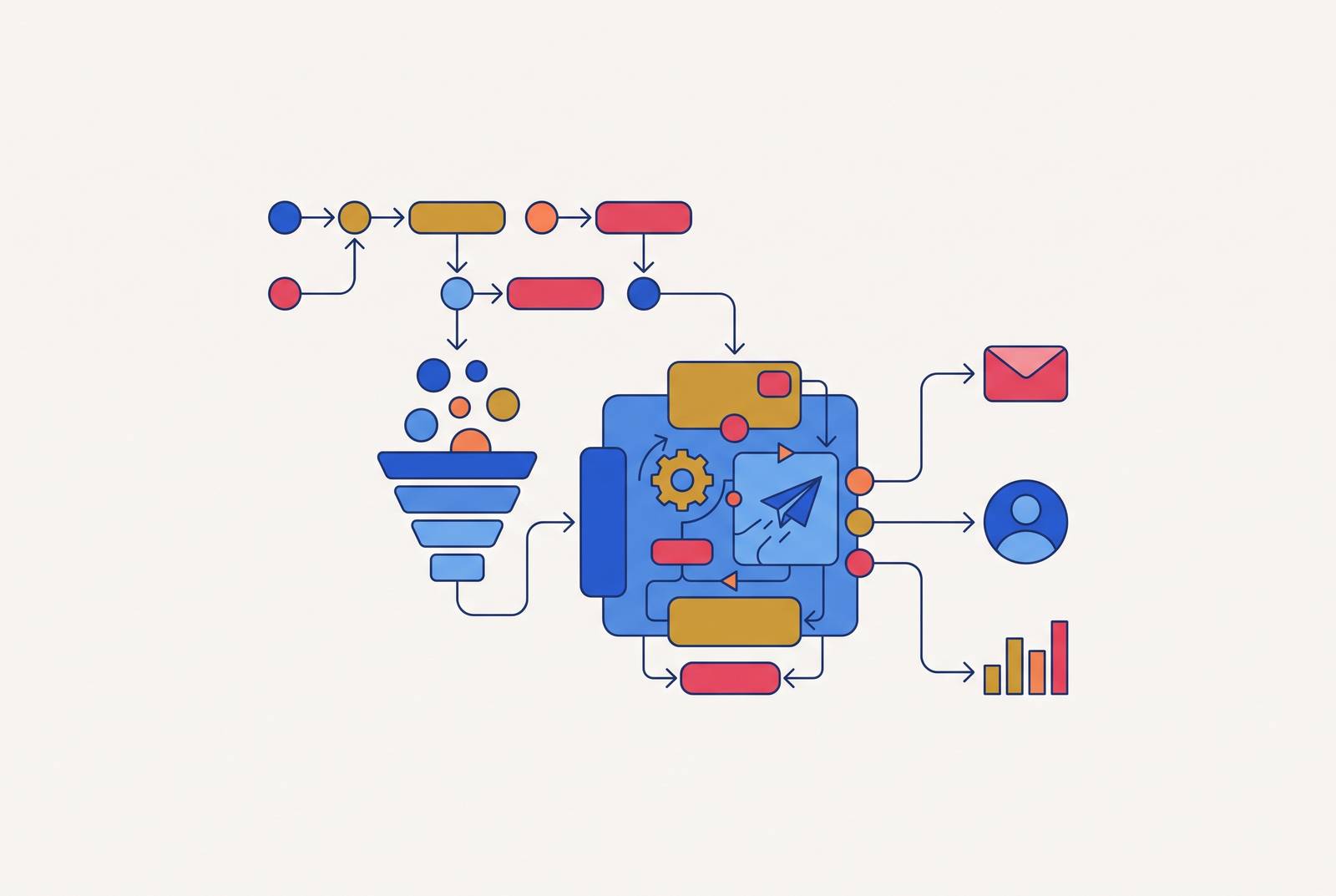
Startup failures don't usually come from a lack of marketing. They come from marketing that produces the wrong kind of proof. This piece is about the marketing automation workflows that matter at seed stage, and none of them are designed to send more of anything. They're designed to produce the exact numbers a Series A investor is going to ask for, and if a workflow can't do that, it doesn't belong in the build.
Here's the pattern to name up front. A founder gets access to HubSpot or ActiveCampaign, and the instinct is to automate output: more emails, more LinkedIn touches, more "just checking in" sequences. It feels like progress because the dashboard shows activity. But a large waitlist and a Product Hunt spike tell an investor nothing about whether the business repeats, and treating them as proof points is the single most common mistake in this whole exercise. Vanity metrics are a red flag in due diligence, not a green one, because they measure attention instead of economics. Every workflow below answers one question instead: what data does this produce, and does that data compound into a story about CAC, conversion, and pipeline velocity that survives scrutiny?
What the Series A bar actually requires from your pipeline data
Median Series A revenue hit $2.5 million in 2025, roughly 75% higher than in 2021. That's the figure as written. It means the bar for "proven" has moved, and a pipeline that looks active isn't the same as one that's provably efficient, no matter how full the top of the funnel looks.
A few thresholds are close to non-negotiable now. CAC payback over 18 months is a hard stop in most due diligence processes, not a footnote to explain away. Net revenue retention below 100% tends to end a Series A conversation regardless of how good the top-line ARR number looks, because it means the existing customer base is leaking value even as new logos come in. David Sacks of Craft Ventures has a useful frame here: a Burn Multiple below 1.5x signals the market is pulling the product forward, while anything above 5x signals the company is pushing the product uphill, at cost. Automation spend shows up directly in that ratio, which is exactly why sloppy automation is expensive in ways that don't show up until the term sheet stage.
The average gap between a $1M+ seed round and a Series A has stretched to 25 months. That's the runway window, full stop. A workflow either compounds toward the metrics that unlock the next round, or it quietly burns months and budget producing numbers nobody upstream will ever ask about. So the rule is blunt: if a workflow can't be traced to a pipeline metric, cut it. Shelve it for later, when brand-building spend actually makes sense. Investors are looking for something other than busy. They're looking for a plan to deploy capital toward specific, named metrics, and the workflows below are that plan in operational form.
Before any workflow: getting ICP precision right
Skipping ICP work is the most common shortcut in early marketing, and it's the wrong one. None of the workflows below function without a tight ideal customer profile, and most startups treat that definition as a delay before "real" marketing starts. It's the foundation, not the delay.
ICP-targeted campaigns see 68% higher ROI than broadly targeted ones. Research puts a 36% conversion rate advantage on companies with a clearly defined ICP. The default failure mode is familiar: target VP-level and above, across every industry that could theoretically write a check. That produces messaging so broad it offends no one and convinces no one either.
Two things get confused constantly, and they're worth separating clearly. The ICP describes the organization: headcount, industry, tech stack, revenue band. The buyer persona describes the human inside that organization making or influencing the decision. Both need defining before any segmentation logic gets built, because a workflow that targets "the org" but writes to nobody in particular reads as generic no matter how well-targeted the list is.
Start segmentation with one dimension, company type, target department, or use case. Layer in more only once that first cut produces clean signal. Technographic data (what tools a prospect already runs) is a useful second layer later, since it tells you integration fit and buying readiness before a rep ever picks up the phone.
Run every message through a specificity test before automating it. "Companies where reps spend less than 30% of their time actually selling" beats "companies struggling with sales productivity," and it isn't close. Vague messaging automated at scale doesn't become more effective. It becomes vague at scale, which is worse than not automating at all. Clean data has to be in place before any of this works: unified customer identifiers and a real segmentation taxonomy need to exist before any AI-assisted scoring gets layered on top. Dirty data fed into a predictive model doesn't average out into something roughly right. It produces confidently wrong answers, consistently, which is a much harder mistake to catch.
The lead capture and qualification workflow
This is the workflow that turns anonymous traffic into a scored, segmented lead with a defined next step. Get it wrong and every downstream workflow inherits the mess, so it's worth more care up front than most teams give it.
Trigger it on behavior, not on a calendar. Pricing page views, asset downloads, repeat visits, these are the signals that should fire the sequence, not a weekly batch send that catches whoever happens to be sitting in the database that day. Build a scoring model that weights actions by how close they sit to purchase intent: a pricing page visit outweighs a blog read, and a repeat visit outweighs a single touch by a wide margin.
Set a clear MQL threshold, the score at which a lead routes to a rep instead of into nurture. This matters more than it looks, because it's the point where CAC tracking actually starts. Tag for ICP fit at the moment of capture, using company size, industry, and tech stack where available, so the nurture sequence a lead lands in is already somewhat personalized before the first email goes out.
The output that matters is customer outcomes tied to revenue. It's source attribution, time-to-MQL, and ICP fit score: three numbers that feed straight into the pipeline velocity metric an investor will actually read on a slide.
For tooling: HubSpot Marketing Hub bundles lead scoring with native CRM, a solid fit for teams that want marketing and sales data living in one place. ActiveCampaign runs $29 a month and offers a flexible journey builder for teams that need automation depth without carrying a full CRM. Other platforms bundle in customer-data-platform-style features and stronger visual analytics, useful for SaaS teams that want funnel visibility baked into the automation layer itself.
The welcome and onboarding sequence
Median NRR for venture-backed B2B SaaS is around 106%, and the welcome sequence is the first place that number gets won or lost. Churn risk gets introduced or reduced in the first few days of a customer relationship, long before anyone's tracking retention on a dashboard.
Keep the architecture simple. A 3-email sequence beats a 12-email maze every time, because complexity here just adds more places for a customer to drop off. Email one confirms the value proposition and sets expectations specific to the customer's use case, personalized by ICP. Email two delivers a first concrete win, a template, a benchmark, a quick-start guide, something that produces an actual result before the trial period runs out. Email three brings in social proof from a customer who matches the recipient's ICP, paired with a direct call to action toward a demo or check-in call.
Branch the sequence on behavior. A user who completes a key activation step (connecting an integration, inviting a teammate) should move into expansion messaging. A user who doesn't should get rerouted into re-engagement instead of riding out the rest of the original sequence on autopilot.
Track activation rate, time-to-activation, and the specific point where users drop off. These three numbers are leading indicators of retention long before there's enough history to calculate NRR properly. And this is the piece that actually feeds the investor narrative: a well-instrumented onboarding sequence proves repeatability. It shows users don't just sign up, they consistently reach value, which is the difference between traction and a one-time spike nobody can explain.
The lead nurture workflow for longer B2B sales cycles
MQLs that don't convert right away meet one of two fates: they get forgotten, or they get dumped into a generic monthly newsletter. Both waste the CAC already spent acquiring them, which makes this one of the more expensive mistakes to make quietly, since nobody notices the leak until the CAC payback number comes back ugly.
Nurture isn't broadcasting, and it shouldn't run on a fixed calendar. Sequence logic should respond to actual engagement, an open, a click, a visit to a specific page, rather than firing every Tuesday regardless of what the lead is actually doing.
A reasonable cadence for a longer B2B cycle looks like this. Weeks one and two lead with ICP-relevant education, including use case content, a peer case study, and a benchmark that makes the problem concrete instead of abstract. Weeks three and four shift into objection handling, addressing the specific reasons this ICP tends to delay a decision, integration worries, budget timing, the need for internal buy-in. Weeks five and six bring urgency and proof, customer outcomes, ROI framing, and a low-commitment ask like a 20-minute call rather than a full demo pitch.
Build in a re-engagement branch. Leads who go quiet mid-sequence get a re-permission email before getting suppressed entirely, which protects list health and keeps deliverability from degrading over time. The output metric that matters most is time from MQL to SQL, tracked cohort over cohort. Shrinking that number is the compounding advantage a well-tuned nurture workflow actually delivers, and it's a far better proof point than "leads generated" will ever be.
Customer.io fits product-led SaaS teams with engineering resources on hand, given its event-based, API-first approach, starting around $100 a month. ActiveCampaign covers similar ground for teams that want comparable depth without needing a developer to set it up.
The trial-to-paid conversion workflow
CAC payback either gets proven or gets broken right here. No amount of top-of-funnel volume fixes a business where trials aren't converting, which is exactly why this workflow deserves more attention than most founders give it.
Time-based triggers actually make sense in this one case, since the trial deadline is a known date. Fire messages at seven days out, three days out, and on the day itself. The personalization lever that matters most: reference the specific features a user actually touched during the trial. "Your trial is ending" converts poorly. "Here's the integration you connected last week, and what happens to it Friday" converts a lot better, because it proves the product noticed what the person actually did.
Branch by behavior. High engagement paired with no conversion usually points to a price or budget objection, so offer a payment plan or route the lead to a rep for a real negotiation conversation. Low engagement points to an activation failure, so route back into onboarding with a targeted nudge instead of a generic reminder. No login at all since signup suggests a possible ICP mismatch, in which case suppressing from the conversion sequence and routing to a requalification step makes more sense than chasing a lead that was never going to fit.
Track trial-to-paid conversion by cohort, by ICP segment, and by traffic source. That last cut matters more than founders usually expect, because it separates channels that produce leads from channels that produce actual customers. A rising trial-to-paid rate across cohorts is one of the cleanest signals of product-market fit available, since it shows the product is delivering on what the marketing promised in the first place.
The retention and expansion workflow
NRR is close to binary in a Series A conversation. Above 100% keeps the discussion open. Below 100% tends to close it, no matter how strong the rest of the deck looks. This workflow is what keeps the number on the right side of that line.
Three triggers do most of the work. A usage drop, someone who logged in daily and has suddenly gone quiet, should fire a check-in sequence before churn happens, not after the cancellation email arrives. A milestone hit, a customer crossing a meaningful usage threshold, should trigger a message that introduces the next tier of value: a feature they haven't tried yet, a use case they haven't explored. And the renewal window, in the weeks leading up to expiration, should surface account-specific ROI evidence, time saved, pipeline influenced, records processed, whatever number actually anchors that account's version of value.
Expansion deserves its own trigger. Customers bumping against usage limits, or poking around upgrade-adjacent features, should get an automated sequence that frames the upgrade as an obvious next step rather than a sales pitch bolted on top. Layer in NPS surveys at key points post-conversion, which builds a feedback loop feeding both product and messaging, and flags high-NPS responders as candidates for case study outreach later.
Startups in the $1M to $5M ARR range saw average gross revenue retention around 92% in 2025. A retention workflow that's actually instrumented, not just running quietly in the background, is what closes the gap between that 92% and the 106% NRR median investors expect to see.
The referral and case study workflow
Referrals are the cheapest acquisition channel in B2B, full stop, and automation's job here is to make the timing and context of the ask smarter. It's to ask at the exact right moment, which is a narrower window than most teams treat it as.
The trigger is a signal, not a schedule. A customer who just hit a usage milestone, left a high NPS score, or renewed without friction is sitting in the highest-propensity moment to refer someone. Fire the workflow within 48 hours of that signal. Waiting for a quarterly newsletter to make the ask wastes the moment.
Structure the sequence around specificity. The first email should name the actual milestone: "you just processed your 2,000th record" reads as attentive, while "love our product?" reads as a mail-merge. If there's no action after that, a second email using light social proof from a peer referrer normalizes the behavior before repeating the ask directly.
Customers who agree to refer, or who leave a detailed positive review, should route into a case study pipeline: a short interview request with a clear time commitment stated up front, no ambiguity about how much of their day it'll eat. This workflow matters more to the investor narrative than it looks like it should. Case studies and real customer quotes are the qualitative proof that makes the quantitative story credible, and an investor reading a deck that names actual customers with actual outcomes has less digging to do in diligence. Referral-sourced customers tend to carry meaningfully lower CAC than most other acquisition channels, and showing that number on its own is how founders prove the flywheel drives real results. It's actually spinning.
The re-engagement workflow for dormant leads and churned customers
This is the workflow nobody puts in a pitch deck screenshot, and it's also where a lot of CAC efficiency quietly gets won or lost. Re-engaging someone who already knows the product costs a fraction of acquiring someone new, which makes ignoring this workflow one of the more expensive habits a growth team can pick up.
Two populations need separate treatment. Dormant leads, MQLs who entered the funnel and never converted, should get segmented by recency (under six months versus older) and by original ICP fit score before any re-engagement attempt goes out. Churned customers need a different cut entirely: segment by reason, price, poor fit, a competitive switch, or an activation failure, before deciding whether re-engagement is even worth the effort.
For dormant leads, lead with something new: a fresh data point, a product update tied to their original interest, or a customer outcome that matches their use case. A "just checking in" email is the fastest way to get marked as spam, and deservedly so. If two touches produce no response, send a re-permission email before suppressing the contact entirely, both for list hygiene and to keep CAC math from getting muddied by dead weight sitting in the denominator.
Churned customers where the ICP fit was genuinely strong deserve the narrowest trigger of all: a feature release that directly addresses the reason they left is the only re-engagement message worth sending. Anything else reads as a company that wasn't listening the first time. Timing this one right takes real coordination between marketing and product, since the message is only as good as the release it's riding on, and firing it before the feature actually ships just reopens the same wound that caused the churn in the first place.