HubSpot vs Mailchimp vs ActiveCampaign for Startups
Pick the wrong tool at seed stage and you'll rebuild your pipeline twice.

Three tools, three different bets on what a founder actually needs at seed stage. Most founders pick based on the homepage price, the wrong number to anchor on. HubSpot, Mailchimp, and ActiveCampaign overlap just enough on paper to confuse people, and diverge just enough in practice to bankrupt the wrong founder six months in.
The clock is the part people underweight. Median time between seed close and Series A hit 616 days in mid-2025, and the bar to clear that milestone climbed at the same time: the bar to clear that milestone climbed at the same time. Fewer founders get a shot, and the ones who do need real pipeline numbers, not a folder of blog drafts and a newsletter open rate. Whatever gets picked in month one quietly decides what data exists in month eighteen. CAC, pipeline velocity, MQL-to-customer conversion, all of it either comes out of the tool on its own or gets stitched together by hand at 11pm before a board meeting. Retrofitting that later costs real time and real money.
How the three platforms are fundamentally different from one another
Mailchimp was built as an email tool and still acts like one. It's fast, it's simple, and it's built for someone doing five other jobs that same week.
HubSpot took the opposite bet: one platform, six connected Hubs (Marketing, Sales, Service, Content, Commerce, and Operations), meant to grow with a company for years. Breadth is the whole pitch, and breadth is also the whole friction. A founder has to understand how HubSpot's CRM data model works before sending a first campaign, which is a strange ask for a team with no CRM data yet.
ActiveCampaign sits in the middle, and it was built from the ground up around automation, not automation bolted onto a newsletter tool after the fact. It runs on behavioral journeys: if a lead does this, send that; if they don't open in three days, branch somewhere else. The learning curve used to be steep. AI tooling has flattened a good chunk of that lately.
Mailchimp gets a founder sending in under an hour. HubSpot asks for patience before reward. ActiveCampaign asks for a bit of both.
On CRM, the gap is not subtle. HubSpot ships a full CRM with deal tracking and contact management built in from day one. ActiveCampaign has a CRM with sales automation baked in, with a stronger version sold as a paid add-on. Mailchimp has no real CRM at all, just audience lists and tags dressed up to look like segmentation.
And on deliverability, the numbers settle the argument. Independent testing from EmailToolTester puts ActiveCampaign at a 94.2% delivery rate, ranked first out of 15 tools tested. HubSpot came in at 77.7%, twelfth out of 15. For a founder whose whole pipeline depends on outbound email landing in an inbox instead of a spam folder, that gap isn't a nitpick. It decides whether the email gets read at all.
What the real costs look like when you run the numbers past the homepage
Homepage pricing is marketing copy. Here's what founders actually end up paying.
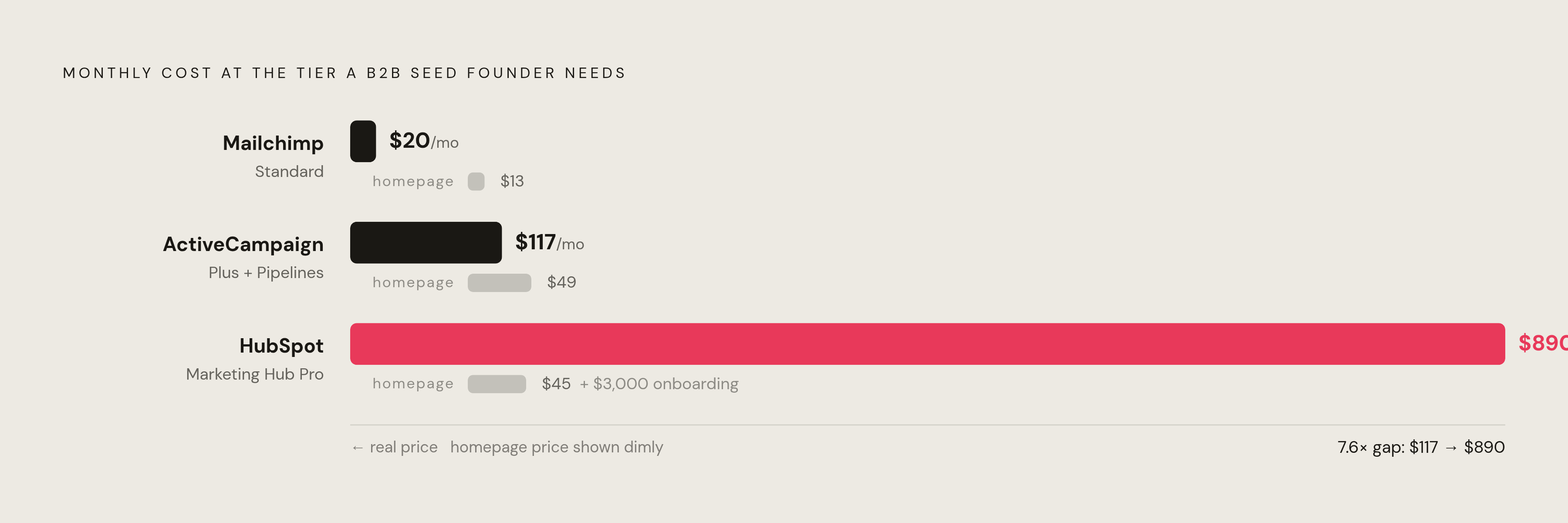
HubSpot's free CRM sounds generous until you notice it ships with no multi-step workflows, only basic automated email actions and manually enrolled sequences with limited depth. Starter plans begin at $15 per user per month per Hub, with a bundled Starter Customer Platform at a low entry price too. But the plan that actually unlocks automation and real reporting, Marketing Hub Professional, jumps to $890 a month. Add a mandatory onboarding fee ($3,000 for Marketing Hub Professional, more for Enterprise, though partners can sometimes waive it) plus a required annual commitment, and the "starter" number on the homepage stops meaning much. There is a real escape hatch: HubSpot Startup Partners can offer up to 90% off for eligible founders, and that changes the math completely for anyone who qualifies.
Mailchimp's free plan caps out at 500 contacts, one audience, and 30 days of email support before that support just disappears. Essentials runs $13 a month for 500 contacts. Standard runs $20 a month and adds multi-step automation and branching journeys. Premium jumps to $350 a month. The real trap is contact-based billing: every contact stored costs money whether it's ever emailed or not, and list growth triggers tier upgrades automatically, sometimes before revenue shows up to justify the jump. Consolidating down to one audience with tags is the standard workaround for keeping contact counts from inflating the bill. (Mailchimp also renamed its Customer Journey Builder to Marketing Automation Flows in June 2025. Same tool, new label, same invoice.)
ActiveCampaign skips the free tier and offers a 14-day trial instead. Starter runs $15 a month for 1,000 contacts and one user. Plus runs $49. Professional runs $79. Enterprise runs $145. All billed annually, all priced against that same 1,000-contact baseline. The CRM isn't included by default: the Pipelines add-on costs another $68 a month and only works on Plus tier or higher, and the Sales Engagement add-on (win probability, automated one-to-one emails, sentiment analysis) runs $111 more on top of that. Here's the part that matters for anyone signing up now: accounts created on or after November 3, 2025 get billed for every contact on the list, including unsubscribed, unconfirmed, and bounced contacts, not just the active ones. Accounts opened before that date stay grandfathered on the old policy. Layer in the broader 2024-2025 plan restructuring, and some existing users reportedly saw bills climb 30 to 40% once real feature needs got mapped to the new tiers. There's an offsetting discount too: 90% off any annual plan for the first year through ActiveCampaign's startup program, and annual billing runs about 20% cheaper than monthly at the entry tier.
Mailchimp looks cheapest until the list grows. ActiveCampaign looks mid-range until the CRM add-on and the new contact-billing policy get factored in. HubSpot looks expensive until a Partner discount lands, or until a founder actually prices out what it costs to duct-tape three separate tools together instead.
When Mailchimp is the right call and when it becomes a ceiling
Mailchimp fits a founder in the earliest stage of GTM, doing founder-led sales with no dedicated marketing hire, who needs a newsletter or a nurture sequence live by Friday. The product requires no learning curve, which is the whole point.
The drag-and-drop builder is genuinely the most intuitive of the three, and the templates are well-regarded out of the box. The Standard plan's automation flows handle common nurture use cases well enough for a short sales cycle. Mailchimp also bundles social and ad channel features alongside email, which helps a solo founder juggling every channel alone.
But there's no real CRM here, and that's a wall a B2B founder hits fast. Audience lists and subscriber ratings aren't deal pipelines, no matter how they're labeled. Automation tops out at basic-to-intermediate, so anything with real branching logic needs a workaround or a platform switch. Reporting wasn't built for the pipeline attribution depth a B2B founder needs at scale, and the contact-billing model means the moment traction actually kicks in, so does the bill.
Mailchimp earns its keep as a launchpad, not a growth engine for B2B. Founders who need to prove pipeline velocity outgrow it eventually, usually right when they can least afford the distraction of switching tools.
When ActiveCampaign earns its place and what the new pricing reality actually means
ActiveCampaign fits GTM Stage 2, roughly ten to thirty customers, once the pitch is repeatable and the founder needs behavioral automation and lead scoring without paying HubSpot's Professional price.
The automation engine was built for complex if-then logic across email, SMS, and site messaging from day one, not stapled on after launch like an afterthought. Lead scoring runs in real time across contacts and deals, factoring email opens, site behavior, and custom events, then feeds straight into automations that route leads to sales or trigger a nurture sequence. That's the kind of segmentation that turns into investor-grade reporting later, once the board asks where the pipeline came from. The newer AI layer, Active Intelligence, builds full campaigns and multi-path workflows from a prompt now, cutting a lot of the setup time that used to make this platform feel heavy for small teams. And that 94.2% deliverability score isn't a footnote: it means the emails a founder sends actually show up, which matters enormously when the whole pipeline runs on cold and warm outreach. Add a broad integration library, and it plugs into most of the stack a seed startup already runs.
None of that erases the pricing reality, though. All legacy accounts got migrated to the new plan structure by August 2024, and new accounts started on it back in June 2024. Plenty of users reportedly saw their bills climb 30 to 40% once real feature and seat needs got mapped against the new tiers. Then, quietly, the billing policy shifted again: accounts opened on or after November 3, 2025 get charged for every contact, active or not. Founders signing up today are working under that rule from day one, whether they've read the fine print or not. The Starter plan at $15 a month is thin for actual B2B pipeline work too, since the CRM lives behind Plus tier or higher. Realistic cost for a founder who wants automation plus CRM: $49 a month for Plus, plus $68 a month for the Pipelines add-on. Call it $117 a month, not $15.
ActiveCampaign is the strongest value play for a founder who needs automation depth and real lead scoring but isn't ready to write a HubSpot Professional check. That only holds, though, if the founder walks in understanding what the current billing model costs over a full year, not just at signup.
When HubSpot makes sense and when its cost structure is actually a trap
HubSpot fits a founder who is documenting process, hiring the first salesperson, and needs marketing and CRM data telling the same story to investors. It also fits any founder who qualifies for the Partner startup discount, full stop, regardless of stage.
The CRM being native from day one means marketing activity connects directly to the deal pipeline. That's the attribution story investors want, built in rather than assembled from three CSV exports the night before a pitch. Reporting here is the strongest of the three platforms for showing a closed loop from campaign to closed revenue. Automation at the Professional tier rivals ActiveCampaign, landing pages personalize per visitor, and predictive scoring exists at higher tiers. And because six Hubs share one data model, a founder can start with Marketing and bolt on Sales, Service, or Operations later without stitching together separate tools and separate logins.
The trap is the gap between what's free and what's actually usable. The free plan and the Starter tier ships with no workflows or email sequences, so the features a B2B founder actually needs sit behind that $890-a-month Professional wall. Add the $3,000 onboarding fee and an annual commitment, and the real first-year cost looks nothing like the number on the homepage. That 77.7% deliverability score, twelfth of 15 platforms tested, is a legitimate concern for anyone whose pipeline depends on email actually arriving instead of getting filtered. And As automation use cases grow more complex, the workflow engine can become harder to manage, right as pricing climbs across contact tiers and Hub combinations.
The one thing that flips this whole calculation: the Startup Partner discount, up to 90% off for eligible founders. For a qualifying seed-stage company, that changes the argument completely, turning HubSpot from the expensive option into arguably the cheapest one. Eligibility has to be checked directly though, never assumed.
Matching each platform to a stage and founder type
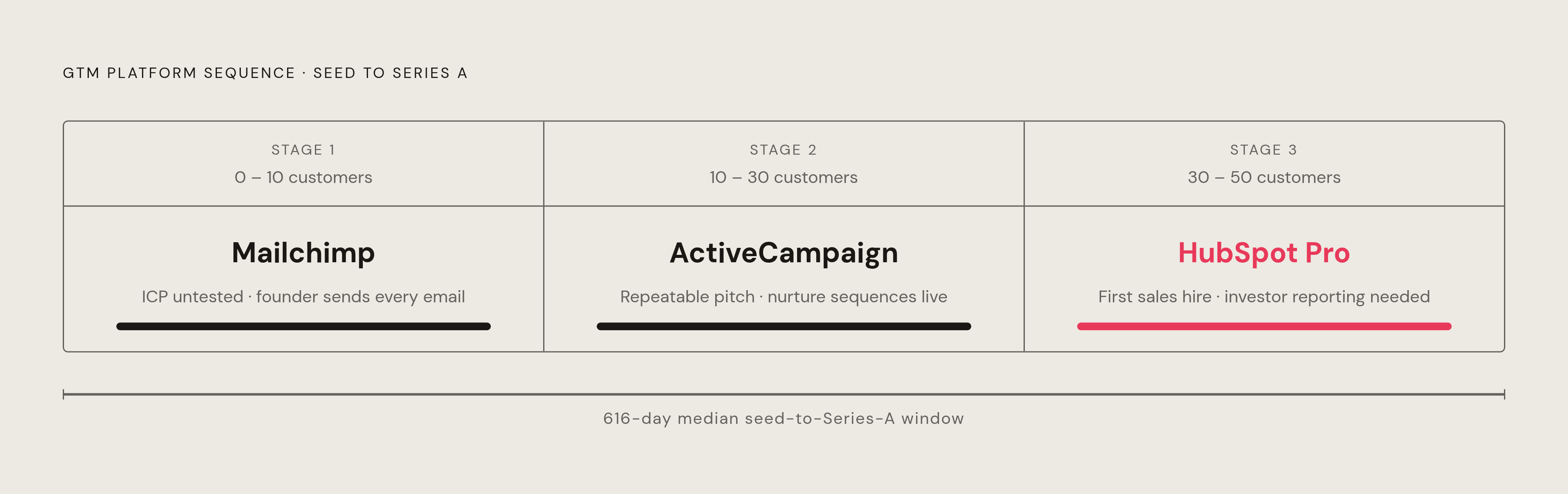
At GTM Stage 1, zero to ten customers, founder-led sales, still testing the ideal customer profile: Mailchimp. Get campaigns live now, keep cash in the bank, and accept that a migration is probably coming once things pick up.
At GTM Stage 2, ten to thirty customers, a pitch that's starting to repeat itself, nurture sequences running, ICP mostly confirmed: ActiveCampaign. Behavioral automation and real lead scoring without HubSpot's price ceiling, but budget for Plus plus the CRM add-on from the start, and go in understanding the current contact-billing policy rather than discovering it on an invoice three months in.
At GTM Stage 3, thirty to fifty customers, first sales hire on board, building the story for investors: HubSpot's Professional tier is worth considering, especially if the Partner discount applies or if unified reporting across customer records and marketing has become the actual bottleneck. Just check the deliverability math before signing the annual contract.
One thing holds true no matter which tool gets picked. A founder racing toward Series A in 616 days or fewer needs CAC, pipeline velocity, and MQL-to-customer conversion numbers from day one, and those numbers need to come out of the platform on their own, not get assembled by hand in a spreadsheet the night before a board update. No software fixes a fuzzy ICP or a nurture sequence that doesn't exist yet. Strategy comes first; the platform just amplifies whatever's already working, for better or worse. AI tooling is turning into a real differentiator between these three: one vendor's AI agents can generate full campaigns and multi-path automations from a prompt, while another vendor's AI layer, Breeze, leans toward customer-record functions and sits mostly behind the higher-priced tiers.