Email Drip Campaign Strategy for B2B Startups
Automated sequences outperform blasts by 37 percent in revenue.
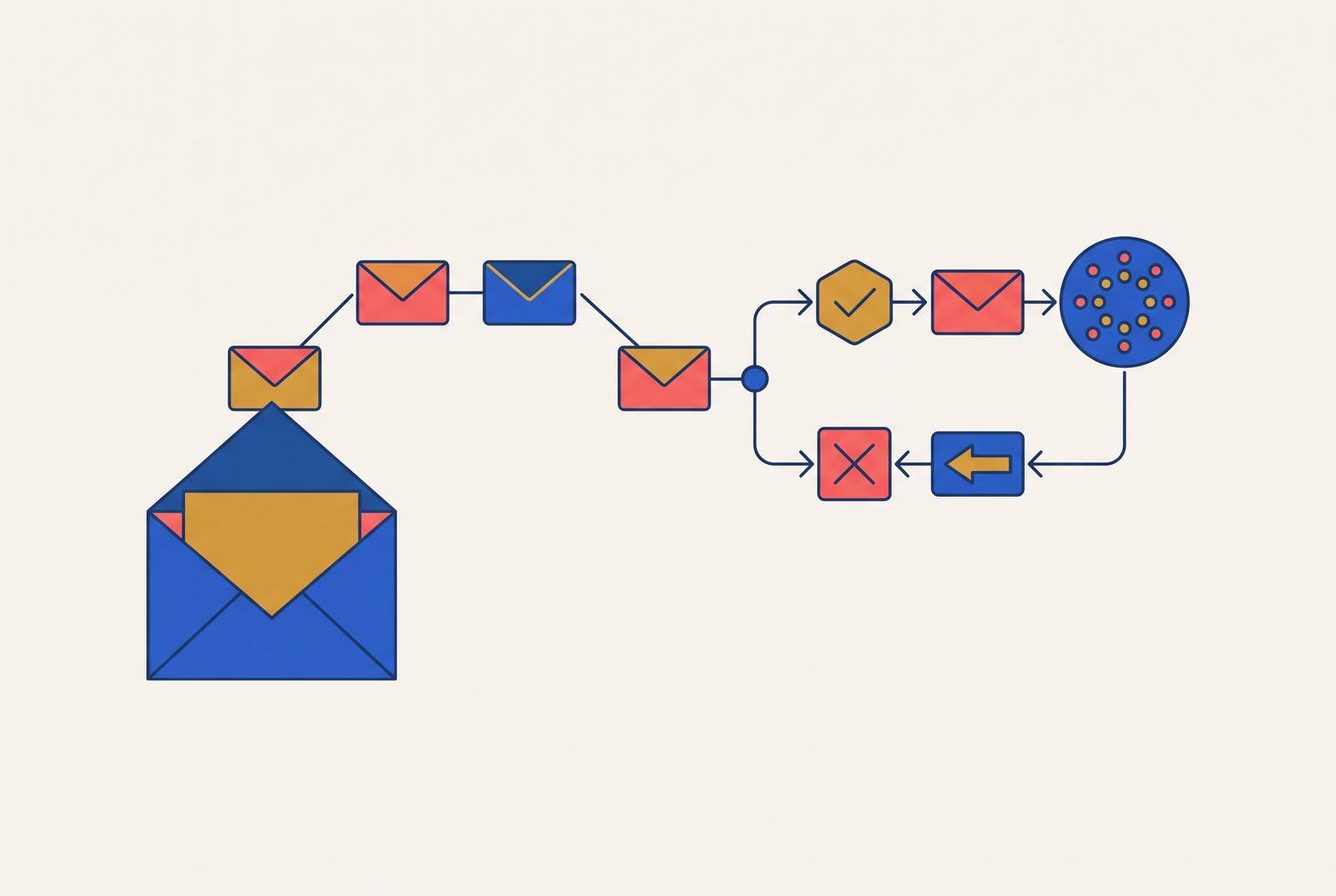
Most B2B founders build one email, blast it to everyone on the list, and call it a strategy. That's not a drip campaign, that's a foghorn. A real drip is a triggered sequence that responds to what a lead actually does, moving them through the buying journey stage by stage instead of yelling the same thing at everyone regardless of where they stand.
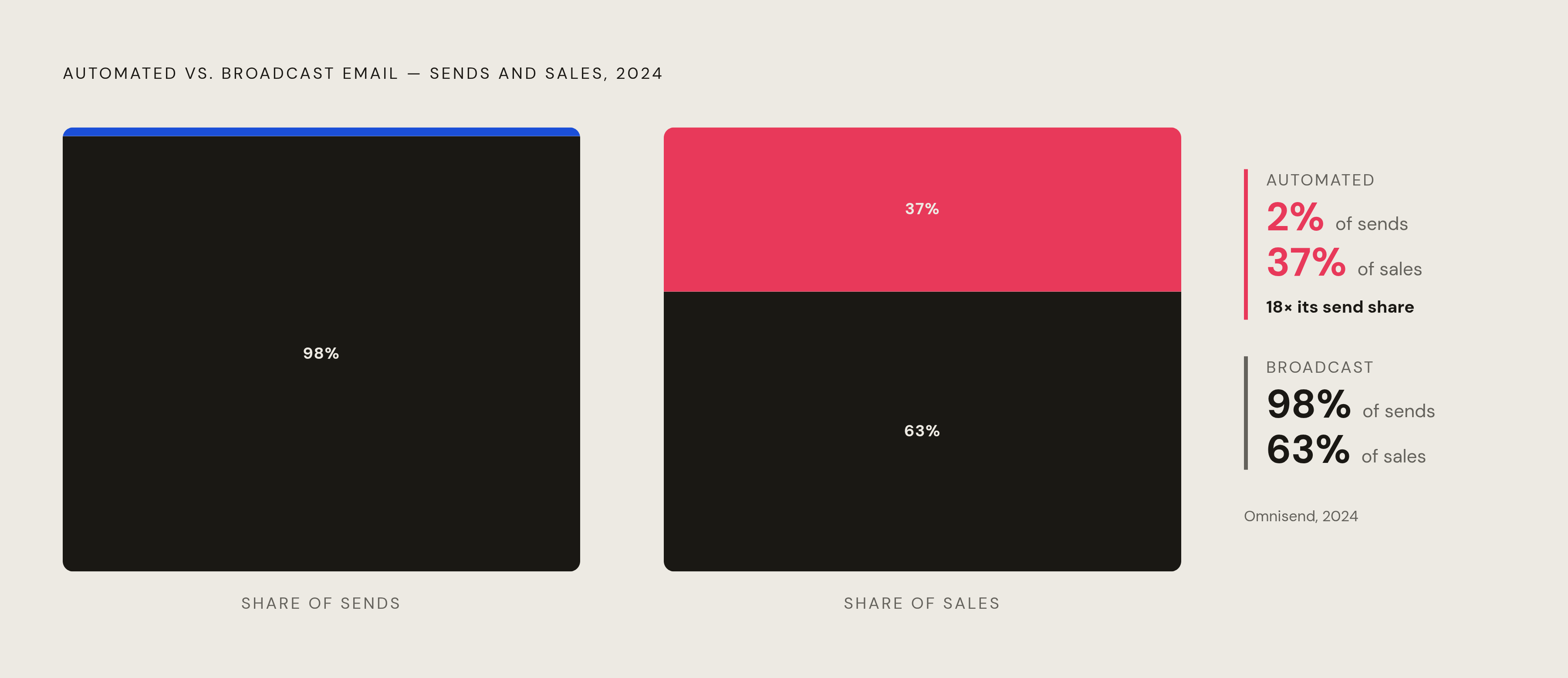
Here's the math that should bother you: something like 96% of website visitors aren't ready to buy the moment they land on the page. So the one-off blast treats a cold stranger and a hand-raiser who just visited the pricing page three times this week exactly the same. That's the structural flaw. Drip campaigns fix it by generating meaningfully higher open rates and click-through rates than single sends, and studies on automated versus broadcast email have found drips driving multiples more revenue per send. Omnisend's 2024 numbers back this up hard: automated emails made up roughly 2% of total sends but accounted for 37% of email-driven sales. That's not a volume game. That's an efficiency game.
For a seed-stage founder running sales solo, out of a laptop, between fundraising calls, this gap isn't cosmetic. Every lead who goes unworked is a proof point you didn't get to use in the next investor update. So here's the actual blueprint: how to segment, how to architect the sequence, what infrastructure keeps it out of spam folders, how to write emails people open, which six sequences to build first, and how to know if any of it is working.
What a drip campaign actually is, and what it is not
A drip campaign is an automated series of pre-written emails, sent on a schedule or triggered by something a contact does, built to move that person toward one specific action. That's the whole definition. Nothing fancier going on underneath it.
The confusion usually starts with newsletters. A newsletter is a single broadcast, sent to everyone on the list at the same time, regardless of who they are or what they've done. A drip is the opposite of that: automated, behavior-driven, tailored to wherever each contact currently sits in their journey. One is a megaphone. The other is closer to a conversation that happens to run on autopilot.
The name itself tells you the mechanism. Each email delivers one small drop of value. Trust builds incrementally, drop by drop, instead of one email trying to close the deal in a single shot. Push too hard too early and the whole sequence reads as a sales pitch wearing a trench coat.
B2B startups typically need six kinds of these running at once:
- Welcome and onboarding sequences
- Lead-nurture sequences triggered by content downloads
- Cold-outreach follow-up cadences
- Re-engagement sequences for contacts gone quiet
- Post-demo or post-call follow-ups
- Upsell and expansion sequences for existing customers
A few terms are worth nailing down before going further. A trigger is the event that starts or advances a sequence, a form fill, a whitepaper download, a trial signup, or silence after a cold email. An exit (or suppression) trigger is the rule that pulls someone out of the sequence the moment they reply, book a meeting, or buy. Skip this step and the drip turns into exactly the kind of spam people complain about, emails still arriving after the deal already closed. And MQL versus SQL marks the handoff point inside a nurture sequence: an MQL matches the ideal customer profile, an SQL has actually signaled real buying intent.
None of this is optional in B2B specifically. Forrester's research on buying groups puts the average number of stakeholders involved in a purchase decision somewhere between six and ten people. A single broadcast email cannot speak to a CFO, a VP of a core business function, and an IT security reviewer all at once, not with one message. As for length, MoEngage's data points to 3 to 7 emails as the effective range for most nurture sequences, while cold outbound performs best across 4 to 7 touches spread over two to three weeks.
Segmentation before sequencing: why ICP clarity determines whether a drip works
Segmented campaigns generate roughly 760% more revenue than generic blasts. Sit with that number for a second, because it's not a small edge; it's the difference between a system that pays for itself and one that quietly drains time into a void.
Why such a gap? Because segmentation is really just relevance in disguise, and relevance is the only thing that gets an email opened by a busy person who has fourteen other tabs open. The variables that actually move the needle in B2B:
- Industry (a message built for healthcare buyers rarely lands the same way with finance buyers)
- Company size (a 10-person startup and a 10,000-person enterprise are not shopping for the same thing, even if they use the same product)
- Buying stage (someone just becoming aware of the problem needs different words than someone actively comparing vendors)
- Behavior (what someone actually did, downloaded, clicked, went silent, should decide which sequence they land in next)
Top-performing marketing teams tend to use more than three segmentation dimensions at once, layering industry with behavior with buying stage. And campaigns built around specific buyer personas see substantially higher open rates and click-through rates than campaigns without them, research points to as much as 2x and 5x respectively. That's not a marginal lift. That's the difference between a drip that gets read and one that gets archived on sight.
Specificity is where this gets fun, or at least where it stops being generic. Don't describe your ICP as "companies struggling with sales productivity." That's the corporate equivalent of describing a house fire as "a temperature issue." Instead, describe them as "companies where reps spend less than 30% of their time actually selling, buried instead in admin work and CRM data entry." The second version makes a reader think "oh no, that's us" within about two seconds. The first version makes them think "sure, I guess, who isn't."
For a founder at seed stage, the temptation is to build three or four parallel sequences for three or four different ICPs, because surely casting a wider net catches more fish. It doesn't. It catches confusion, plus it burns twice the writing time for half the clarity. Pick one segment. Go deep. Build a second sequence only once the first one is actually converting. Each ICP deserves its own distinct sequence with distinct content, not a find-and-replace job on the company name.
Sequence architecture: how to structure a drip that moves prospects through stages
A buying journey has stages, so the sequence needs to mirror those stages rather than just firing off information in whatever order it was written. Four stages, roughly, each doing a different job.
Stage one is awareness. The first email or two exist purely to name the problem in the prospect's own language, no product mention, no pitch. The goal is recognition: "yes, that's the exact thing keeping me up at night." Stage two is education, where emails three and four bring in case studies, specific use-case detail, or benchmark data that makes the problem feel urgent and solvable rather than just annoying.
Stage three is consideration, and this is where the solution finally shows up, but described in outcome terms rather than feature terms. "Three hours saved per manager per week" beats "report automation tool" every time, because nobody wakes up excited about automation, they wake up excited about getting three hours of their week back. Stage four is decision, where the sequence offers one clear next step, such as a demo, a call, or a limited trial, with an exit trigger built in so the sequence stops the instant someone converts.
Triggers do the mechanical work underneath all four stages. Entry triggers include a form fill, a content download, a trial signup, silence after cold outreach, or a demo that didn't lead anywhere. Advancement triggers push someone forward inside the sequence, a link click, a repeat visit to the pricing page, downloading a second asset. Branch logic matters here too: someone who clicks through to pricing is showing more intent than someone who just opens an email, so they should get routed into a faster, more sales-forward sub-sequence rather than waiting through two more education emails they don't need.
Cadence-wise, 4 to 10 emails spaced 4 days to 2 weeks apart tends to be the effective range, and cold outbound specifically performs best across 4 to 7 touches over 2 to 3 weeks. Each individual email has to stand on its own, too. If someone misses email three because they were on vacation, email four still needs to make sense without it. And one CTA per email, always. Two calls-to-action in a single message just means the reader picks neither, which is the email equivalent of asking someone what they want for dinner and giving them the entire menu to choose from.
Timing counts as well. B2B decision-makers read email during work hours, not while unwinding on the couch at 9 p.m., so schedule sends accordingly. And the patience this whole structure demands does get repaid: nurtured deals tend to close at meaningfully higher value than deals that skipped the nurture step entirely, something in the range of 47% more, according to research on lead nurturing outcomes. Building the architecture takes longer than firing off a blast. It's also the difference between a system and a stunt.
Deliverability and infrastructure: the foundation that determines whether any of this reaches an inbox
None of the sequence architecture above matters if the email lands in spam. Google and Yahoo tightened bulk-sender rules in 2024, requiring proper authentication, one-click unsubscribe, and enforcing spam-rate thresholds that used to be more of a suggestion. List hygiene and easy opt-outs went from "nice to have" to "the cost of entry."
Before any sequence launches, three technical pieces need to be in place. DKIM, SPF, and DMARC all need setting up correctly, and checked periodically, not configured once and forgotten. Marketing email should run on a separate sending domain from transactional email, so if the marketing domain trips a spam filter, password resets and receipts still get through untouched. And any new sending domain needs a warm-up period: blast high volume from a brand-new domain on day one and spam filters treat it like a stranger showing up uninvited to a party, immediately suspicious.
List hygiene isn't a spring-cleaning task, it's ongoing maintenance. Contacts who haven't opened or clicked in a while should get removed or moved to a re-engagement sequence, since a shrinking list with higher engagement outperforms a bloated list that nobody reads. Purchased lists are a hard no, full stop, because one spam complaint from a bought contact can poison sender reputation for the whole domain, not just that one email. Double opt-in, meanwhile, filters out fake addresses and typos before they ever become a deliverability problem, and it builds a list of people who actually asked to hear from you.
Cold email specifically has gotten tighter. Instantly's benchmark data puts average cold-email reply rates around 3.4% in 2026, down from close to 5% the year before. In a tighter environment like that, deliverability and precise targeting matter more than sheer volume, because sending more emails into a filter that's gotten stricter just means more emails disappearing without a trace.
ISPs watch engagement rates closely as a trust signal: high opens and clicks tell major mailbox providers that people actually want this mail, which keeps future sends out of the spam folder. Bounce rates and spam complaints deserve a daily check, especially during a launch window, because catching a problem early takes an afternoon to fix. Catching it late can take months to undo.
Writing the emails: what makes a B2B drip message worth opening and acting on
A large share of B2B buyers say they prefer communicating through email over other channels. That's the good news: the channel already has permission. The copy is what wastes that permission or earns it.
Subject lines get the obvious attention, but preview text, the roughly 90 characters that show up next to the subject line in an inbox, matters just as much and gets ignored by most senders writing on autopilot. Skip the "amazing offer" and "limited-time deal" language entirely; it signals mass-blast energy before the email even opens. The same specificity that makes ICP targeting work applies here too: the more precisely a subject line names the reader's actual situation, the more likely it gets opened instead of swiped away.
Inside the email, write for skimmers. Short paragraphs, bullets, white space, because nobody reads a cold email word for word like it's a novel they picked up at the airport. Kill any trace of corporate language, "we're excited to announce" and "as a valued customer" are the email equivalent of a robot trying to sound friendly, and readers can smell it instantly. Write like an actual person talking to another actual person. One message, one purpose, one CTA per send, and frame everything around outcome rather than feature. Nobody buys a "report automation tool." They buy their Friday afternoons back.
Check every email on a phone screen before it goes out. If it looks broken on mobile, it doesn't matter how good the copy is, because most people are reading on their phone in the gap between meetings anyway.
AI has changed the production side of this meaningfully. Salesforce's State of Sales report found 87% of sales organizations now use AI for tasks like prospecting and drafting emails, and AI agents are cutting email-drafting time by something like 36%. For a founder writing every sequence solo without a marketing team behind them, that's a real force multiplier, but it only works with a clear brand voice and a specific ICP already defined. AI can speed up the writing. It can't invent the strategy underneath it.
The real trick to making automation feel personal, rather than robotic, is letting behavior drive content. Someone downloads a whitepaper, they get relevant case studies next. Someone keeps visiting the pricing page, they get a demo invitation, not another generic newsletter. That responsiveness is the entire difference between a drip and a blast, dressed up in nicer copy.
The six core drip sequences a B2B startup should build first
Start with welcome and onboarding, triggered by a signup, trial start, or first form fill. The goal is quick orientation, fast value, and setting expectations for what's coming next. Welcome sequences tend to carry some of the highest engagement of any drip type, because the moment someone signs up is the moment they're paying the most attention they'll ever pay.
Content-download nurture comes next, triggered by a whitepaper or guide download. The goal is extending the conversation that asset already started, moving someone from "aware of the problem" to "considering a solution," using related case studies and supporting data with a soft nudge toward a call.
Cold outbound follow-up runs on non-reply as its trigger, aiming to get a response without torching the relationship. Four to seven touches across two to three weeks, each one adding new context instead of just repeating "just checking in" like a broken record. And the exit trigger is non-negotiable here: any reply stops the sequence immediately.
Post-demo follow-up kicks in after a sales call that didn't convert on the spot, addressing whatever objection actually came up and keeping the door open without applying pressure. Reference something specific from the actual conversation, because a generic follow-up after a demo is a wasted opportunity to look like you were paying attention.
Re-engagement targets contacts who've gone quiet, no opens, no clicks, no site visits for a defined stretch. A simple "still interested?" email with an easy way to opt out protects both deliverability and list quality, since holding onto dead contacts just drags down engagement metrics that ISPs are watching anyway.
And upsell or expansion sequences trigger off usage thresholds, product milestones, or an approaching renewal window, introducing adjacent use cases or higher tiers before a competitor gets the chance. This one has real stakes attached: B2B startups in the $1M to $5M ARR range averaged 92% gross revenue retention in 2025, down from 95% in 2024. Expansion sequences are one of the more direct levers for protecting that number from sliding further.
The metrics that prove a drip system is working (and what to do when they don't)
A drip campaign either moves people through stages toward revenue, or it doesn't, and the metrics say which one is happening pretty quickly. Open rate and click-through rate are the surface-level signals, useful for spotting a subject-line problem or a content mismatch, but they're not the finish line. The real test is whether MQLs are converting to SQLs at a decent clip, and whether SQLs are actually turning into closed deals.
Reply rate matters most for the cold outbound sequence specifically, and it's worth comparing against the kind of benchmark numbers already common in this space (something in the low single digits is normal now, not a red flag on its own). If reply rate is dramatically below that, the problem usually isn't the sequence length, it's the targeting: wrong ICP, wrong pain point, wrong person receiving the email entirely.
Unsubscribe rate and spam complaint rate deserve a daily glance rather than a monthly one, because both feed directly into sender reputation, and a reputation hit doesn't recover on the timeline a startup can afford. If unsubscribes spike right after a particular email, that email is probably where the sequence tipped from "helpful" into "annoying," and it's worth rewriting before the whole domain pays the price for it.
When a sequence underperforms, the fix almost always sits in one of three places: the segment is too broad, the trigger logic is routing the wrong people into the wrong sub-sequence, or the copy is pitching too early relative to where the reader actually stands. Rarely is the fix "send more emails." That instinct, more volume as the answer to weak performance, is exactly the blast mentality this whole system was built to replace in the first place.