Email List Building Tactics for Pre-Launch Startups
Investors fund engaged waitlists paired with behavior signals, not headcount alone.

Most founders treat email as something to configure after launch, right alongside the invoicing tool and the support inbox. That sequencing kills the most valuable data collection window a startup ever gets. Before a product exists, before there's a brand or a single testimonial to lean on, the only thing a founder has to sell is a promise, and watching who raises their hand for that promise is the cheapest market research available.
CB Insights finds that roughly 42% of startups fail not because the tech was broken but because nobody confirmed real demand existed in the first place. A pre-launch list is the first cheap test of that question. Every person who types in their email before there's a product to click on is doing something a social-media follow or an upvote on a discovery platform never does: making a small, real commitment with nothing to show for it yet. That's not curiosity. That's a signal.
Email pre-launch does two jobs, and they're different jobs. One is proof: a growing list of the right people says demand exists before a single line of code ships. The other is warmth: it builds a pool of buyers who feel like insiders by the time launch day arrives, because they've been let in on the process. Skip either job and launch day becomes a cold start instead of a reunion.
What investors actually do with waitlist numbers, and what makes them meaningful
Investors have heard the "10,000 people on our waitlist" pitch enough times to be numb to it. They know waitlist size can mean real demand, or it can mean a viral tweet, a Product Hunt spike, or a raffle for a free hoodie. None of those things tell a VC whether the demand repeats.
So what do investors actually dig into? Conversion rate from list to trial or demo. Whether the growth came from organic pull or paid spend. Engagement signals buried inside the list itself, like opens, replies, and referrals. A big number with no texture behind it is basically an inkblot test open to any interpretation, and investors know it.
Research on funding conversations maps this out with some precision:
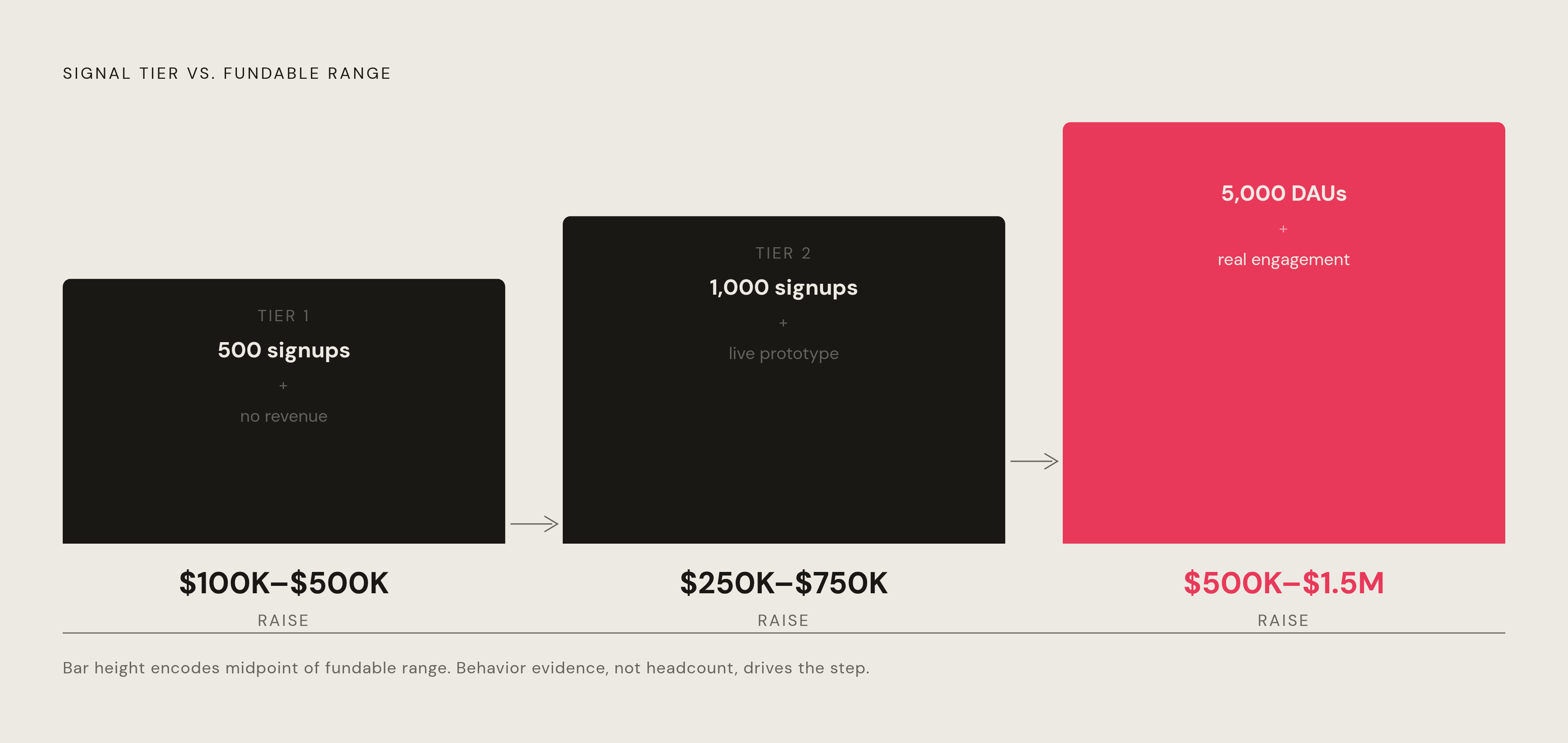
- 500 waitlist signups with no revenue tends to support a raise in the $100K to $500K range.
- 1,000 signups paired with a live prototype tends to support $250K to $750K.
- 5,000 daily active users with real engagement tends to support $500K to $1.5M.
Notice the pattern. It's never the headcount alone doing the work, it's headcount plus proof of behavior. That's why the target for a meaningful pre-launch list is a modest 100 to 1,000 range, and the word doing the heavy lifting there is "engaged."" A list of 300 people who open every email and answer a one-question survey beats a list of 3,000 people who signed up from a paid ad and then went dark. The second group isn't a list. It's a graveyard with good posture.
Sending monthly investor updates before there's even a product to update on might sound premature, but it's really just rehearsal. The habit of communicating traction clearly, on a schedule, is the same habit that unlocks warm intros later. And the posture among investors has shifted anyway: the quality-of-revenue audit has become a standard part of early conversations, with fundability carrying more weight than raw growth signals.
ICP clarity before list building, and why targeting the wrong audience compounds fast
Collecting any email from anyone who'll give one out feels like progress. It's the startup equivalent of eating cereal for dinner: technically food, technically forward motion, still going to leave you hungry an hour later.
A diffuse list costs more than it looks like it costs. Messaging fragments because you're writing to five different buyers at once. CAC balloons the moment you try to convert, because the list was never actually your customer to begin with. And when an investor asks who's on the list, "everyone" is not an answer that survives a follow-up question.
At seed to Series A, the guidance is blunt: pick one ICP. Spreading across two or three before validating even one is a classic go-to-market mistake, and it dilutes both the messaging and the product roadmap at the exact moment focus matters most.
ICP and buyer persona get used interchangeably and shouldn't be. ICP is the company: the size, industry, growth stage, and buying triggers that predict who spends the most and sticks around the longest. Buyer persona is the human inside that company: the title, the motivation, the objection they'll raise in a sales call. Pre-launch list building needs both, because ICP tells you where to show up, and persona tells you what to say once you're there.
A sharp ICP sounds like this: "Series A SaaS companies, 20 to 75 employees, hiring their first dedicated ops hire in the next two quarters." A fuzzy one sounds like "startups that need better operations." One of those lets you pick a Slack community and write a headline. The other leaves you guessing. Before touching any list-building tactic, a founder should be able to answer one question without hedging: who exactly is this subscriber, and what does their signup confirm or deny about the ICP hypothesis?
The pre-launch landing page as a conversion instrument
A one-page site is the minimum viable surface here, and that's not a euphemism for "cut corners." Headline, value proposition, email field. Mailsoftly's guidance says that's genuinely all it takes to start collecting signals.
The page does two jobs at once, and founders tend to only notice one of them. It captures the email, sure. But it's also testing whether the positioning lands. A low conversion rate isn't just a marketing headache, it's product-market fit feedback showing up early and for free.
A few structural pieces matter more than the rest:
Headline: lead with the outcome the buyer wants, not a list of features. Nobody signs up for "automated workflow orchestration." They sign up for "stop chasing approvals in six different Slack channels." Value proposition: specific enough that the right visitor nods and the wrong visitor bounces. Vagueness doesn't win more signups, it wins the wrong ones. CTA copy: per Brevo's guidance, "Get Early Access" tends to beat "Subscribe," because it implies scarcity and a payoff, while "Subscribe" implies a newsletter nobody asked to join. Incentive: early access, founding-member pricing, or a lead magnet, something that makes the micro-commitment feel worth the click.
Deliverability is the unglamorous plumbing behind all of this, and it's easy to skip until it bites. SPF, DKIM, and DMARC need to be set up before the first confirmation email goes out. A signup that never confirms because it landed in spam undoes all the trust the landing page just built, which is a strange way to lose a customer: not because they said no, but because their email provider said so first.
A/B testing headlines against different traffic sources is free research, and it beats guessing every time. Send one framing to a LinkedIn post and another to a Slack community, and the gap between conversion rates tells you which ICP framing is actually landing. And a dedicated landing page has a second life beyond the initial visit: it's the URL that gets dropped into a podcast appearance or a community thread, easier to track and easier to reference than a generic homepage link that dumps traffic into the void.
Lead magnets that earn B2B signups, and what works for buyers with budget authority
No incentive, no list. Brevo notes that every list-building tactic that actually works starts with something the customer values, and a weak lead magnet just means no lead generation, full stop.
Buyers with budget authority aren't trading their inbox for novelty. They've seen a hundred "free guide" popups and ignored ninety-eight of them. What earns the click is a real professional pain point solved in a way that respects their time.
A few formats do this well in B2B pre-launch contexts:
Checklists and frameworks: cheap to produce, immediately usable, and they position the founder as someone who's actually done the work, not just theorized about it. An audit checklist for the exact problem the product solves is the clearest example. Whitepapers or original research: even something modest, like ten to twenty synthesized customer interviews, counts as original research pre-launch and signals the founder is thinking at the category level, not just the product level. Templates: save the buyer time on something they already do weekly. High perceived value, low production cost, and it maps directly onto the product's use case. Webinars or live Q&As: gives the founder a room full of prospects to talk to directly, which doubles as ICP research disguised as content marketing. Assessments or diagnostics: personalized output drives engagement way up, and the responses double as raw material for sharpening positioning later.
The lead magnet needs to connect directly to what the product does. If someone downloads the checklist and can't draw a line to the eventual product, the download collected the wrong person, full stop. For B2B pre-launch, top-of-funnel visitors generally respond better to something educational than to a discount, which means the magnet should teach, not just give away a coupon nobody asked for.
The magnet should be so specific to the ICP that a non-ICP visitor wouldn't bother downloading it. Specificity isn't a nice-to-have here. It's doing the qualifying work that a sales call would otherwise have to do later.
Where to find your first subscribers when you have no traffic
Zero traffic isn't zero opportunity, it's just a forcing function toward channels that don't require a budget.
Community participation is the obvious starting point: LinkedIn threads, Slack groups, Discord servers, Reddit, and niche industry forums where the ICP already spends time. Show up as a practitioner sharing something useful, not as a founder with a pitch deck disguised as a comment.
A single LinkedIn post that names the problem the product solves, without mentioning the product at all, is a legitimate list-building move. The CTA in that post isn't "buy my thing," it's "here's a checklist if this resonates." Podcast and newsletter guest appearances work the same way: a dedicated landing page URL dropped into a niche podcast episode tends to convert well, because the audience showed up already self-selected. That's exactly what a well-targeted landing page is built for.
Cold outreach still works, but the pitch matters. Offering the lead magnet instead of a demo lowers the friction dramatically and filters for people with genuine interest instead of polite curiosity.
Referral loops should be built into the confirmation flow from day one. Mailsoftly's guidance explains that referral-driven waitlists grow without any paid spend, because each subscriber gets a shareable link and an incentive to use it. Dropbox ran a well-known referral program where referrers and their friends both earned extra storage, 500 MB per referral, demonstrating how mutual incentives can drive organic list growth. For B2B, the incentive isn't free storage, it's early access, founding-member pricing, or a bump up the waitlist, whatever makes "I told a colleague" feel worth the thirty seconds it took.
Co-marketing with an adjacent, non-competing product is underused. Swap newsletter placements, or co-host a webinar with a startup serving the same ICP from a different angle. Both lists grow, and both founders get exposure to an audience they didn't have to build from scratch.
Exit-intent popups on any published content are also worth setting up. Exit-intent popups are widely used to recover a share of otherwise-lost visitors, and the same mechanic works on a blog post or resource page just as well.
None of this requires a budget beyond founder time and some lightweight tooling. At pre-seed, GTM software spend typically stays under $2K a month, which means these organic, community-first channels aren't a compromise, they're the correct starting point regardless of what the bank balance looks like.
The confirmation and welcome sequence that converts a subscriber into a qualified prospect
The welcome sequence is probably the single highest-leverage piece of automation a pre-launch startup builds, mostly because it runs without anyone lifting a finger, and it fires exactly when attention is at its peak.
The numbers back this up in a way that's hard to argue with. Automated sequences consistently outperform manual broadcasts across opens, clicks, and conversions, which means the confirmation email can't be something a founder gets to eventually. Speed-to-contact matters: the confirmation email can't be something a founder gets to eventually. It has to fire immediately, and it has to speak directly to whatever the person actually signed up for.
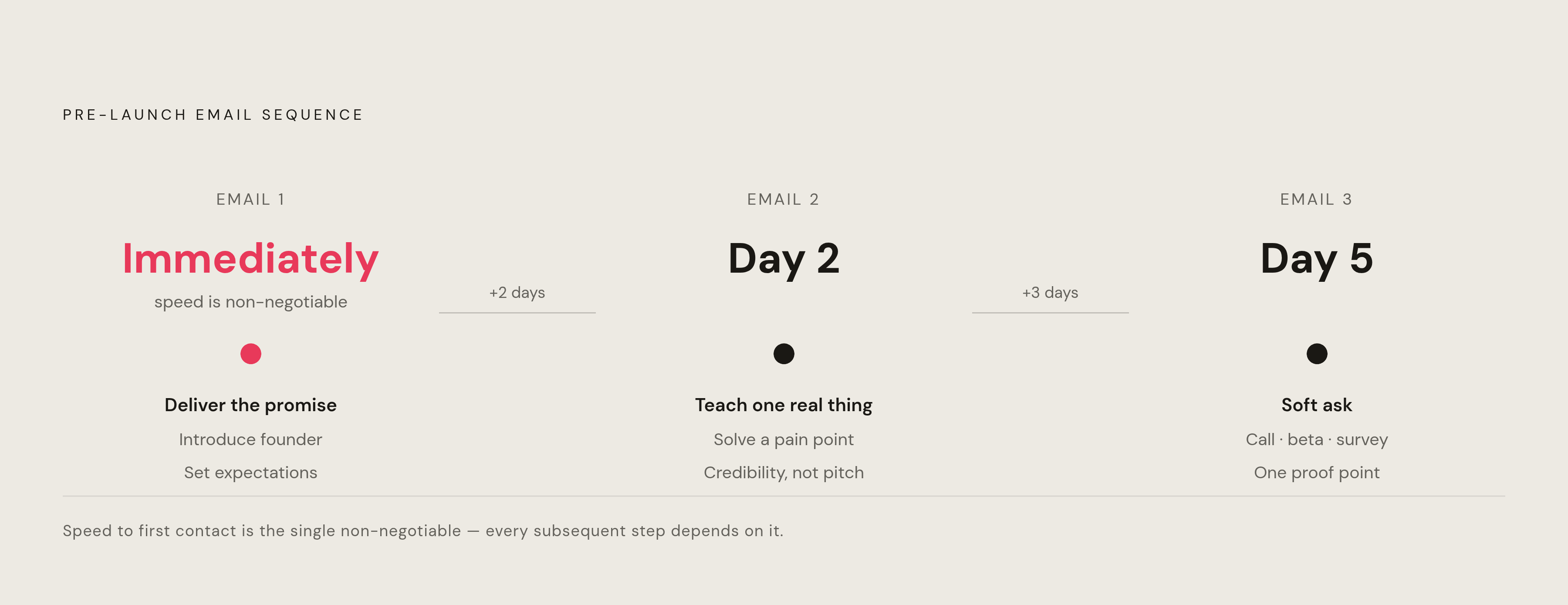
Mailsoftly's guidance lays out a structure that works: three emails:
Email 1, immediately: deliver on the promise, introduce the founder by name, and set expectations for what's coming and how often. Email 2, day 2: teach one real thing that solves a pain point. This builds credibility through usefulness, not through a pitch about the product. Email 3, day 5: a soft ask, maybe a discovery call, a beta application, or a short survey, ideally with one piece of social proof attached, even if that's a single customer quote.
Welcome emails as a category are widely documented to outperform standard campaigns by a significant margin on both open and click-through rates, which makes this sequence one of the few places in early-stage marketing where the effort-to-payoff ratio actually favors the founder.
Between Email 3 and launch day, two or three updates that treat subscribers like insiders (behind-the-scenes decisions, problems the team is wrestling with, early numbers) build the founding-member psychology that pays off in conversion once launch actually happens. Beyond that welcome arc, a structured nurture sequence continued over the weeks before launcho to four weeks, moving from education to proof to the ask, which gives the sequence a shape instead of a random drip.
One small habit pays off later: tag every subscriber by source, whether that's a community post, a lead magnet, or a referral, from the very first day. That tagging is what eventually reveals which channel brought in the buyers who actually mattered, instead of just the ones who clicked.
Metrics that turn a waitlist into a traction story, and what to measure and report
Revenue per email sent affects whether the list is actually producing pipeline, and the research shows it's a better indicator of that than open rate. Open rates feel good to report. They also hide a lot of rot underneath if nothing downstream is converting.
A handful of metrics actually count as evidence of demand rather than just evidence of activity:
Opt-in rate on the landing page: a low rate is feedback about positioning or traffic source, not a marketing failure to shrug off. Open rate on confirmation and welcome emails: per Brevo's benchmark across more than 175,000 senders, automation emails average a 30.63% open rate against 20.73% for standard campaigns, so that's the number to measure against. Reply rate: the strongest signal on this whole list. A reply means someone stopped scrolling and typed something back. Referral rate: what share of the list shares the link with someone else? Organic compounding inside the list is exactly what investors want to see. Survey response rate: measures engagement depth, not just whether an email got opened. Conversion to demo or beta request: the number that actually tells an investor whether interest is turning into pipeline.
What not to lead with: raw headcount with no context behind it, open rates with no conversion rates sitting next to them, or a list built entirely on paid acquisition with zero organic growth to point to. Any one of those, on its own, reads as a number chosen because it was the biggest one available.
The stronger frame sounds something like this: "400 subscribers, with a majority from organic community participation and a meaningful share from referrals, no paid acquisition run yet." That sentence does more work than a headcount ever could, because it shows the list came from people who actually wanted in, not from an ad budget that bought attention and called it demand.