Email Deliverability Best Practices for Startup Senders
Compliance failures now trigger permanent rejections from Gmail and Outlook.
Deliverability is an infrastructure problem. Most startup founders don't learn this until the pipeline goes quiet and nobody can explain why the same emails that used to work suddenly don't. A server accepting your message isn't the same thing as a human seeing it, and that gap between "delivered" and "actually landed somewhere a person checks" is where most seed-stage sending programs quietly bleed out.
Unspam.email's 2025 corpus analysis, run across millions of test messages, found only 60% of sent emails reached a visible mailbox location, and that's the baseline, not the worst case. Compliant senders average an 89% inbox rate, and non-compliant ones see 22% to 34% of mail routed straight to spam. Compliant senders average an 89% inbox rate. Non-compliant ones see 22% to 34% of mail routed straight to spam, and with 376 billion emails moving through the system daily in 2025, inbox providers filter at a scale that has zero patience for a new domain with no track record. For a founder doing founder-led sales off a list of a few hundred prospects, every email swallowed by a filter is a conversation that never happens. Low volume means each message carries more weight, and sloppy setup doesn't get forgiven at that scale.
What the 2026 compliance floor requires (and what happens when you miss it)
Google and Yahoo drew the line first, announcing bulk sender requirements in October 2023. Gmail started enforcing them in February 2024 with soft deferrals (the 421 error, basically "try again later" from Google's servers). By November 2025, the softness is gone. Non-compliant mail now gets hit with permanent 550 rejections, replacing the earlier temporary deferral phase.
Microsoft followed in May 2025. Starting May 5, Outlook.com, Hotmail.com, and Live.com began routing non-compliant bulk mail to Junk, with rejection as a subsequent enforcement phase. Microsoft's rollout moved non-compliant senders toward increasingly strict handling over time. Apple's iCloud Mail hasn't announced its own rules yet, but expect it to fall in line sometime across 2026 and 2027. Every major inbox provider is walking the same direction: authenticate, or get bounced.
The threshold that triggers all this is 5,000 or more messages a day to personal Gmail or Yahoo addresses. Crossing it once, even by accident during a big campaign push, makes the compliance rules apply to that domain permanently. There's no opting back out.
The floor itself comes down to five things: SPF, DKIM, and DMARC configured with DMARC actually enforced (not sitting in monitor mode forever), one-click unsubscribe under RFC 8058 honored within two business days, spam complaints under 0.1% as a working target with 0.30% as the hard ceiling, valid forward and reverse DNS (PTR) records resolving back to the sending hostname, and TLS on the SMTP connection.
Roughly 30% of bulk senders are still failing at least one of these. That's not a fringe group of stragglers, that's close to a third of everyone sending mail at volume. And passing compliance doesn't guarantee a good outcome on its own: Gmail's inbox placement for compliant senders runs around 87%, while Microsoft sits closer to 75.6% industry-wide. Microsoft is just a harder inbox to land in, and skipping compliance there makes an already tough number worse.
Google also retired the old Postmaster Tools interface in October 2025. The replacement, Postmaster Tools v2, drops the old Domain Reputation and IP Reputation dashboards for a binary read: Compliance Status, Pass or Fail, based on authentication, unsubscribe handling, and spam rate. A Fail means the domain risks permanent SMTP rejection. Checking that tab once a week is cheap insurance against a problem that's expensive to fix after the fact.
Configuring SPF, DKIM, and DMARC without breaking your sending setup
SPF is a TXT record in your DNS listing every server allowed to send mail on your domain's behalf. The trap is the lookup limit: SPF allows a maximum of 10 DNS lookups, and going over it fails SPF across the board, even for a sending IP that's correctly listed. Adding a new email tool without checking that count is how founders quietly break their own authentication and never notice until deliverability craters.
DKIM works differently. It stamps a cryptographic signature onto every outgoing message, tying it to your domain. Use RSA keys at 2048-bit or longer, rotate them on a schedule, and make sure the signature covers the From: header specifically, since that's the field spammers spoof most often.
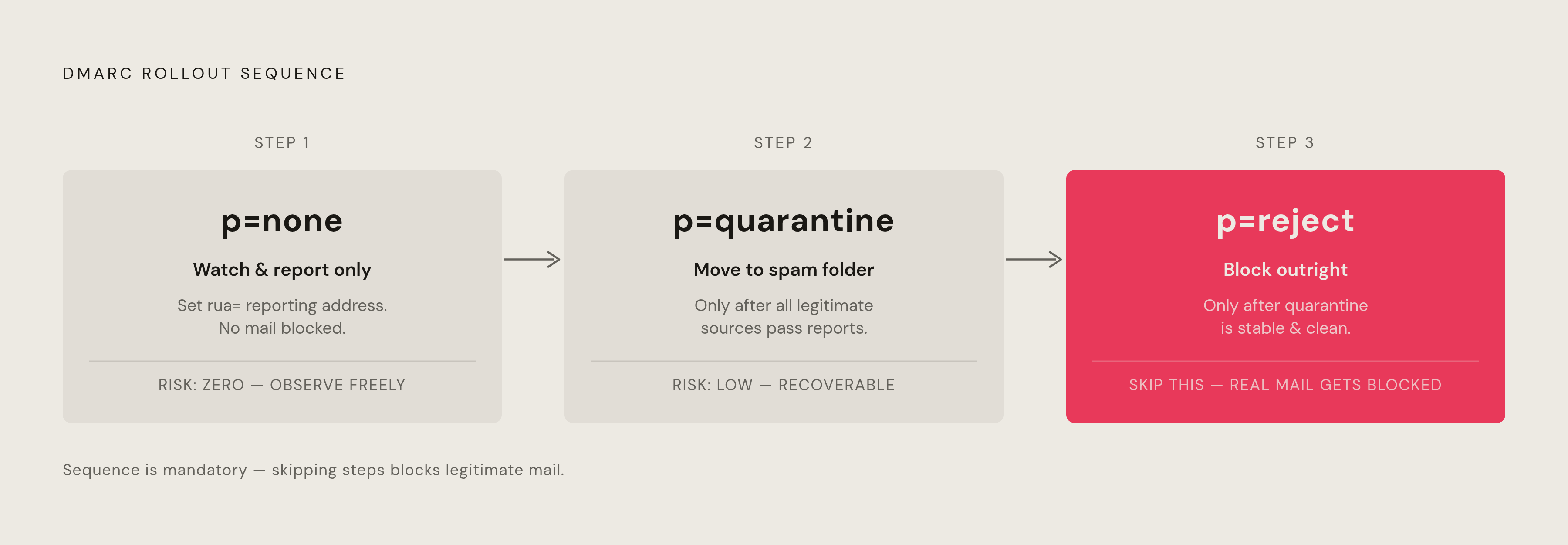
DMARC sits on top of both and tells receiving servers what to do when a message fails SPF or DKIM. A message passes DMARC if it clears at least one of the two protocols and the domain lines up (alignment, in the jargon). The rollout order matters more than anything else in this section: start at p=none with a rua reporting address. That setting only watches and reports, so it lets you see who's actually sending on your behalf before you block anything. Once every legitimate source passes, move to p=quarantine. Only after that's stable should the domain move to p=reject. Jumping straight to reject before confirming every sending source authenticates properly blocks real mail, including the emails a founder is trying to send in the first place.
Authentication alone doesn't save a sender. Unspam.email's analysis found fully authenticated mail still landed in spam more than 30% of the time. SPF, DKIM, and DMARC prove a message is who it says it is. SPF, DKIM, and DMARC prove a message is who it says it is, but they don't tell a filter whether the recipient wants the email; that gap is a reputation and engagement problem, not an SPF problem.
BIMI, a small brand logo that shows next to the sender name in the inbox, is worth setting up once DMARC sits at quarantine or reject. Senders using BIMI logos report open rates up to 39% higher. It needs a certificate, either a VMC (requires a registered trademark, supported by Gmail, Yahoo, and Apple Mail) or a CMC (no trademark needed, works for Gmail).
Register the domain at postmaster.google.com before sending a single message. It's free, and it gives real-time visibility into domain reputation, spam rate, and authentication status inside Gmail. DNS fixes take effect within hours of publishing, and of everything in this piece, fixing broken SPF or DKIM is the fastest win on the table for a struggling sender.
Why new domains need a warming period
A brand-new domain blasting out high volume on day one looks, to an inbox provider's filters, indistinguishable from a spammer standing up fresh infrastructure. No history means no trust, and providers are built to default to suspicion.
Domain reputation and IP reputation get scored separately but read together. A new domain on a new IP is two unknowns stacked on top of each other, and a strong existing domain reputation doesn't excuse a new sending IP from needing its own runway.
Heading into 2026, a newer wrinkle called the "Reputation Portfolio" model has every linked asset in an email, tracking domains, image hosts, redirect links, feeding into one combined trust score. A sloppy redirect URL or a shady image host drags down placement even when the sending domain itself looks clean.
Warming works like this: start small, ramp volume gradually over 4 to 6 weeks, and send first to the people most likely to open and click. Watch bounce and complaint rates the whole time, since either one spiking is a signal to slow down, not push through harder. If reputation does take a hit, recovery typically runs 4 to 12 weeks of clean sending: low complaints, real engagement, no shortcuts.
Volume isn't the only lever. Frequency and engagement quality both shape how a provider reads a new sender, so a smaller number of emails a day to people who actually open and reply beats a much bigger number sent into the void.
For B2B outreach, a few platforms ship with warmup built in, including Instantly, Mailforge, and Reply.io, each with its own monitoring layer for tracking the ramp. Founders can run a standalone warmup tool or use whatever's native to their sending platform. Either way, one rule holds: send cold outreach from a separate domain, not the company's main one. If the outreach domain gets blacklisted down the line, the core business domain stays untouched.
List hygiene as a deliverability input, not a cleanup task
Contact lists rot. Industry research puts natural database decay at 20% to 25% a year, driven by job changes, abandoned inboxes, and accounts nobody checks anymore. A list that was spotless at launch is a liability twelve months later if nobody's maintaining it, and most founders treat list hygiene as a one-time chore instead of an ongoing input.
Sending to bad addresses raises hard bounce rates and drags down the reputation score inbox providers use to decide where your next email lands. Stay under a 2% hard bounce rate and a 0.5% unsubscribe rate. Crossing either one reads to a filter as a list nobody's managing.
A few habits keep a list healthy on an ongoing basis, rather than clean once at signup. Suppress contacts who haven't opened anything in 90 or more days, and only after a genuine re-engagement attempt has failed. Build a sunset policy: a defined rule for when disengaged contacts get pulled from active sends instead of sitting there dragging down engagement forever. Treat bounce, complaint, and unsubscribe numbers as a running health check. Use confirmed opt-in on signup forms so fake or mistyped addresses never make it into the funnel. Use confirmed opt-in, so every address on the list belongs to someone who actually asked to be there.
Most B2B cold outreach underperforms because of generic messaging paired with bad data. Tighter targeting on an ideal customer profile produces stronger engagement signals, and those signals build domain reputation faster than volume ever will. One rule has zero exceptions: never touch a purchased or scraped list. Inbox providers have no tolerance for it in 2026, and it's the fastest way to torch a new domain's reputation before it ever had a chance to build one.
The effect of sending behavior and sequence structure on spam rates in practice
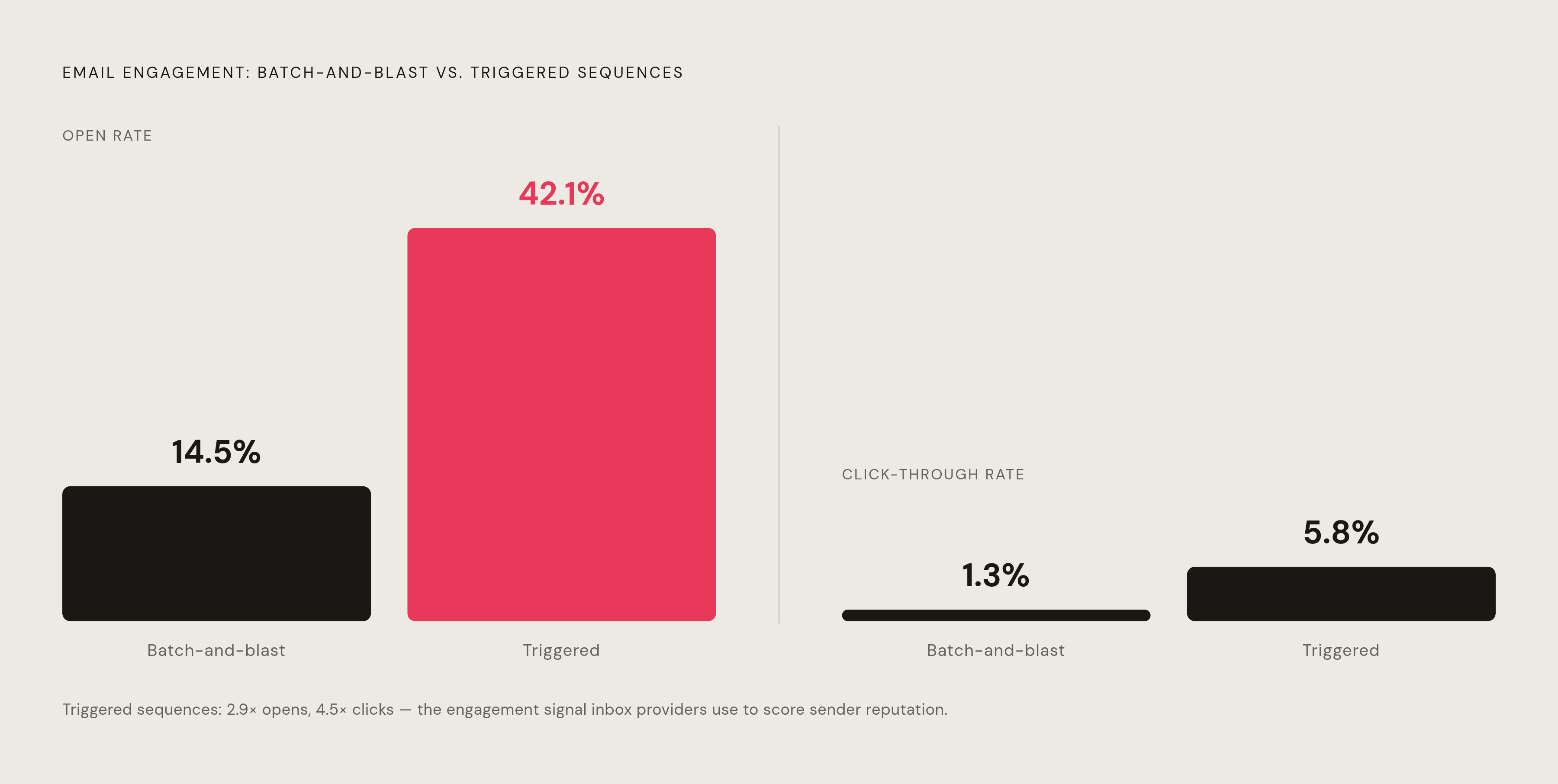
Batch-and-blast sending averages a 14.5% open rate and a 1.3% click-through rate. Automated sequences, triggered by what a subscriber actually does, average 42.1% open and 5.8% click-through. The gap between a program that works and one that doesn't appears directly in the engagement data providers use to score reputation.
Sequence length matters too. Follow-up emails in a sequence capture 42% of all replies, making sequence length a meaningful lever in outreach programs. The remaining 58% of replies come from the very first email, so that opening message earns the sharpest targeting and the most time spent on personalization.
One structure recurs repeatedly in the data. A typical multi-touch sequence might alternate email, phone, and social touches across two to three weeks, spacing contacts to avoid overwhelming a prospect while maintaining momentum. On high-value accounts, pairing cold email with other outreach channels can help establish some familiarity before the email arrives.
For broader B2B nurture sequences, typical benchmarks run around 25% to 35% open rate, 3% to 8% click rate, and 12% to 20% click-to-open. The number that actually matters past those benchmarks is how many leads ultimately progress toward a sales conversation.
Spam rate moves with every send, so it's not a number that sits still once measured. Every recipient who hits "report spam" pushes the domain closer to that 0.30% ceiling, and on a small list, a handful of complaints moves that number fast. Making unsubscribe painless isn't a compliance nicety, it's a deliverability strategy on its own: someone who unsubscribes does nothing to the spam rate. Someone who hits "report spam" instead, because the unsubscribe link was buried three menus deep, does real damage.
Reply rates give a useful gut check on program health. Anything at 5% or above counts as good for B2B cold email, with top performers clearing 10%. The industry average is 3.43%. Belkins' 2024 analysis of 16.5 million cold emails found average reply rates sliding from 6.8% down to 5.8% year over year, which says the same thing from a different angle: more volume produces diminishing returns, and precision beats brute force every time.
Where AI-powered workflows fit into a deliverability-conscious email program
AI's real job in a deliverability-conscious program is raising engagement signals, the behavioral data inbox providers weight right alongside authentication status. Better engagement protects the reputation a domain spent weeks building during warmup, and that's the only lens worth judging an AI tool through.
AI-optimized campaigns consistently show higher engagement metrics than generic batch sends, and engagement gains are deliverability gains wearing a different hat.
Industry data has found signal-personalized emails pulling an 18% reply rate against 3.43% for generic outreach. For a sender running a small list that's still warming up, a gap that size means a domain builds trust fast or stalls out.
None of this replaces the infrastructure covered earlier. AI personalization multiplies a setup that already works, it doesn't fix one that's broken. A beautifully personalized email sent from a domain with broken DMARC still bounces. Authentication and sequencing come first, every time, no exceptions.
Sequenzy's AI sequence builder generates multi-email sequences, timing, subject lines, and body copy from a plain description of a campaign goal, pulling brand context from the company's own website during setup. ActiveCampaign offers a broader automation builder with conditional logic, split paths, wait steps, goal-based exits, and native CRM handoff through webhooks.
For a two-person founding team, this means something concrete: small companies can now run segmented, personalized sequences that produce engagement signals competitive with much bigger sales orgs. Inbox providers score behavior, not headcount. They have no way of knowing whether an email came from a twenty-person sales floor or a founder typing at midnight. AI output still needs a human checking tone and positioning, though, especially in cold B2B outreach, where copy that reads generic erodes the exact personalization signal that moved the engagement numbers in the first place.
A startup deliverability checklist organized by the order things break
Three phases here: pre-send setup that happens once, at-send hygiene that happens every campaign, and ongoing discipline that never really ends.
Pre-send, infrastructure and authentication:
- Register the primary domain and the cold-outreach domain separately
- Publish a valid SPF record (under 10 lookups), a DKIM signature (RSA 2048-bit minimum), and DMARC starting at
p=nonewith aruaaddress, moving top=quarantineand thenp=rejectonly once every sending source passes - Set up valid PTR (reverse DNS) records for every sending IP
- Turn on TLS across all SMTP connections
- Register the sending domain at postmaster.google.com before the first campaign goes out
- Start the warmup at small volume, ramped over 4 to 6 weeks, most-engaged contacts first
At-send, list and content hygiene:
- Check list quality before every campaign, no purchased or scraped contacts, ever
- Include a one-click unsubscribe header (RFC 8058) on all marketing mail, and process opt-outs within two business days
- Keep hard bounces under 2% and unsubscribes under 0.5%
- Hold spam complaints at or below 0.1% as a working target, treat 0.30% as an absolute ceiling and never a target to approach
A domain that fails authentication never gets a fair shot at the inbox, so a botched pre-send phase undermines everything downstream. Get the at-send phase wrong and the damage compounds slowly, one bounce and one complaint at a time, until a founder is staring at open rates half what they used to be, wondering what changed. Usually nothing changed. Nobody was watching the numbers that predicted it.