Fractional CMO vs Marketing Agency
Strategy before execution: why most founders hire the wrong marketing help.

A fractional CMO is a senior marketing person working part-time, usually two or three days a week, on retainer. Think architect, not the crew swinging hammers, since the job is the blueprint: who you're selling to, what you say to them, which channels are actually worth showing up on, and how you'll know if any of it worked.
Somebody still has to write the blog posts, launch the campaigns, build the email flows, and that somebody is almost never the fractional CMO. I've watched founders sign that contract expecting a marketing department and get, instead, a very sharp person with strong opinions and a Google Doc.
Here's where it goes sideways: hire a fractional CMO without a team already in place, and your execution problem hasn't moved an inch. You've added a smart person telling you what to build while you're still the one hunting freelancers and babysitting three contractors who all bill differently. The coordination burden doesn't disappear; it just gets a nicer strategy stapled on top of it.
So the model actually works in two situations, and really only two. Either you've already got people who can build things and just need someone senior pointing the ship, or you genuinely don't know what to build yet and need to figure that out before you torch another dollar on execution. Fractional leadership has gone from a niche line item to something every founder's heard of in the last few years, and that growth tells you the market trusts the model. Whether the execution gap closed is a separate question, and often it hasn't.
What a marketing agency actually does and does not do
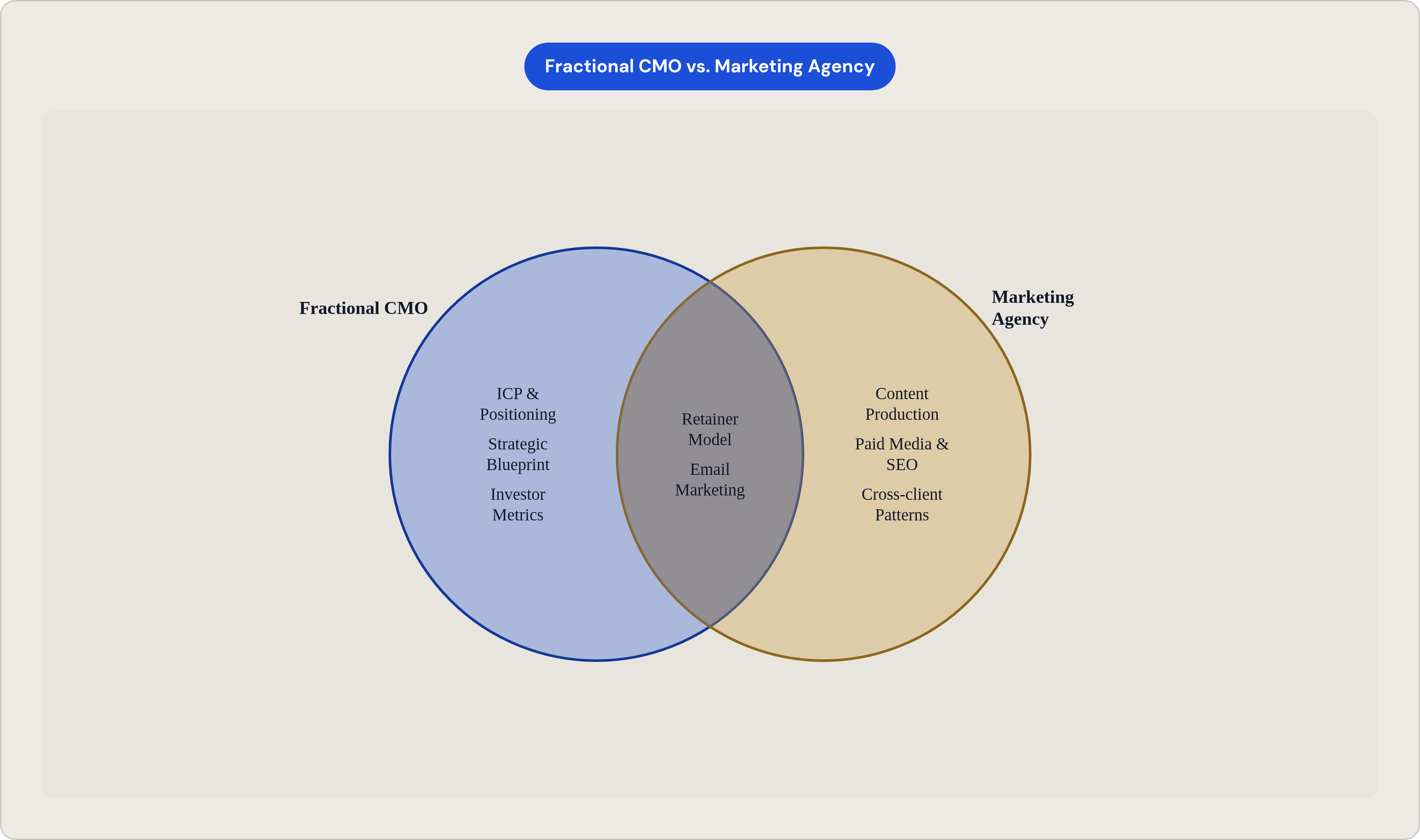
An agency sells throughput: content calendars, paid media, SEO, email, run by a team that's done this exact motion for a dozen other clients. That repetition is worth something real, since a decent agency has watched enough campaigns die across enough companies to smell a bad one coming before it launches.
Strategy is where they hit a wall. Most agencies work off a brief, and they rarely build your ideal customer profile from scratch or set your positioning or design the kind of metrics reporting an investor would sit still for. They optimize whatever you hand them. Hand them something vague, and they will competently, cheerfully, and expensively execute the vague version, on schedule, invoice attached.
Content is where agencies earn their fee most honestly. It's a primary reason companies bring in outside marketing help — nearly half of companies outsource content marketing to agencies or third parties, according to Forbes Advisor — and that's not an accident, since it's a lane they've genuinely mastered.
There's a cost worth knowing before you sign, though. The first three to six months of most agency engagements crawl, because you're paying full retainer while they learn your product, your market, your weird internal shorthand for things. Output during that window trails what the contract promised, and add tool markups, scope creep, and the hours you'll spend just managing the relationship, and the real price tag runs well past the number on the quote.
The costs founders actually pay, and what those costs buy
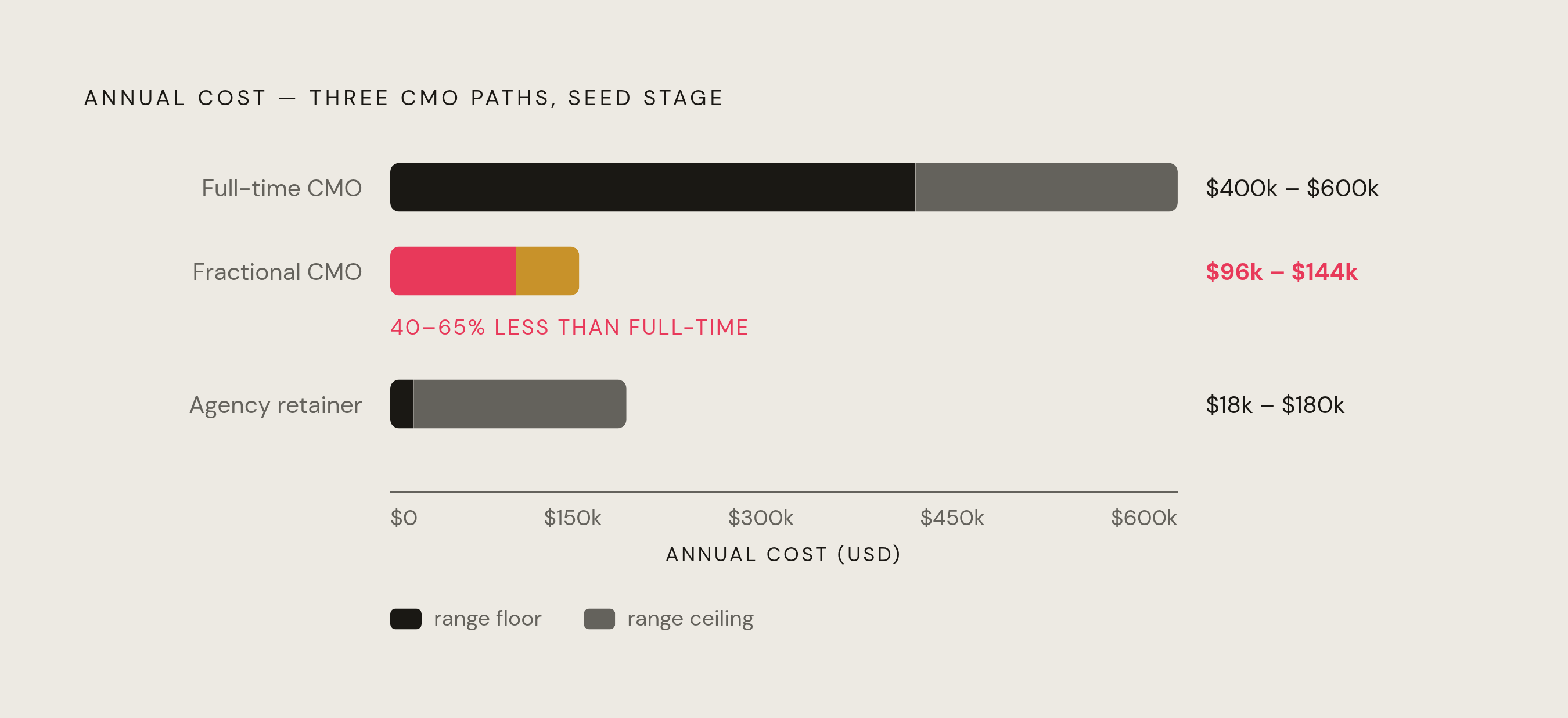
Start with the number that scares seed-stage founders straight. A full-time CMO in 2025 runs somewhere between $245,000 and $550,000 in base salary alone, and total comp often lands between $400,000 and $600,000 once benefits and equity get folded in. For nearly every seed-stage company, that's a hard number to justify against the stage of the business.
Fractional pricing looks nothing like that, with typical retainers running $5,000 to $15,000 a month and most deals landing between $8,000 and $12,000. Very early companies sometimes get 10 to 20 hours a month for $3,000 to $6,000, which annualizes to roughly $96,000 to $144,000, somewhere around 40 to 65 percent cheaper than the full-time hire. What you're buying there is direction rather than hands on keyboards, and that distinction matters more than founders give it credit for.
Agencies split into tiers. Small specialized shops run $1,500 to $3,500 a month, while full-service retainers covering SEO, content, paid, and reporting land between $5,000 and $15,000. Enterprise-grade shops start north of $15,000, and at that price you'd hope somebody's answering the phone on weekends. The retainer buys execution inside whatever strategic frame you've handed it, good or bad, and it will not tell you which one you gave it.
Compare either path to a single full-time marketing hire (typically well into the six figures fully loaded, covering exactly one discipline) and the math tilts fast toward fractional or agency models, since both buy broader coverage for similar or lower spend. But the real question was never the monthly number. It's which dollar moves the metrics that matter at your stage, and that's a much harder thing to shop for on price alone. Worth sitting with this: companies using fractional CMOs or hybrid models well report faster strategy execution and stronger campaign returns than companies leaning purely on agencies. Used well is carrying a lot of weight in that sentence, and most founders skim right past it.
Where most seed-stage founders actually sit on the strategy-execution spectrum
Most founders at seed are doing founder-led sales against a customer profile that's more gut feeling than data, running a handful of disconnected tactics, and honestly unsure which channel, if any, is going to scale. That's just what seed stage looks like from the inside, and there's no shame in it.
Only about a third of seed-funded companies make it to Series A, and the gap between the two has stretched past 600 days on average now. Whatever marketing system gets built in that stretch either produces the evidence investors want or it doesn't, and there's no partial credit on this one.
The sequencing is where most of the real damage happens. Correct order: ICP, then positioning, then channels, then measurement. Most founders show up to hire an agency or a fractional CMO having skipped the first two steps entirely, jumping straight to "we need more content" or "we need a paid campaign." Hand an agency a vague brief and it will faithfully execute the vague brief, producing vague results right on time. A fractional CMO who inherits a broken foundation can fix it, sure, but only if fixing it was the job they were actually hired for.
Two questions cut through most of the fog. Do you know exactly who your buyer is, what keeps them up at night, and why they'd pick you over doing nothing at all? And do you have one channel that reliably produces qualified pipeline, or are you still guessing? Two no's means your problem is strategic, and stacking more execution on top just produces louder noise, faster. Two yes's means your problem is capacity, and adding a strategist on top will slow you down instead of speeding you up. Most founders, if they're honest with themselves, land in that first camp more often than they'd like to admit.
When a fractional CMO is the right answer
The fractional CMO earns the retainer when the foundation is genuinely missing or genuinely broken. A few tells: your ICP is a demographic sketch (mid-market, 50 to 200 employees) instead of something built around an actual buying trigger. Your positioning lists features instead of the outcome a buyer actually cares about, and your channel mix reads like a list of things you tried rather than hypotheses you tested, with nobody tracking CAC, net revenue retention, or burn multiple as part of the daily marketing motion.
It's also the right call when you've already got execution muscle, a small internal team or contractors you trust, but nobody senior enough to point that team somewhere coherent.
The pattern shows up repeatedly in practice: a company with genuine execution capacity but no senior strategic voice brings in fractional go-to-market leadership to sharpen the commercial story, and that clarity around positioning does the work. Strategy is the point of that engagement, and content production comes later, as it should.
Watch for the coordination tax, though, because it's real and it's sneaky. Without execution capacity sitting behind the fractional CMO, you're still the one sourcing, briefing, and managing whoever actually builds the campaigns. Your total time on marketing might not drop at all; it just shifts from doing the work to managing the people doing the work, which some days feels worse. The engagements that actually land build a handoff plan from day one, strategy documented, metrics instrumented, playbooks written down, instead of an open-ended retainer with no finish line anywhere in sight.
When a marketing agency is the right answer
An agency earns its keep when the strategy's already solid: ICP defined, positioning sharp, at least one channel showing real early signs of working. In that world, the right agency scales what's already proven, working off hypotheses you've already tested rather than hunting around for what might work.
A few scenarios make the case obvious. You need a lot more content to capture search demand from a strategy you've already validated. You're running paid across three or four channels and need optimization bandwidth you don't have hours in the week for, or you need email nurture sequences with copy, sequencing logic, and platform management happening every week, on schedule, without you thinking about it.
The cross-client pattern recognition is genuinely valuable here, more than founders tend to credit. An agency that's run paid acquisition for ten B2B SaaS companies at your stage has seen failure modes and benchmarks a single strategist, however sharp, hasn't run into that many times, no matter how good they are.
The catch is brief-quality dependency, and it controls basically everything downstream. The clearer your input, the better the output, since agencies amplify direction rather than manufacture it out of thin air. For founders on a tight budget, a specialized shop running $1,500 to $3,500 a month is usually the most accessible entry point. That range typically buys strength in one channel though, not a full multi-channel engine, so keep expectations sized to the invoice.
Why neither option alone solves the seed-stage problem cleanly
A fractional CMO produces a strategy that sits on a shelf if nobody's around to build it. An agency produces a steady stream of outputs that don't add up to much without a strategy underneath them holding it together. Stack them together, fractional CMO directing an agency, and you get something that looks right on paper but adds a coordination layer and a translation step between strategy and execution. That's exactly where things start to drift.
A recent survey of founders and small business owners found only about 9 percent were currently using or actively planning to hire a fractional CMO, up from roughly 5 percent a couple years back. Growing, sure, but still a small slice of the market, and most founders are solving this some other way, often not particularly well.
What seed-stage founders actually need is one partner holding both the thinking and the doing in the same engagement, with no handoff, no brief written by an exhausted founder at 11pm, and no translation layer where meaning gets lost somewhere between the strategy deck and the campaign brief. Running a fractional CMO and a separate agency at once dumps the coordination cost straight onto the founder's calendar, and the founder is the one person in this whole arrangement with the least spare time to absorb it.
Fractional adoption keeps climbing anyway, with projections putting well over 40 percent of small and mid-size businesses using some form of it within a couple years. The market keeps drifting toward integrated strategy-and-execution setups precisely because the pure advisory version leaves a hole nobody wants to keep falling into.
The investor-metric dimension both models frequently miss
At seed stage, your marketing system has to generate something beyond leads. It has to generate the evidence a Series A investor will read as proof the business actually works. That's a different job than most marketing engagements are built to do, and almost nobody scopes for it upfront, which is a little wild when you think about it.
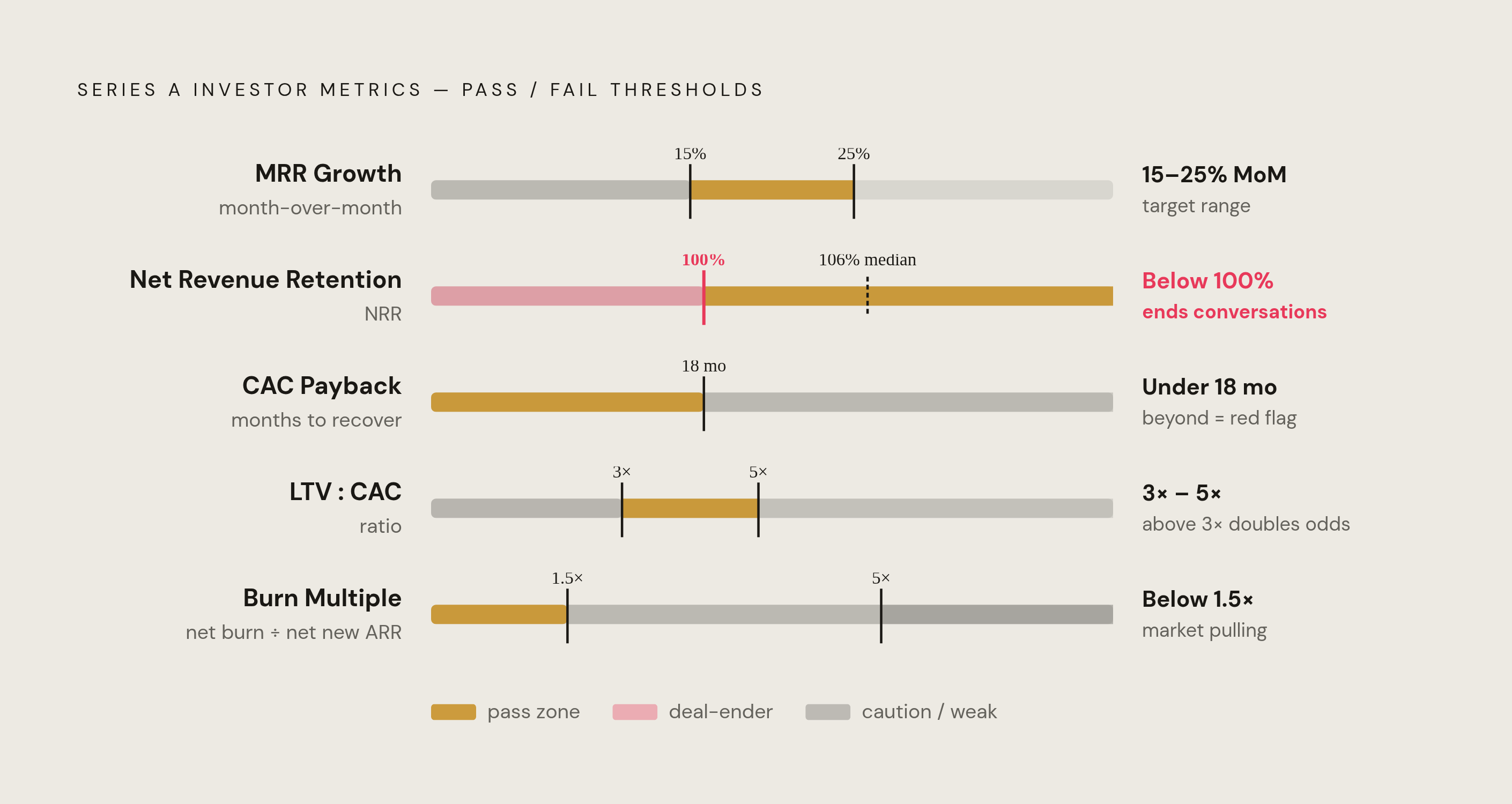
The numbers here are specific, and they don't bend for a good story, no matter how well you tell it. Monthly recurring revenue growth in the 15 to 25 percent range, month over month, is the rough bar at seed. Net revenue retention for venture-backed B2B SaaS sits around 106 percent at the median, per SaaS Capital's 2025 numbers, and dropping below 100 percent tends to end Series A conversations before they really start. CAC payback stretching past 18 months gets treated as a red flag no matter how fast you're otherwise growing. LTV to CAC above 3 to 1 roughly doubles your odds of landing venture funding, while anything past 5 to 1 can actually mean you're underinvesting in growth (yes, that's a real problem investors flag too). Burn multiple, cash burned against net new revenue, tells a similar story: below 1.5x, the market's pulling the product forward; above 5x, the founder's pushing uphill alone, and everyone can tell.
Most agency retainers get scoped around outputs: posts published, campaigns launched, impressions delivered. None of that maps cleanly to the Series A story. Most fractional CMO engagements get held to strategic milestones instead, not to building the metrics architecture an investor will actually read. A partner that wires CAC tracking, pipeline velocity, and MQL-to-customer conversion into the system from day one, instead of bolting on a dashboard six months before the fundraise, is addressing a gap that both standard models tend to leave open.
How a small number of integrated partners collapse the strategy-execution gap
Name the gap plainly: seed-stage founders need strategic direction and execution capacity in the same engagement, built around investor-grade metrics, at a price that fits a pre-Series A budget. Everything above has been circling that one problem, so let's just say it.
Some integrated partners are built around exactly that configuration. Instead of managing a client from a distance and lobbing decks over the wall, the team embeds into how the founder actually works, in Slack, inside the product roadmap, in the weekly rhythm of the company. That embedded setup removes the brief-translation problem outright, since strategy and execution sit with the same people, and a positioning decision flows straight into content, paid, and email without getting rewritten twice on the way there.
The scope covers the full engine, not one channel optimized in isolation while the rest of the system limps along behind it: positioning, SEO, content, email, paid acquisition, conversion work. Metrics get built in from the start instead of retrofitted before a fundraise, with CAC, pipeline velocity, and MQL-to-customer conversion instrumented as part of the engagement itself, not assembled in a panic three months before diligence starts.
Other integrated models exist, and founders looking at any of them should ask a couple of pointed questions before signing anything. Does this partner own both strategy and execution, or does the brief-writing land back on your desk anyway? Are they building toward the metrics a Series A investor will actually read, or just toward a bigger pile of output? The real benchmark worth judging any of these partners against is readiness for that Series A conversation, measured against actual marketing activity, not a glossy case study with a stock photo on the cover.
Applying the diagnostic to make the decision
The whole decision collapses into one question: do you have a proven engine that needs more fuel, or are you still building the engine?
If your ICP is fuzzy, your positioning reads like a features list, and no channel's proven itself yet, an agency will just execute your confusion faster and send you an invoice for the privilege. Fix the strategy first, fractional CMO or otherwise, before handing anyone a brief to work from.
If your strategy's already sound and at least one channel is showing signs of working, an agency's throughput is exactly what unlocks the next stage. Stacking a strategist on top of that just slows down a system that was already pointed the right way.
Most seed-stage founders sit somewhere in the middle, and the honest answer for that group is that neither model alone was built to solve the actual problem. What you need is a single partner who can hold the thinking and the doing at once, wired directly into the metrics that'll matter the day you sit across from a Series A investor. That's a narrower category than "agency" or "fractional CMO." Worth hunting for on its own terms, rather than forcing your company into whichever vendor happened to email you first this week.