Fractional Marketing Services vs Agency vs In-House Hire
Understand what each model actually owns before you pay for the wrong thing.

Founders pick their marketing model by asking "what can I afford?" That question has produced more wasted budgets than any other single decision at the seed stage, because affordability has little to do with what your business actually needs right now. The real question is what your marketing situation requires. Get that wrong, and you'll pay full price for the wrong thing.
What the three models actually deliver — and what they don't own
Here's the part nobody explains clearly enough: fractional CMOs, agencies, and in-house hires aren't three price points on the same product. They're three different products entirely.
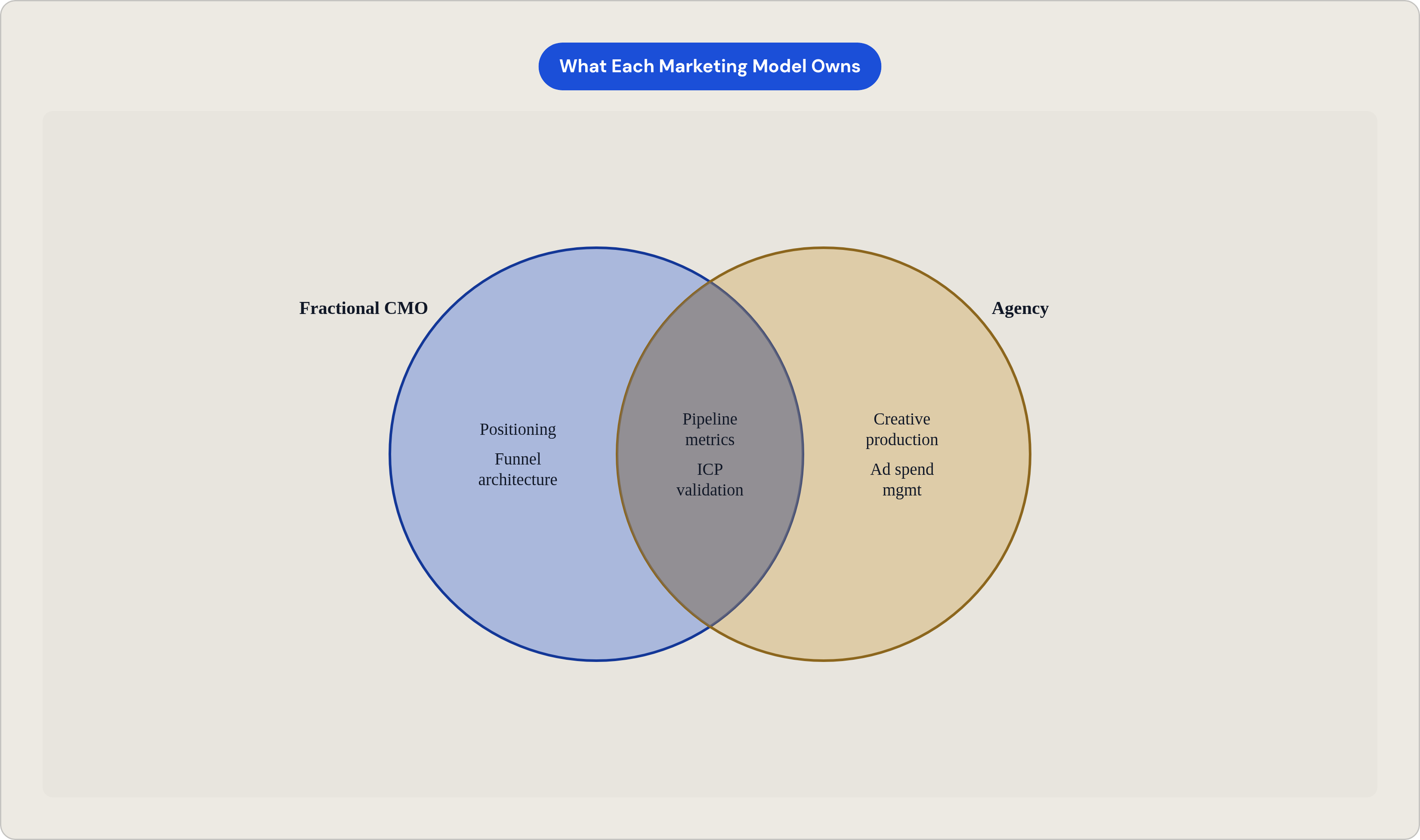
An agency owns execution. Campaigns, content, ad spend, creative production, that's their lane, and a good one runs it well. An agency generally does not own your revenue outcome; they won't sit across from your board and defend why marketing spend turned into pipeline (or didn't). That's just not the job.
A fractional CMO owns direction. Positioning, channel prioritization, how the funnel should be built, that's the value. But a fractional CMO typically shows up for a handful of days a month, and they don't execute. Strategy without someone to run it is, at the end of the day, a slide deck. A well-organized, thoughtful slide deck. Still a slide deck.
An in-house hire owns both, strategy and execution, full-time, accountable to revenue like any other core function. That's the appeal. But it comes with the longest ramp of any of the three models and, when it goes wrong, the most expensive mistake of the three.
The gap nobody talks about is what happens when you buy one of these without the pieces it assumes are already in place. Fractional CMO with no team underneath means strategy with nobody to run it. Agency with no strategy means execution racing in a direction nobody validated. In-house hire on an unproven engine means an expensive ramp built on ground that hasn't been tested. None of these are failures of the model. They're failures of matching the model to the moment.
So the real question was never "which is better." It's what does your situation actually call for, and which of these three is actually built to deliver that.
Why the fractional CMO model has grown so quickly — and what that growth obscures
The fractional executive world has exploded since 2020. Layoffs across tech pushed a lot of senior marketing talent out of full-time roles, budgets tightened everywhere, and portfolio-style consulting arrangements became the landing spot for a lot of that talent.
There's more to this growth than cost-cutting, though. Private equity firms went from rarely suggesting fractional executives to recommending them across the majority of their portfolio companies. That's a real shift in how growth-stage companies get staffed, one that looks likely to persist even as budgets loosen.
What gets lost in the growth is quality control. "Fractional CMO" has become a title anyone can put on a LinkedIn profile, and the range underneath that title is wide. Some are genuine senior strategists who've run marketing at scale. Others are content freelancers or generalist consultants who found a better label. The title tells you nothing about the person behind it.
And here's the sharper problem: the model only works when there's an execution layer for it to direct. The fastest-growing use case, a pre-Series A startup with zero marketing headcount hiring a fractional CMO, is also the case where the model fails most often. There's nobody there to catch the strategy and run with it.
The question every founder should ask before signing that retainer: what changes in the business ninety days from now? Documents, or pipeline?
The real cost of each model once you account for what it doesn't include
Sticker price lies. Every time.
An in-house CMO's base salary is significant on its own, and once you layer in benefits and equity, the total comp number climbs well past that. Then add the six to twelve months where they're ramping and results are, generously, minimal. That's a lot of runway spent before you see anything back.
A fractional CMO looks cheap by comparison, and the monthly retainer usually is lower than a full-time salary. But that number almost never includes execution. Founders find this out the hard way, usually around month two, when they realize they've paid for a strategy with nobody assigned to run it.
An agency retainer covers execution, full stop. But execution without direction can turn into a cost multiplier rather than a force multiplier. If you haven't nailed down your ICP or your positioning, you're paying good money to produce content and ads that might not touch pipeline at all. The machine runs. It just might be running in the wrong direction.
The honest cost comparison means adding back whatever's missing. Fractional CMO alone: tack on the cost of execution, whether that's freelancers, an agency, or your own time (which, by the way, is not free, even though founders love to pretend it is). Agency alone: tack on the cost of strategy, either your time or a separate strategist. In-house CMO: tack on the ramp period, the risk of a bad hire, and the opportunity cost of hiring before you've proven anything worth scaling.
The most expensive mistake at seed stage, hands down, is hiring an in-house CMO to build something that hasn't been validated yet. They walk in expecting to scale an engine. What they actually inherit is a discovery problem wearing an engine's clothes.
Where a fractional CMO is the right call — and where it isn't
Fractional CMOs earn their keep in a specific set of circumstances. Positioning is muddy and you need a senior operator to diagnose it, not a junior team cranking out content around a guess. There's already some execution capacity in place, even if it's just one or two people who can act on direction once it's given. Or you need investor-grade thinking on channel strategy before you can justify a full-time senior salary.
Where it falls apart: no execution team underneath, so the strategy sits there, unused. The founder needs someone showing up daily, coordinating across functions, not dropping in periodically with strategic input. Or, worst case, the fractional engagement is being used as a discount stand-in for the in-house hire the business genuinely needs.
The combination that actually works pre-Series A: fractional CMO sets the direction, a specialist execution partner, agency or contractors, runs it. Direction from one, delivery from the other.
Before signing anyone to a fractional engagement, ask yourself one question. Do you have anyone who can execute what this person produces? If the honest answer is no, you're buying a strategy you have no way to use.
Where an agency is the right call — and where it misfires
Agencies do their best work when the brief is already solid. ICP defined, positioning clear, agency executes against something real instead of guessing. They shine when you need volume or channel coverage beyond what any one person could pull off solo. And they're built to accelerate a motion that's already working, rather than to discover whether a motion works in the first place.
Where it goes sideways: positioning and ICP are still up in the air, so the agency produces plenty of output, and none of it connects to pipeline because the targeting underneath it was never right. Or the agency gets asked to own strategy and execution at once, and most agencies, however good, aren't built to do both simultaneously and do both well. Or the whole relationship runs on a retainer with no metric tied to it, so deliverables pile up while pipeline sits flat.
The version of the agency model that actually works at seed stage looks less like a vendor and more like a teammate. Embedded in your workflow, sitting in your Slack, knowing your product roadmap, accountable to specific pipeline numbers, iterating in real time instead of delivering a monthly report on a schedule. When you're evaluating an agency at this stage, skip the case studies and ask three things: are they in your Slack, do they actually understand your ICP, and are they accountable to demo requests and MQLs instead of blog posts and impressions.
When making an in-house hire is actually the right move
An in-house hire makes sense once the engine is proven. Channels are validated, ICP is sharp, and the job is scaling what already works, rather than discovering whether anything works. It also makes sense as you approach Series A and need someone who can own the investor narrative around marketing traction. And it makes sense once the coordination tax between a fractional layer and an execution agency starts costing you more than an internal owner would.
The failure mode is hiring an in-house CMO at seed stage to solve a strategy problem before there's a proven engine to hand them. They show up expecting to run something real. What they get instead is a discovery project, except the title and the salary suggest otherwise.
What that seed-stage in-house hire often ends up actually doing: propping up founder-led sales, building from zero with no playbook to work from, and burning months of runway on a ramp an outside specialist could have compressed into weeks.
The sequencing that works: external resources build and prove the engine first. The internal hire steps in to own and scale it. Reverse that order and you're paying full-time comp for part-time-worthy work.
How to locate yourself on the spectrum from no engine to proven engine
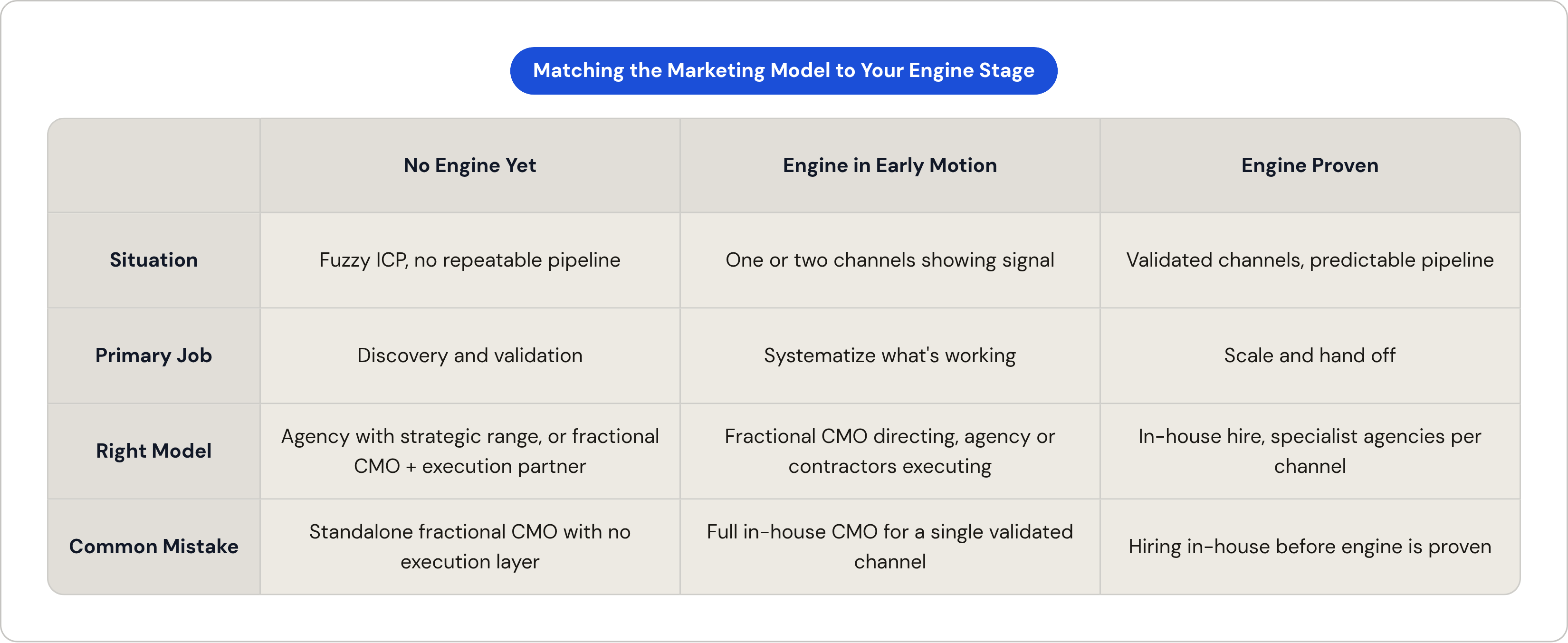
Three real positions exist here, and most founders can place themselves in one without much soul-searching.
No engine yet: ICP is fuzzy, positioning is unclear, no channel has produced repeatable pipeline. The job right now is discovery and validation, not scale. Anyone telling you to scale at this stage is selling you something you don't need yet.
Engine in early motion: ICP is defined, one or two channels are showing real signal, but execution is inconsistent and the founder is still the one driving it day to day. The job here is systematizing what's already working, not inventing something new.
Engine proven: channels are validated, CAC is understood, pipeline is predictable. The job is scale and handoff.
Match the model to the position. No engine yet calls for an agency with real strategic chops built in, or a fractional CMO paired tightly with an execution partner. A standalone fractional CMO with nobody to execute, or an in-house hire built on a foundation that hasn't been tested, tends to underdeliver here. Engine in early motion calls for a fractional CMO to direct and systematize, with an agency or contractors running execution. Engine proven calls for an in-house hire to own and scale, backed by specialist agencies on individual channels where it makes sense.
Before choosing anything, answer these honestly. Can you describe your ICP precisely enough that an agency could brief against it without you in the room? Do you actually have an execution layer, or would a strategist just be handing you plans nobody runs? Are you trying to discover what works, or scale what already does? Is the risk in front of you a strategy risk, or an execution risk?
What the model decision looks like in practice at the seed stage
Scenario A: Pre-PMF, founder-led sales, no marketing function at all. The founder is grinding through fifteen to twenty-five manual outbound touches a week, no content pipeline, no inbound, and an ICP based on gut feel rather than data. The right move is an embedded execution partner with real strategic range, someone who can validate the ICP, stand up the first content and channel infrastructure, and generate pipeline signal before Series A conversations start. A fractional CMO who hands over a positioning framework nobody executes, or a content agency brought in before anyone knows what message actually converts, tends to waste this stage.
Scenario B: Post-first-revenue, one channel showing signal, founder is the bottleneck. One or two channels are working, but the founder is the only person who can run them, and scaling means getting the founder out of the day-to-day. The right move is a fractional CMO to systematize and hand off what's working, paired with an execution agency or contractors to run the validated channel, while the founder shifts from doing the work to reviewing it. Hiring a full in-house CMO to own a single validated channel over-resources a problem that doesn't need it yet.
Scenario C: Series A approaching, pipeline is predictable, but there's no investor story built around it. Traction is real, CAC and pipeline velocity and MQL-to-customer conversion all exist, but none of it is packaged in a way that reads clearly to an investor. The right move is either an in-house hire who can own that metrics narrative and grow into the Series A role, or an agency partner that's been embedded long enough to co-own the story with you.
The metrics that should drive the model decision, not just the budget
Whatever model you land on, one thing matters more than any other: pipeline, over content volume, follower counts, or impressions.
The signals worth watching at seed stage: MQL-to-customer conversion rate, a key bottleneck in early SaaS funnels and the clearest tell for whether your targeting and messaging are actually right. CAC relative to ACV, because unit economics need to be at least directionally legible before you scale anything, and at seed stage, directional is good enough to make channel calls. And pipeline velocity, meaning are qualified conversations happening faster month over month, or slower?
These metrics need to be built into the engagement from day one, not bolted on after the fact when someone in a board meeting asks a hard question. Any agency or fractional engagement that can't tell you what it produced in pipeline within ninety days is functioning as a cost center, whatever the pitch deck said. Investor-ready traction is a signal every model you choose should be wired to produce continuously, rather than a report generated once a quarter.
None of this is a permanent decision. As the engine changes, the model should change with it. The founders who get this right treat the model as a variable they revisit, not a commitment they defend long after it's stopped making sense.