Best Sales Prospecting Tools for Small Sales Teams
Cut through the overhead: these tools let small teams prospect without the RevOps complexity.

A survey of sales reps found prospecting is the part of the job people dread most, more than closing, more than objection handling. That checks out once you look at what prospecting actually involves for a small team: finding contacts, verifying they're real, and shuffling records between a spreadsheet, an inbox, and a CRM that was never asked for its opinion but gets one anyway. For a two-person sales team, or a founder doing sales between everything else, that overhead isn't a minor tax. It eats the exact hours that were supposed to go toward talking to humans who might buy something.
The fix people reach for is usually "more tools," but that instinct is off target most of the time. What a lean team needs is fewer manual steps, not a longer login list. This piece walks through the actual tools worth considering, organized by the decisions that matter, not by who has the flashiest homepage.
What "small team" really means for tool selection
A small sales team isn't a mini version of a 200-person sales org. It's a founder, maybe one SDR, maybe a two-person pod, with zero RevOps and nobody whose job is "maintain the tech stack." That distinction changes everything about what tool actually helps.
A few things follow from that. Nobody's building or babysitting a complicated automation workflow. There's no budget for enterprise pricing tiers built around annual contracts and dedicated customer success managers. Time to value matters more than how many features are buried in the settings menu. And CRM integration needs to work in an afternoon, not require a solutions engineer on a call.
Founder-led sales adds one more wrinkle: the founder is also writing the investor update, tweaking the pitch deck, and probably answering a support ticket. Whatever tool gets picked has to work with almost no ramp time. Enterprise platforms built for teams with dedicated admins, the ones with the deep databases and the steep learning curves, often cost a small team more in setup hours than they ever give back in pipeline. The better question centers on what gives the highest return to a team that has almost no spare bandwidth to spend, rather than what's the most powerful tool on the market.
The four criteria that actually matter when choosing a prospecting tool
Four things decide whether a prospecting tool earns its keep. Everything else is marketing copy.
Data accuracy. B2B contact data goes stale fast. People change jobs, companies get acquired, email domains get retired. A list built in January is noticeably shakier by June. Bad data doesn't just waste a rep's time; it bounces emails, wastes dials, and can ding your sender reputation hard enough to hurt every email after it.
Pipeline fit. Does the tool match how your team actually prospects? LinkedIn-heavy outreach, cold email sequences, phone-first, or account-based targeting aimed at a short list of dream accounts. A tool built around a workflow you don't run is dead weight, no matter how good it is at that workflow.
Complexity versus time saved. This is the real test. Does the tool cut manual steps, or does it hand you a new set of tasks (setup, upkeep, training your one SDR on yet another dashboard) that quietly eat the time it was supposed to give back? Some AI-powered platforms need RevOps-level configuration before a rep ever sees useful output. That's a real cost if you don't have a RevOps person, because you're paying it in founder hours instead.
Total cost at actual usage. Sticker price lies. Credits run out faster than expected, seat minimums kick in, CRM integration fees show up later. A tool priced for one person can balloon once you add a second or third seat.
One more thing worth naming for seed-stage founders specifically: does the tool spit out something you can show an investor? Pipeline numbers, conversion rates, logged activity tied to outcomes. A tool that just runs quietly in the background is fine. One that also gives you a slide for the board deck is doing double duty.
Tools built for contact discovery and email verification
If your team already has a workflow and just needs reliable contact data feeding into it, start here before buying anything bigger.
Hunter.io does one thing and does it well: finding and verifying email addresses, whether one at a time or in bulk. It's the right fit for teams whose main channel is email and who just need clean data without a full platform to manage. The individual plan starts at $39 a month, which is about as low a barrier as it gets for a solo SDR or a founder testing the waters. It won't run your sequences for you, so plan on pairing it with something that does.
Snov.io folds contact finding and outreach into one tool, which matters if you'd rather not juggle two subscriptions and two logins. Its verification process runs contacts through multiple checks, which keeps bounce rates low, and for a lean team with a narrow, well-defined ICP, that matters more than having the biggest database on the market. Speaking of which: Snov.io's database is smaller than the giants. If you're targeting a broad market, that's a real limitation. If you're targeting a specific niche, it's mostly irrelevant. Starter plan runs $39 a month billed annually, right in line with Hunter but with sequencing already built in.
Lusha is built for speed: phone numbers and emails, fast, without a lot of enrichment fluff. There's a free plan with limited credits, which is a genuinely useful way for a founder to test fit before paying anything. Paid tiers scale up cleanly from solo use to team use, and it pushes contacts directly into Salesforce and HubSpot with minimal friction. Worth noting: Lusha ships an MCP server, which puts it ahead of most prospecting tools when it comes to plugging into AI-agent workflows. That's a small detail today. It might not stay small.
If the bottleneck is "we can't find good contact info," and your sequencing setup already works, start in this category before spending money on a bigger platform you don't need yet.
All-in-one outreach platforms that replace multiple point tools
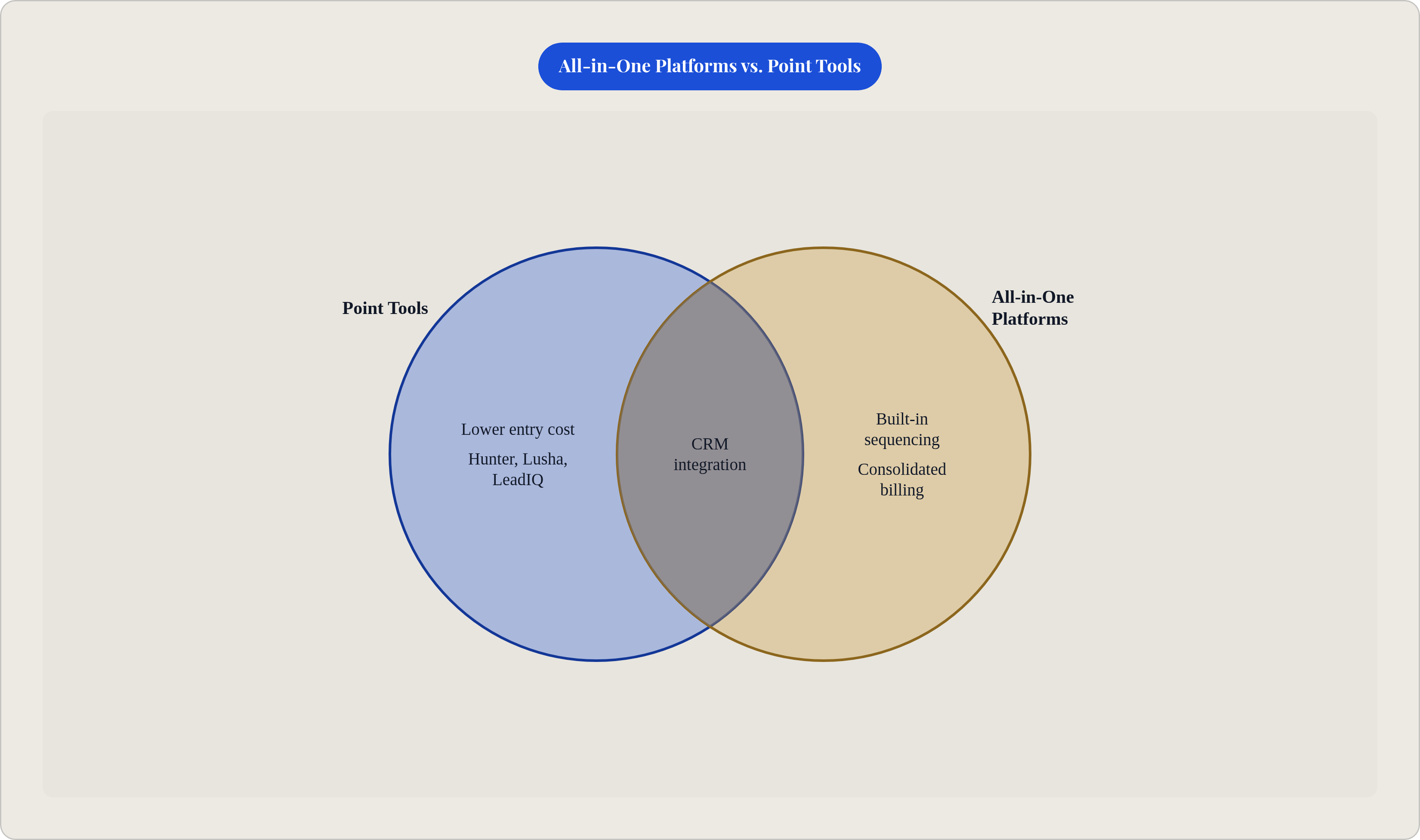
Running a separate data tool, a separate sequencing tool, and a separate CRM sync means three things can break, three logins to remember, and three vendors to email when something goes wrong. A small team often can't absorb that coordination cost, which is the whole argument for consolidation.
Apollo.io pairs a large B2B contact database with built-in email, phone, and social outreach sequencing, so finding prospects and reaching them happens in the same place. It's built specifically with smaller teams in mind, the ones trying to scale outbound without hiring a stack of specialists to run it. For a seed-stage founder doing outbound alone, Apollo is a strong starting point: affordable, fast to set up, no RevOps degree required. The trade-off is depth. You won't get the richest data or the sharpest intent signals compared to a specialist tool built around just one of those things. But across the board, for the price, the coverage holds up.
Overloop runs as a Chrome extension that hooks into LinkedIn directly, so LinkedIn prospecting and email campaigns live in the same workflow instead of forcing you to bounce between tabs. That's a real time saver for teams sourcing socially. Pricing runs $69 per user per month on the Starter plan, with Growth at the same rate but more credits and connected accounts. Per-seat pricing is worth doing the math on before adding your third person; it adds up faster than the sticker suggests.
Lemlist bets on personalization: dynamic images, video, little creative touches meant to stand out in an inbox that's otherwise full of the same three sentence templates everyone's using. Plans run $39 a month for email-only outreach, $69 a month for multichannel. This one's a genuine edge for founder-led outreach, where a generic sequence reads as exactly what it is. But the value only shows up if someone's actually making the personalized assets; Lemlist doesn't source contacts, so you'll need a list from somewhere else first.
Rule of thumb: if your day involves a lot of tool-switching between a data source, an email tool, and a spreadsheet tracker, an all-in-one platform almost always pays for itself in saved time.
LinkedIn-native tools for relationship-driven B2B prospecting
LinkedIn prospecting runs on a different currency than cold email. Relationship signal matters, a warm intro converts far better than a cold one, and the platform itself puts a ceiling on how aggressively you can automate anything.
LinkedIn Sales Navigator gives native access to the full professional network, with search filters and lead recommendations that don't require exporting anything to a third-party enrichment tool. The standout feature is TeamLink, which surfaces warm introduction paths through shared connections. For founder-led sales, that's genuinely valuable; a referral path closes faster than a cold one almost every time. This is the right tool for teams where relationship mapping and social selling are the actual motion, not a side activity. The catch is price: it's a real monthly commitment, and its value only shows up if LinkedIn is genuinely your primary channel, not an occasional detour.
LeadIQ handles the unglamorous part: one-click contact capture straight from a LinkedIn profile, synced automatically into your CRM, so nobody's manually retyping a name and title after a prospecting session. It also flags job changes for contacts you already know, which is one of the higher-signal buying triggers in B2B (someone who liked you at their old company just got budget authority at a new one). Best fit is an SDR-style team doing volume LinkedIn work who needs clean CRM records without babysitting the data entry.
The logic underneath both of these: they earn their spot when LinkedIn is the main channel. If email is doing most of the work, the LinkedIn features baked into an all-in-one platform like Apollo or Overloop are usually enough.
Enterprise-grade platforms and when small teams should not buy them
ZoomInfo has the largest B2B contact and company database on the market, plus intent data, org charts, and technographic overlays that most lean teams will never fully use. It's a recognized leader in intent data and ABM platforms in independent evaluations, and the depth is real. It's also priced well above what most seed-stage teams can justify, with a learning curve that's been well documented as a barrier for smaller buyers. There's one clear exception: if your entire motion is account-based selling against a short, specific list of named accounts, and intent data is central to timing your outreach, ZoomInfo's depth is worth the cost. Outside that use case, you're paying for capability you'll never touch.
Clay works like a spreadsheet that pulls enrichment from a long list of data sources and automates building your lead lists. It's genuinely powerful, and for data-driven prospecting, there's not much on the market that matches it. Here's the catch: reps don't touch Clay directly. It needs someone with RevOps or technical chops to set up and keep running, and if your team doesn't have that person, you're paying the setup cost in founder hours instead of dollars. Clay makes sense for a team with real RevOps capability (in-house or fractional) that wants a custom enrichment workflow. It's not a plug-and-play choice for a first outbound motion.
General rule worth remembering: if a tool needs a dedicated admin to get value out of it, it was priced and built for a team bigger than yours. The overhead becomes a second job nobody signed up for.
AI-native prospecting tools and what "autonomous" actually means in practice
Artisan, with its AI BDR product called Ava, builds ICP definitions, enriches prospect profiles with firmographic and intent data, and sends personalized email campaigns, largely without a human clicking "approve" at every step. The pitch is obvious: a working outbound motion without hiring an SDR. Worth being honest here, though. "Autonomous" doesn't mean "unsupervised." Somebody still needs to define the ICP correctly, write messaging that doesn't sound like a robot wrote it (even though, in this case, one did), and monitor the campaign to catch problems early. "Set and forget" undersells the amount of judgment still required. It's a strong fit for a founder who's already validated who they're selling to and what they're saying, and just wants more volume without adding headcount.
Meanwhile, AI features have quietly become standard inside mid-tier platforms. Apollo, LeadIQ, and Lemlist all offer some version of AI email generation, lead scoring, or sequence optimization now, no separate AI tool required. The real difference is scope: embedded AI assists a rep who's still doing the work. A dedicated AI BDR replaces the top-of-funnel work entirely.
Here's the part worth repeating to any seed-stage founder eyeing an AI tool as a shortcut: it works best as a multiplier on a motion that already works. If your ICP is fuzzy or your messaging hasn't been tested, automation just does the wrong thing faster and at higher volume. And if you can't explain why the AI tool made the decision it made (why this prospect, why this message), you can't fix it when it's wrong. Opaque logic isn't a feature.
How to match a tool to the prospecting motion you actually run
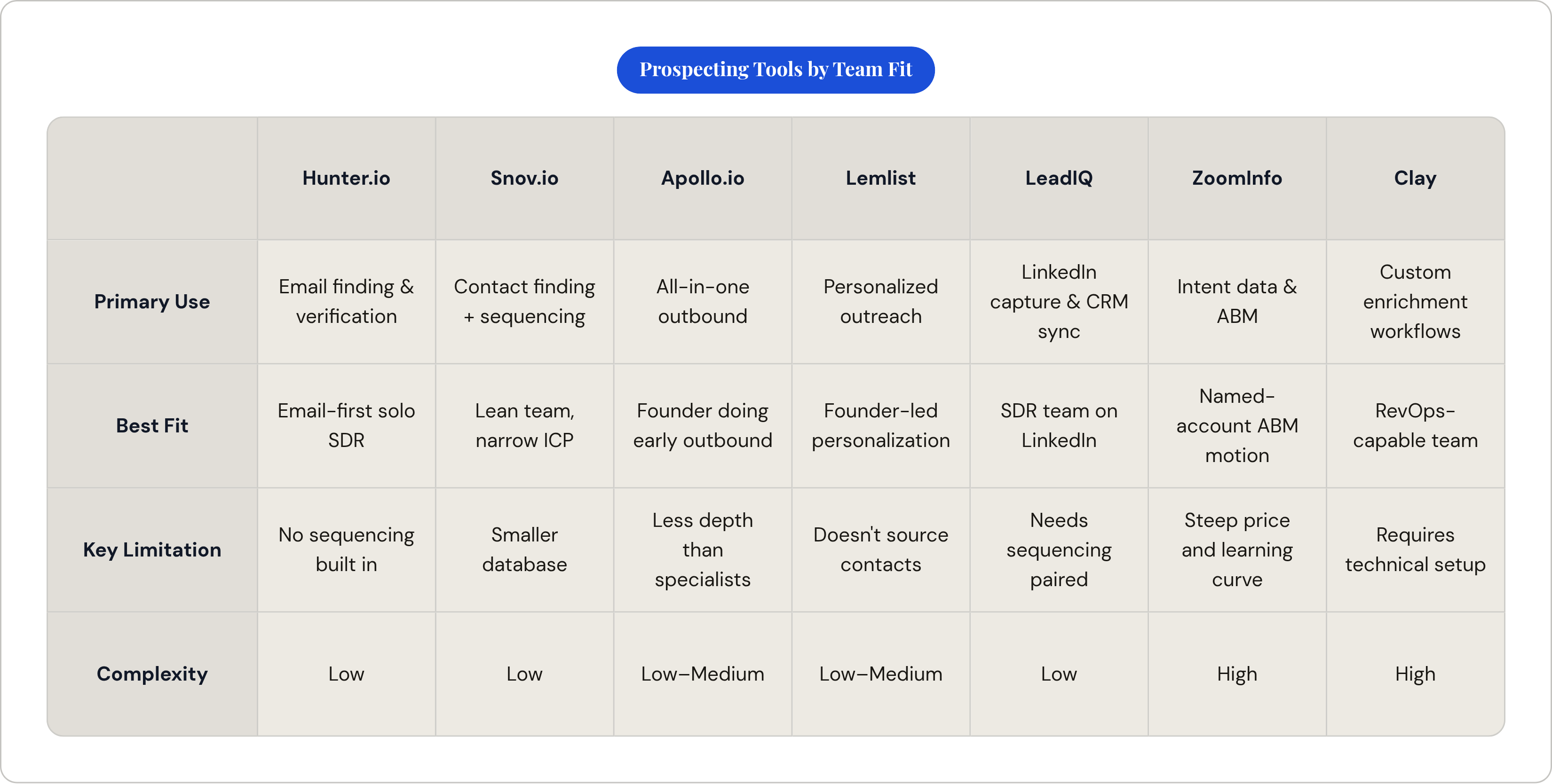
The question worth asking isn't which tool has the most features, but which tool removes the specific manual step that's costing your team time this week.
A founder doing early outbound to a tight ICP with no SDR should look at Apollo or Snov.io first: affordable, consolidated, minimal setup. Add LinkedIn Sales Navigator on top if relationship mapping and warm intros are central to how deals actually happen. A small SDR team sourcing mostly on LinkedIn does well pairing LeadIQ for capture and CRM sync with Overloop or Apollo for the sequencing layer.
A team that's already validated its messaging and wants to push more email volume should look at Lemlist for personalization at scale, or consider an AI BDR like Artisan if headcount, not process, is the actual constraint. A team working a narrow, named-account list with real budget for intent data is exactly where ZoomInfo starts to make sense; below that threshold, it's more tool than the job requires. And a team with technical or RevOps capability and a genuinely complex enrichment need can use Clay as the backbone, feeding whatever sequencing tool is already in rotation.
Most small teams don't need more than two tools running at once: one for data, one for outreach. Plenty of the all-in-one platforms collapse that down to just one. For seed-stage founders specifically, the tool that wins isn't the one with the most logos on its homepage. It's the one that quietly produces logged activity and real pipeline numbers, so when someone asks "is outbound working," there's an actual answer instead of a shrug.