Startup Marketing Agency Pricing Models Explained
Six pricing models startups use, and why retainers dominate when execution must iterate.

Let's get concrete, because the names alone don't tell you much.
Hourly. The agency bills by time logged. Rates shift based on who's doing the work. This model shows up most in one-off consulting, overflow projects, or narrow advisory relationships. It is almost never the right call for ongoing execution.
Project-based. Fixed scope, fixed fee. You define a thing, they deliver it, you pay for it. Fees run from a few thousand dollars for a messaging sprint to well above $50K for a full site overhaul. Clutch's 2024 report found over half of digital agencies offer this as a primary or supplementary option. Works well when the work is genuinely bounded.
Monthly retainer. An ongoing relationship where the agency holds dedicated capacity each month for a recurring fee. This is the most common model for sustained marketing execution, and the range in the market is wide. Entry-level boutique shops sit at one end. Full-service SaaS agency programs sit at the other. Seed-stage B2B typically lands somewhere in the low-to-mid range.
Performance-based. The agency gets paid when agreed metrics move. Leads, MQLs, pipeline, revenue. Sounds ideal. In practice, it's a minority of agency arrangements, and the reason it doesn't dominate the market is attribution. B2B sales cycles are messy. Committees are large. Deals close offline. Figuring out what the agency actually caused is genuinely hard — like trying to credit a single raindrop for a flood.
Revenue-share or CPA. The agency takes a cut of new revenue. More common in e-commerce and short-cycle SaaS than in enterprise B2B. The percentages vary widely. The math looks fine until it compounds against real revenue, and then it doesn't.
Hybrid (retainer plus performance bonus). A base retainer funds core execution. Bonuses trigger when targets are hit. This is the direction most agencies are moving in 2025 and 2026, pushed along by founders who want some cost-outcome linkage without signing up for the full chaos of a pure performance structure.
One thing worth knowing before you start having these conversations: most agencies still use custom quotes rather than published rates. If an agency won't give you a ballpark number before a proposal, that's useful information in itself.
The Tradeoffs Each Model Creates in Cash Predictability, Incentive Alignment, and Execution Depth
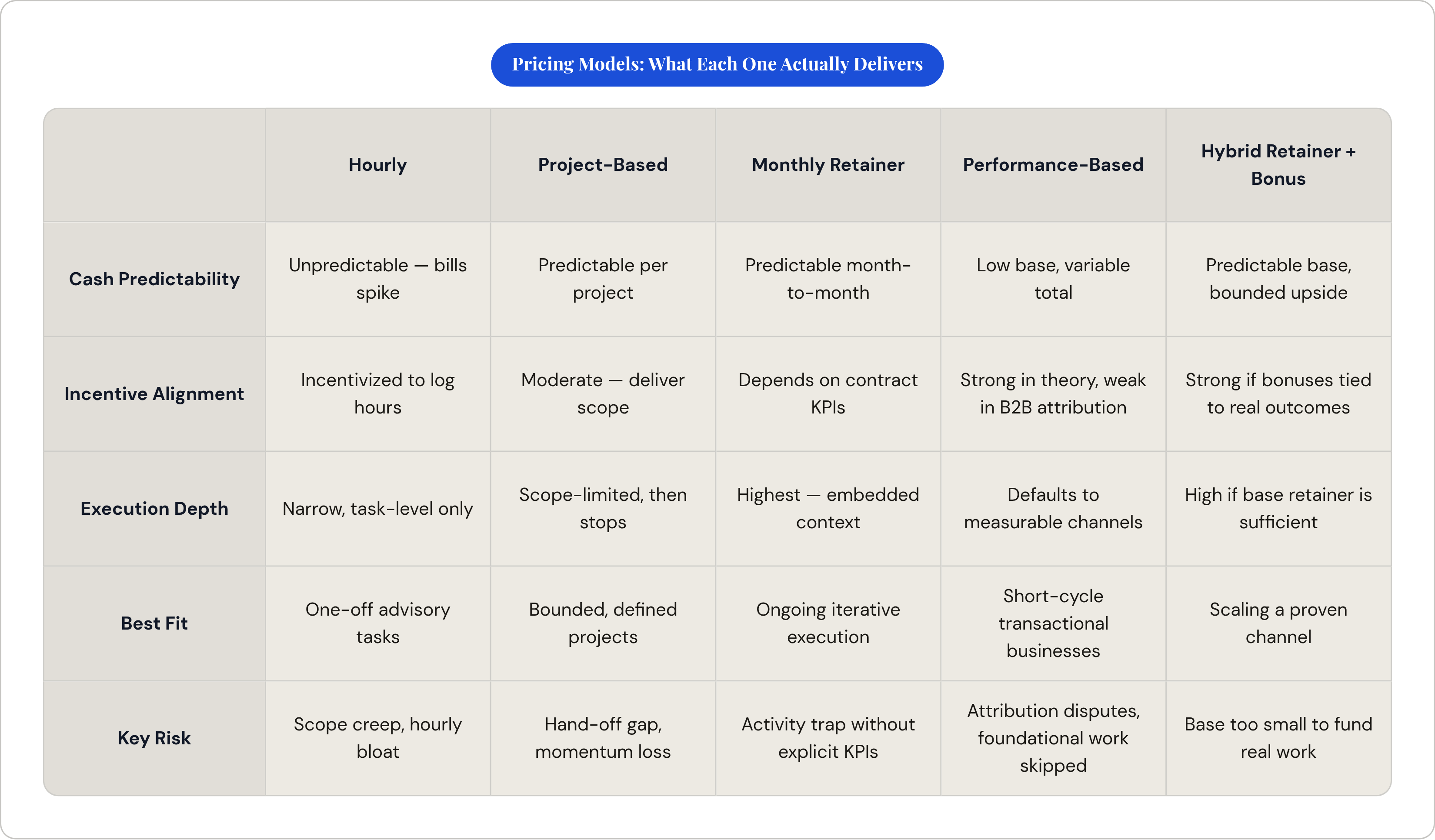
Three things matter most to a seed-stage founder choosing a model.
- Cash predictability. You need to know what goes out each month against a fixed runway.
- Incentive alignment. Whether the agency's comp is actually tied to outcomes you care about.
- Execution depth. Whether the model funds real strategic thinking and full execution, or just reports and deliverables.
Here's the honest breakdown.
Hourly. Cash is unpredictable. Scope creep is common. Bills spike when things get complicated. And the agency is incentivized to log hours, not ship outcomes. Limit it to narrow, defined tasks.
Project-based. Highly predictable for the duration of that project, then zero coverage. Alignment is moderate because the agency is motivated to deliver the scope, but scope is often narrower than what you actually need. The hand-off problem is real and consistently underestimated. The project ends. Momentum stops. Nobody owns what happens next.
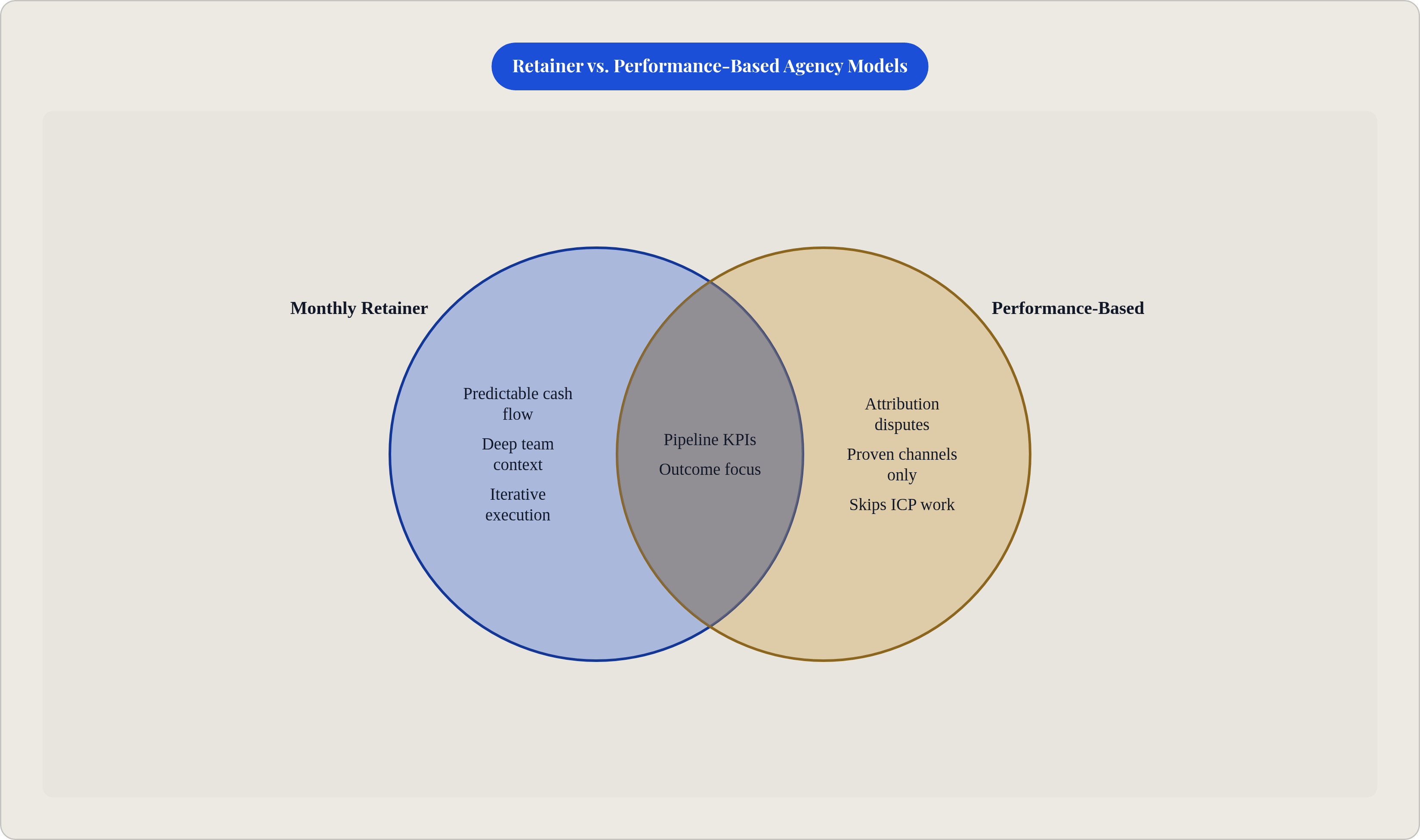
Monthly retainer. Predictable month-to-month. The only model where an agency can genuinely embed with your team, hold context over time, and actually iterate. Execution depth is the highest of any model. The catch is that incentive alignment depends entirely on what's written into the contract. A retainer without explicit metrics is an expensive activity subscription. The contract section below covers this.
Performance-based. Low or zero base fee, which feels like a win when runway is tight. But you still absorb ad spend and tool costs. And the agencies taking on pure performance risk respond rationally: they default to proven channels, skip the foundational positioning work you actually need, and avoid anything that doesn't show up cleanly in attribution. You get the work that's measurable, not the work that matters most at your stage.
Revenue-share or CPA. Low upfront cost. Percentages that compound fast against real revenue. And when attribution gets murky (which it does, reliably, in B2B), disputes follow. Works in transactional businesses with short cycles. Breaks down in enterprise deals with committees and offline stages.
Hybrid retainer plus bonus. Predictable base with bounded upside cost. If the bonus is tied to metrics you actually care about (pipeline velocity, CAC payback, MQL-to-customer conversion), the alignment is genuinely strong. The best structure available at the seed stage, but only if the base retainer is large enough to fund real work.
Why the Retainer Structure Dominates Seed-Stage B2B Engagements Despite Its Upfront Cost
Seed-stage marketing isn't a collection of finished projects. It's an iterative engine that has to be built, measured, and adjusted continuously, often while you're still figuring out who your buyer actually is.
Channels change. A campaign that worked in month two may stop working in month four. An agency on a project contract has no stake in that adjustment. They delivered what they were paid for. The optimization problem is now yours alone.
There's also a context problem that's easy to overlook. An agency embedded in your Slack, tracking your product roadmap, watching how your ICP understanding evolves — that agency is like a navigator who actually knows the road, catching positioning drift and channel decay early in a way that an hourly or project relationship simply can't replicate. You can't buy that kind of working context in one-off engagements.
Fractional CMO-style retainers have grown fast for exactly this reason. They bundle strategy, execution, and senior marketing leadership into a monthly fee. For founders who need a real marketing brain without a full-time hire, it's often the most economical path to the kind of thinking that actually moves numbers.
Here's where most founders get burned: signing an agency retainer before their positioning is clear. An agency that leads with "we'll write 20 blog posts a month" before asking who your ICP is? They're selling activity, not outcomes. A retainer can fund positioning work, channel experimentation, and execution in sequence. Project models can't. But a retainer without explicit KPIs tied to investor-relevant metrics becomes the same problem in slower motion.
The model isn't the protection. The contract is.
What Seed-Stage Founders Get Wrong When Evaluating Performance-Based Deals
The appeal is obvious. Zero base fee feels like zero risk when runway is limited.
It isn't.
The attribution problem in B2B is structural. It's not a flaw in execution you can work around with better tracking. A buying committee with a multi-month sales cycle, multiple touchpoints, and decisions made in offline conversations cannot be cleanly attributed to any single agency action. Both sides end up in disagreement about what caused what. Those disagreements don't resolve cleanly, and the relationship deteriorates.
Agencies accepting pure performance risk aren't being naive about this. They respond rationally by defaulting to proven channels, avoiding category-creation work, and skipping the ICP definition and positioning work your startup actually needs most. Because none of that foundational work shows up cleanly in attribution. You get the deliverables that are easy to measure, not the ones that matter most.
Then there's metric selection. Performance contracts optimize for whatever's written into the agreement. If that metric is lead volume, you get lead volume. If lead volume has a loose relationship to revenue (and at the seed stage, it often does), you've just paid for noise.
Revenue-share and CPA arrangements carry the same distortion, amplified. They work for established businesses with predictable sales processes and short cycles. For startups still learning which channel and message actually converts, they're a bad fit.
The one structure worth considering: a hybrid where a base retainer funds strategy and real execution, and bonuses are tied to pipeline or CAC targets. That preserves alignment without forcing the agency to absorb risk it structurally cannot control.
How to Set a Realistic Marketing Budget Before Choosing a Pricing Model
Seed-stage founders consistently underbid their marketing budget relative to runway, then expect results that require more sustained investment than a single-channel experiment can produce. It happens constantly, and it almost never ends well.
A few things to get straight before you choose a model.
Agency fees and media spend are separate line items. A performance-based model that looks cheap in fees may still require substantial media budget to generate the results the agency is compensated on. Budget for both, explicitly.
Start narrow. One or two high-intent channels, a modest initial budget, real CAC benchmarks from actual tests. Then scale what's working. Spreading budget across too many simultaneous experiments produces false negatives everywhere. You'll conclude channels don't work when the real problem is that none of them got enough investment to actually tell you anything.
Do the runway math out loud. If you have 12 to 18 months to demonstrate traction for a Series A, your marketing budget needs to produce investor-ready metrics within that window. Not to run a few campaigns. Not to check a box. To actually demonstrate repeatable acquisition at unit economics that suggest scalability. Work backward from that requirement.
The false economy of going too cheap is real. A $500-a-month engagement produces $500-a-month of output. When that output fails to move the metrics you need, the spend is wasted regardless of how small it was.
The budget range in the market is genuinely wide. Single-service boutique retainers sit at one end. Integrated multi-channel programs sit at the other. The gap between those two is the gap in expected output. Be honest with yourself about which type of output you actually need, and budget accordingly.
What the Contract Terms Behind a Pricing Model Reveal About the Agency's Actual Intentions
The pricing model is the headline. The contract is the story.
On minimum contract lengths. Fractional CMO and full-stack retainers frequently require six-month minimums. This reflects genuine ramp time: building and iterating a marketing engine takes months, not weeks. That's not just agency self-interest. If an agency offers month-to-month from day one with no onboarding structure, ask yourself why they're comfortable with that.
What a well-structured retainer contract actually includes:
- Defined deliverables tied to a specific scope of work
- Explicit KPIs tied to investor-relevant metrics, not activity counts
- Clear ownership of ad accounts, CRM data, and content assets (these belong to you, full stop)
- A defined review cadence with a real mechanism to adjust channel strategy mid-engagement
Red flags worth taking seriously:
- The agency retains ownership of ad accounts, CRM data, or content after the engagement ends. Non-negotiable.
- KPIs are defined as activity outputs (posts published, emails sent) rather than outcomes (MQLs generated, pipeline influenced).
- No mechanism exists to review and adjust channel strategy mid-engagement.
- The "strategy" deliverable is a deck, and execution depends entirely on your follow-through after the handoff.
The embedded agency test. Does the agency want to sit in your Slack, learn your product roadmap, and iterate alongside your team? Or does it want to receive a brief and return a deliverable? Those are fundamentally different operating models, and the answer tells you more about how useful any pricing structure will actually be than the pricing structure itself.
Agencies that explain their pricing clearly before a proposal reveal something about how they operate overall. Opacity on pricing usually means opacity on everything else.
Matching the Right Model to Where a Seed-Stage Startup Actually Is
Before you evaluate pricing, answer four questions honestly.
- Has your ICP been validated, or are you still learning who your actual buyer is?
- Do you have a working hypothesis about which one or two channels to test, or is channel selection itself still an open question?
- Is the goal to generate pipeline in the next six months, or to build an asset (SEO, content authority) that compounds over 12 to 18 months?
- Does your team have any in-house marketing capacity, or does the agency need to own end-to-end execution?
Here's the model-to-situation map.
ICP still unclear, no validated positioning. Start with a short project engagement. A positioning sprint or messaging architecture exercise. Do not commit to a retainer before you have clarity on this. Buying execution before buying clarity wastes both.
ICP defined, channel hypothesis in hand, need end-to-end execution. A retainer with explicit pipeline KPIs. If senior strategic leadership is also missing, the fractional CMO retainer model covers both problems at once.
Established channel with measurable CAC, looking to scale a proven motion. Hybrid retainer-plus-bonus becomes viable here. The agency can forecast results and absorb some performance risk on a channel it can actually control.
Pre-Series A, 12 to 18 months of runway, need investor-ready metrics. A retainer built around CAC, pipeline velocity, and MQL-to-customer conversion. These metrics need to be baked into the engagement from day one, not retrofitted three months in when you realize you need them.
If you're a seed-stage B2B founder at exactly this junction, Pier is an embedded fractional marketing agency that handles strategy and execution end-to-end for founders at this stage, covering positioning, content, and channel work as an integrated program rather than a disconnected set of deliverables.
The right pricing model isn't the cheapest one. It's the one that matches your actual constraints, funds the work you genuinely need, and creates incentives pointed toward the outcomes your investors are going to ask about. Start there.