Startup Marketing Agency Pricing and Retainer Models
Understanding which pricing model aligns with your stage saves runway and delivers results.

Three models dominate the market. Choosing the wrong one is like buying a boat to cross a desert — technically a vehicle, but wrong for the terrain. What each model rewards in the agency matters more than what it costs you.
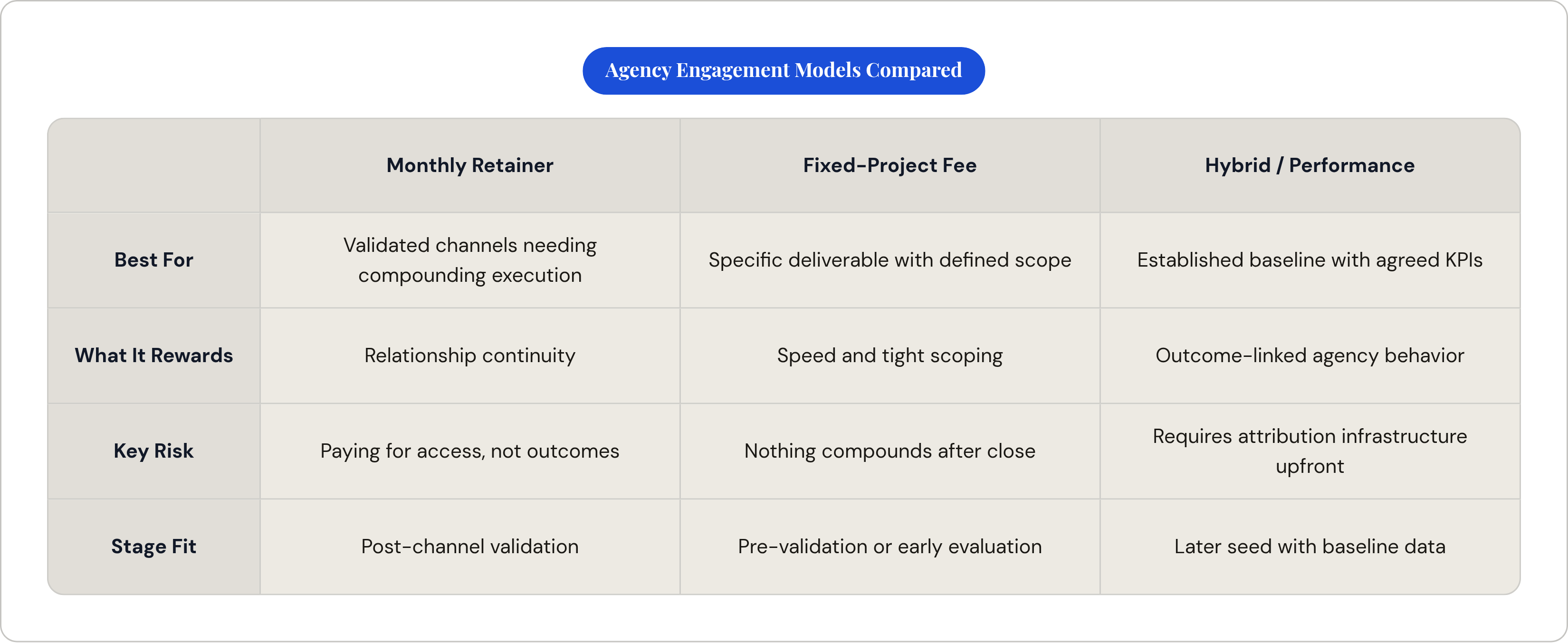
Monthly retainer. Ongoing capacity, predictable fee. This is the default structure for SEO, paid media, content programs, and fractional CMO work. Retainers naturally reward relationship continuity — a different thing from output or outcomes. Without a tightly scoped agreement, you end up paying for access and attention, which is a very common and very quiet way to drain runway.
Fixed-project fee. Defined deliverable, defined cost, defined timeline. This structure pushes the agency to scope tightly and move fast. It works well for positioning audits, GTM buildouts, or paid media account architecture. The limitation shows up the moment the project closes: the deliverable exists, but nothing compounds from it unless someone keeps pushing. What you do with it after is entirely on you.
Performance-based and hybrid models. Pure performance means the agency earns based on leads, pipeline, or revenue. In practice, pure performance is rare. Establishing a defensible baseline is genuinely hard, and most agencies will not absorb full risk on variables they cannot control, like your sales process, pricing, or product quality. Hybrid models are more workable: a reduced base retainer with a bonus tied to agreed KPIs. More on why these are an impractical starting point for most seed engagements in a later section.
Hourly billing exists but is mostly limited to independent consultants or overflow arrangements. You will rarely see it as the primary structure for ongoing agency work.
The question to hold onto across all of these: what behavior does this pricing structure reward in the agency, and is that actually the behavior you need right now?
What the Market for Startup Agency Retainers Actually Looks Like in Practice
The spread is wide enough that "retainer cost" is nearly meaningless without knowing what is and is not included.
By service type:
- SEO-focused agencies generally sit at the lower end of the startup retainer range
- Paid media agencies typically charge a base management fee plus a percentage of ad spend on top. That ad spend is a separate budget line, not part of the retainer
- Full-service growth agencies covering paid, SEO, content, and analytics start notably higher than single-channel shops
- Fractional CMO engagements land in the mid-to-upper range depending on seniority and committed hours
Hidden cost categories founders routinely miss:
- Onboarding or setup fees. Account architecture, tracking installation, and initial audits often carry a one-time charge before recurring work even begins
- Ad spend management markup. Flat fee or percentage of spend, this is a real cost sitting on top of your actual media budget
- Tool and platform access. Some agencies pass through software costs. Others absorb them. Clarify this before you sign anything
One thing about the SEO market specifically: a large chunk of agencies charge well under what a growth-stage startup needs for meaningful impact. The upper-end shops are mostly built to serve established or enterprise clients. A suspiciously low retainer is usually a signal about who the agency was actually designed for.
How to Read Agency Pricing as a Signal About What You Are Actually Buying
A retainer without defined deliverables is a relationship fee. You are paying for access and attention, not a marketing engine. That is fixable at the contract stage, but only if you know to look.
A well-structured retainer should include:
- Concrete outputs per period: content volume, campaigns launched, reports delivered
- Metrics the agency is actually accountable to. Activity metrics like impressions or posts published are insufficient; pipeline metrics like MQL volume, cost per acquisition, and conversion rate by channel are what matter
- Clear ownership: what the agency executes, what the founder decides, where the workflows overlap
Here is something I have noticed after watching a lot of these engagements up close: agencies that report on activity metrics are mostly optimizing for retention. Activity metrics are easy to hit and easy to present as progress. Agencies that report on actual business outcomes keep clients longer, and for a reason that should be obvious. The results are there.
The fractional CMO model is worth looking at closely. It promises strategic leadership. Whether it delivers that depends entirely on whether the engagement includes real execution or just advisory hours. Those are structurally different products at very different price points, and the distinction is not always spelled out clearly in the proposal. Sometimes it is missing entirely.
Questions that reveal what you are actually buying:
- What happens in month three if the channel is not producing? Do you pivot, or do you keep delivering the contracted scope regardless?
- How do you specifically attribute pipeline to your work?
- What does your reporting connect to inside my business?
If an agency cannot answer these cleanly, you already have your answer.
Why the Retainer-Versus-Project Decision Maps Directly onto Your Stage and What You Need Built
This is a stage question, not a stylistic preference.
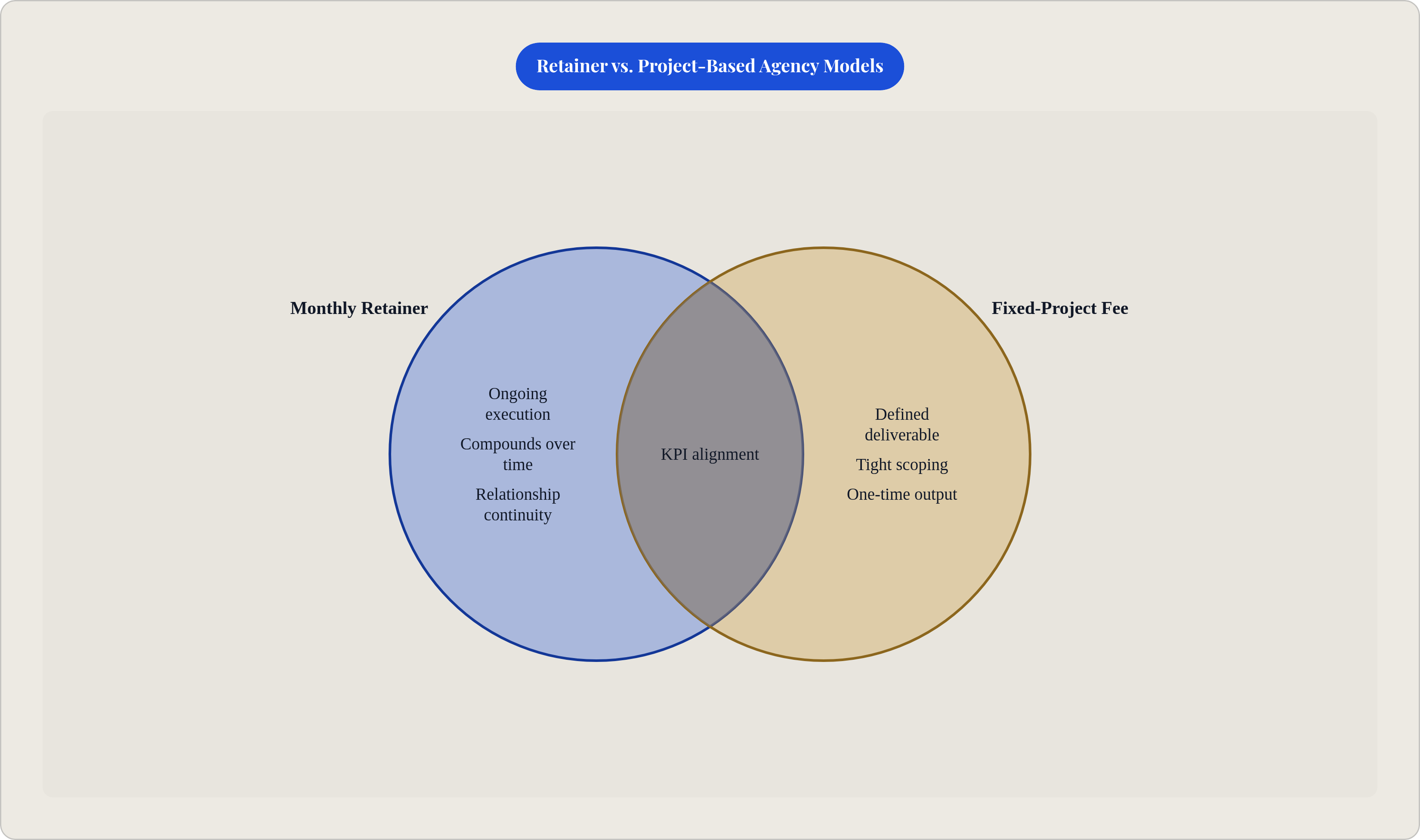
Project-based engagements suit founders who need a specific thing built but have not yet validated whether the agency or the channel deserves ongoing budget. Good use cases: go-to-market strategy, positioning and messaging, paid media account architecture, ICP research and segmentation. Lower commitment, easier to evaluate output quality before extending the relationship. The real limitation is that when the project ends, execution stops. Nothing compounds on its own.
Retainers suit founders who have a validated channel and need consistent, compounding execution behind it. SEO is the clearest example. Month three's results depend entirely on what happened in months one and two. Stop and restart and you have essentially undone the investment. Content programs, email infrastructure, and paid media optimization follow the same logic.
The scenario most seed-stage founders are actually living: channels are not fully validated, but they also cannot afford to spend three months on a project that delivers a document and then goes cold. Picking one model and hoping for the best is unlikely to solve this.
Start with a scoped project designed to build into an ongoing engagement. Define the transition criteria before you sign: what measurable results prove the channel is working, what execution pattern is worth repeating, and whether the agency has demonstrated it can operate inside your actual workflow. Put those conditions in writing.
This is where execution model matters as much as pricing model. Agencies that sit inside the founder's workflow directly, with access to product roadmaps, real-time communication, and end-to-end execution, are a structurally different product than the standard retainer-or-project binary. For seed-stage founders, that difference is usually the one that actually matters. Pier is built around that model. It is not a coincidence that founders at that stage tend to find it more useful than a traditional engagement structure.
How to Size Your Agency Budget Against Your Actual Runway and Investor Timeline
Seed-stage founders are not working with enterprise marketing budgets. The question is not what the full market charges. It is what a founder with twelve to eighteen months of runway can actually deploy without burning capital on work that does not compound toward Series A.
B2B companies at the growth stage commonly allocate a meaningful share of revenue to marketing. Early-stage startups chasing rapid customer acquisition often push that share higher than established benchmarks suggest. That can be exactly right, depending on what the budget is actually building.
The investor timeline is the variable that separates seed-stage budget logic from everything else. The marketing work done between seed and Series A is what builds the traction narrative investors are going to evaluate. Spend too late in the runway and you compress the time you have to show compounding results. Spend poorly early and you waste the window entirely. Neither makes for a good fundraising conversation.
Practical sizing logic:
- Weigh agency cost against what channel or capability is being built, how long it takes to show results, and whether the output survives the engagement itself
- A lower retainer that produces activity without pipeline contribution is more expensive than a higher retainer that builds a durable acquisition channel. The math is simple once you run it
- Ad spend is a separate budget line. Conflating it with agency fees understates total channel cost and distorts your ROI math from the start
The case for starting immediately after closing a seed round is straightforward. The compounding assets — things like SEO authority, a content library, email infrastructure, and attribution instrumentation — take time to build. Starting late means arriving at Series A conversations with thin evidence. That is a harder story to tell than it has to be. Think of it as planting a tree: the best time was the day you closed your round, and the second best time is today.
What Performance-Based and Hybrid Models Require Before They Can Work for a Seed-Stage Founder
Performance-based pricing sounds like a dream: pay for results, not effort. The problem is that it requires something most seed-stage companies do not have yet.
The prerequisites:
- Baseline metrics. Without historical data on CAC, conversion rates, and pipeline velocity, there is no defensible starting point to measure improvement against. You are essentially arguing over a number that neither side can prove
- Attribution infrastructure. Performance bonuses tied to pipeline require knowing which agency actions produced which outcomes. Most seed-stage companies do not have this instrumented from day one, and sometimes not from day three hundred
- Agreed definitions. What counts as a qualified lead, what counts as pipeline contribution, and who controls the variables that affect conversion all have to be documented before money gets tied to outcomes. This conversation is uncomfortable, which is exactly why most agencies skip it
The hybrid model is more realistic than pure performance because it covers agency operating costs and does not ask the agency to absorb full risk on variables they genuinely do not control. A practical path: run a straight retainer for three to six months to establish baseline data, then introduce performance components once there is a real floor to measure against.
Performance metrics worth tying bonuses to:
- CAC by channel
- MQL-to-customer conversion rate
- Pipeline revenue contribution
Do not tie bonuses to clicks, impressions, or content volume. A performance model built on vanity metrics creates the appearance of accountability without any of the substance. The agency hits every number and your pipeline is empty. You have paid for the illusion of a results-based relationship while getting none of the results.
The Evaluation Criteria That Matter More Than the Price Point Itself
The number on the proposal is the last thing to evaluate. The structure behind it determines whether the engagement builds anything at all.
Before you look at price, look at these:
- Execution depth. Does the agency build and run the work, or do they advise and hand the execution back to you?
- Workflow integration. Does the agency operate inside your process, with visibility into your product roadmap and direct communication channels, or do they show up once a month with a PDF?
- Metric accountability. Are the KPIs in the proposal connected to pipeline and investor-facing metrics, or are they activity metrics dressed up to look like outcomes?
- Stage fit. Has the agency actually worked with companies at your stage, with your constraints, meaning limited runway, no in-house team, founder-led sales? Or do their case studies come from later-stage or enterprise clients where the conditions are completely different?
- Channel clarity. Does the agency recommend a specific, prioritized channel strategy based on your ICP, or do they propose doing everything at once and let you figure out what to cut?
Red flags in agency proposals:
- Deliverables defined by output volume rather than business outcomes
- No mention of attribution or reporting methodology
- A strategy deliverable at the start with no execution commitment behind it
- Performance bonuses tied to impressions, traffic, or content quantity
What good agency positioning at seed stage actually looks like: embedded execution across positioning, SEO, content, email, and paid acquisition, with reporting tied to CAC, pipeline velocity, and MQL-to-customer conversion from the start — instrumented before the first quarter closes, when the data still has time to matter.
Pier is built around that model operationally. The reporting connects to what investors actually ask about. The work runs inside the founder's workflow rather than parallel to it. That distinction separates an engagement that fills a filing cabinet with deliverables from one that produces a growth motion you can actually walk into a Series A conversation with.