Red Flags When Evaluating a Startup Marketing Agency
Seed-stage startups need discovery partners, not scaling agencies dressed up as strategy experts.

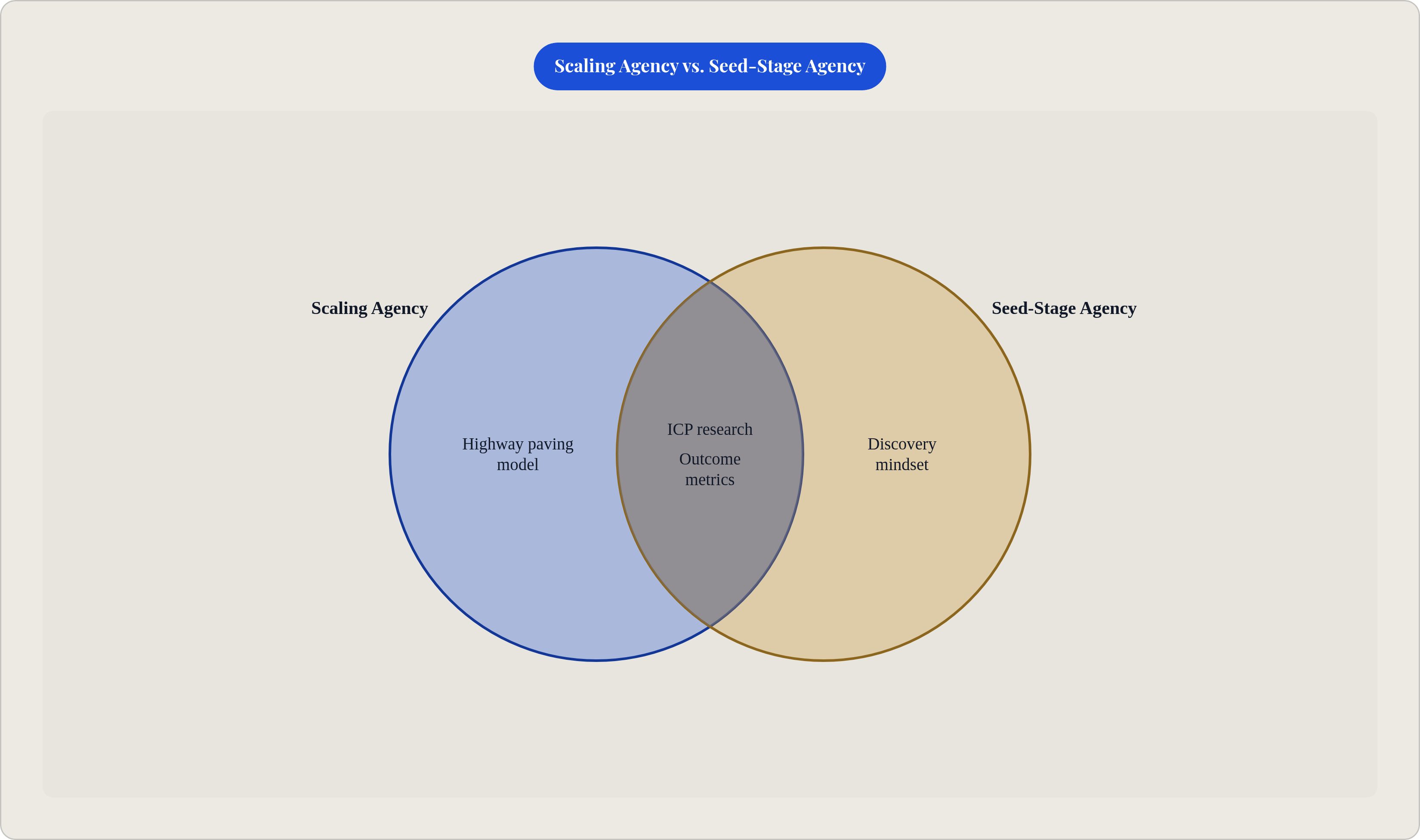
Most agencies were built for companies that already figured something out. They know their buyer, they know their channel, and they need help running it at scale. That's a scaling problem. A seed-stage company has a completely different problem: a discovery problem. You're still figuring out what message lands, with which buyer, through which channel. Hiring a scaling agency for a discovery problem is like bringing a highway paving crew to lay a garden path. The equipment is real. It's just wrong for the terrain.
The structural fallout from this mismatch is predictable, and it happens quietly. When a seed-stage deal lands at a mid-size or large agency, it gets staffed down. The senior people who ran the pitch move on to close the next deal. Execution gets handed off to whoever has bandwidth that week. Nobody is being shady. It's just how their model has to work to stay profitable, and your engagement isn't big enough to change that math.
So before you sign anything, ask: who specifically runs this engagement day to day, and can we meet them now? Evasion is an answer. So is a vague assurance that "you'll be in great hands."
Also watch for enterprise-calibrated deliverables dressed up as startup-friendly. Lengthy brand audits, multi-week strategy phases, elaborate reporting dashboards. None of these are bad capabilities on their own. They're just wrong for your stage, and they eat the two things you genuinely cannot afford to lose right now: time and money.
The right agency can tell you specifically what they're trying to prove in the first 60 to 90 days and what they're trying to learn. That distinction, between proving and learning, is what separates a discovery mindset from a scaling one, and it usually shows up pretty clearly in the first conversation.
Skipping ICP Research Before Proposing a Channel Strategy
Here's a quick read on any agency pitch: what do they ask you first?
Opening questions about budget and timeline mean you're in a sales conversation. Opening questions about who your buyer is, what problem they're solving, and how they currently find solutions like yours mean you're in a strategy conversation. These lead to completely different proposals, and you can usually tell within the first fifteen minutes which one you're in.
"SMBs" is not an ICP. Neither is "mid-market tech companies." A real ICP names a job title, a company stage, a trigger event, and a specific problem that's painful enough to actually buy against. Any proposal built without those four things is a template. It was written for a generic version of a company like yours, filled in with your logo.
The stakes are higher in B2B than a lot of agencies seem to genuinely account for. Research from Sybill.ai's ICP Guide puts the share of B2B purchases involving four or more decision-makers from different departments at over 60%. If an agency's proposal targets one persona for a complex B2B sale, they're missing how the deal actually closes. They're optimizing for the wrong person — and in B2B, picking the wrong person to optimize for is like navigating by a map of a different city.
There's a gut check you can run on any agency before the second meeting. Pull up their website and look for a clearly defined ideal client. Most skip this entirely. A review of agency websites by The Starr Conspiracy found that only a minority publish a documented ICP. An agency that hasn't done this work for themselves is in a genuinely weak position to tell you it matters for yours.
Proposals That Describe Activities Instead of Committing to Outcomes
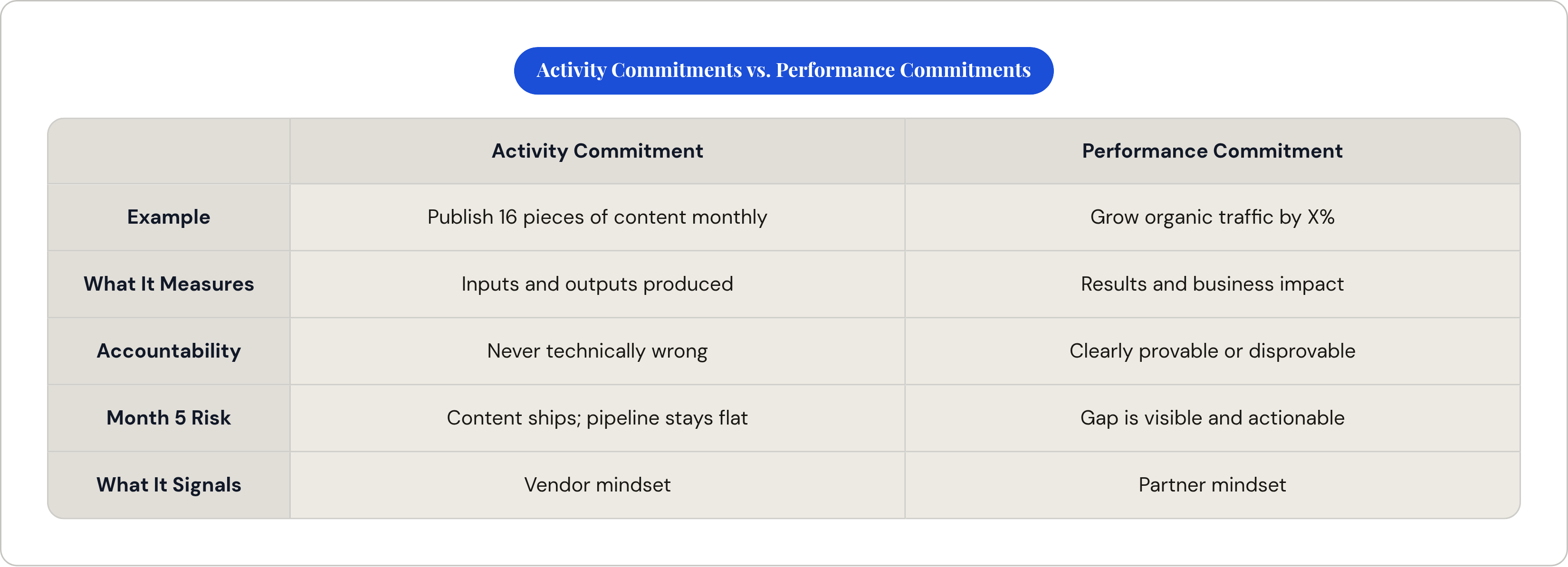
This is the most common form of proposal theater and it almost never gets called out, mostly because the language sounds professional enough that founders let it slide.
"We will publish 16 pieces of content monthly" is a delivery commitment. It tells you what they'll produce. It says nothing about what happens because of it. "We will grow your organic traffic by X%" is a performance commitment. One can never technically be proven wrong. The other can. That difference sounds minor until month five, when the content is getting published on schedule, the pipeline is flat, and nobody is failing to deliver on what they promised. An activity without a committed outcome is expensive busywork with a nice font and a monthly invoice.
Look at what's missing from a proposal as carefully as what's in it.
- No mention of how success gets measured means they're tracking inputs, not outputs.
- No milestone structure means there's no mechanism to hold anyone accountable in month three.
- No statement of what they need from you means they haven't actually thought through how this works operationally.
References matter here too. NDAs are real, but a strong agency can usually produce one or two past clients willing to take a five-minute call. Case studies with specific metrics beat a logo slide every time. Ask to see the numbers. If the resistance holds firm, that's information.
Last thing to watch for: scope padded with deliverables rather than organized around goals. A monthly PDF summarizing activity without interpreting what it means for your pipeline is a time-filler. It feels like a deliverable. It isn't. A real partner reads the data and tells you what to do differently next month. The gap between those two things is the gap between a vendor and someone who actually has skin in the game.
Vanity Metrics in the Reporting Framework
Ask any agency early in the pitch: "What would your report to us look like after month three?"
If the answer leans heavily on impressions, follower counts, reach, and engagement rates, you have your answer. Those numbers are easy to move, safe to report, and almost entirely irrelevant to pipeline. An agency on a flat retainer has no financial incentive to move the metrics that are actually hard to move. So they move the easy ones and call it progress.
If the reporting framework is built around vanity metrics from day one, you'll spend six months feeling like momentum is building. Then you'll walk into a fundraise with nothing concrete to show investors, which is a very specific kind of bad feeling to have when you're trying to close a round.
The metrics that actually matter at your stage:
- CAC and CAC payback period. This is your acquisition efficiency story. Investors want to see it clearly.
- MQL-to-customer conversion rate. This tells you whether the pipeline is real or just a list of names.
- MRR trajectory and net revenue retention. This is the proof that the product works once someone buys it.
These need to be in the reporting framework from month one. Not retrofitted when you're six months from a Series A and someone finally thinks to ask why the numbers look the way they do. Investors aren't impressed by a waitlist or a Product Hunt ranking. They want to see repeatable, measurable demand. An agency that never asks how its work connects to your fundraise narrative is ignoring the thing your next twelve months actually depend on.
Guaranteed Results and Timeline Promises That Don't Survive Contact with SEO Reality
SEO compounds. It also takes a minimum of twelve to eighteen months to do so meaningfully. Agencies that promise faster organic results are either cutting corners or telling you what you want to hear. Either way, you're the one who pays for it when the results don't show up on the timeline they sold you.
Paid demand generation is different. That can ramp meaningfully in 90 to 180 days. Organic search does not work on that timeline, and an agency that blurs the line between the two is doing you a real disservice. A realistic SEO timeline is a sign of honesty. An implausible guarantee is a sign of the opposite, and you should treat it accordingly.
There's a newer version of this problem that's subtler and worth paying attention to. A meaningful and growing share of B2B software buyers now start their research with AI tools rather than Google, per G2's research from early 2026. A significant portion of those buyers ended up choosing a different vendor than they originally planned, based on what the AI surfaced in the process. An agency with no strategy for generative engine optimization or AI answer-engine visibility is selling you a framework that's already losing relevance in how your buyers actually research their options.
Ask directly: "How does your content strategy account for how buyers use AI during the research phase?" Silence or confusion is an answer, and it's not a good one.
Also worth doing before the first meeting: Google the agency's core service plus their city or niche. See what comes up. An SEO agency that doesn't rank for its own keywords has a credibility gap that's genuinely hard to explain away. It takes five minutes and is almost always revealing.
Volume-as-strategy is a close cousin to timeline dishonesty. Twenty blog posts a month sounds productive. It's also straightforward to deliver at low quality, and low-quality content at high volume is mostly noise. Ask how they plan to distribute each piece and where they expect it to rank or convert. Vague answers mean the strategy is also vague.
Financial Model Structures That Misalign Agency Incentives with Founder Growth
Flat retainers are common for a reason, and they're not inherently bad. But they do create a structural misalignment worth naming plainly: the agency gets paid the same whether your pipeline grows or stagnates. That's a design problem, not a character flaw on anyone's part. It's also fixable, if the agency is willing to have that conversation honestly rather than defensively.
Some things to watch for in how contracts are structured:
- Deliverable-based billing. When an agency is paid per piece of content or per campaign, they're incentivized to produce volume, not results. More output means they're technically doing their job, regardless of what it's doing for your MRR.
- Long contracts with no offramp. A twelve-month lock-in with no performance milestone exit clause transfers all the downside risk to you. A confident agency should be willing to earn the relationship on a quarterly basis. If they're not, ask why, and listen carefully to how they answer.
- Budget-first scoping. If an agency asks your budget before asking your goals, they're sizing the engagement to what you'll spend, not to what you actually need. That's a sales move dressed up as a strategy conversation.
Ask them this directly: "How have you handled an engagement that wasn't working?" The answer tells you more about whether their incentives are actually aligned with yours than anything written in the proposal document.
What an Agency Built for Seed-Stage B2B Actually Looks Like in Practice
The difference between the right agency and the wrong one isn't in the service list. It's in how they operate day to day, and how they think about what they're actually there to do.
The right fit embeds into your workflow rather than operating at a distance. Sitting in your Slack, knowing the product roadmap, adapting based on what's coming out of sales conversations this week. A monthly report and a check-in call is a vendor relationship with nicer slides. It's not a partner.
Coordinated execution across positioning, SEO, content, email, and paid acquisition is worth more than any single channel done well in isolation. Disconnected tactics produce disconnected results. A unified approach produces compounding ones, and the compounding is the whole point at your stage.
Investor-readiness has to be built in from the start. CAC, pipeline velocity, and MQL-to-customer conversion rates need to be tracked from month one. Not reconstructed six months before a raise because someone finally thought to ask why the numbers look the way they do.
Pier exists specifically to work with founders at this stage, a hands-on fractional marketing team for seed-stage B2B startups that embeds directly with founders on both strategy and execution, organized around the traction story that closes a next round. The question worth asking any agency, Pier included, is a simple one: were you built for companies that already know what works, or for the earlier, harder problem of figuring it out? That answer tells you more than anything else in the pitch.