Content Marketing Agencies for Tech Startups
Seed-stage startups need agencies built for speed, technical depth, and pipeline ROI.

Most founders treat hiring a content agency like hiring a contractor to renovate a bathroom. Find someone competent, check a few references, sign the paperwork. That analogy holds up fine when you have a Series B budget, an in-house marketing lead, and the luxury of running experiments for six months. It falls apart completely when every dollar is accountable, your runway is finite, and your buyers can tell within two paragraphs whether the person who wrote that article has ever actually shipped software.
The right content agency for a seed-stage tech startup is a genuinely narrow target. Most agencies are not built for it. Founders usually figure that out three months into a retainer, staring at a content calendar full of posts their ICP has never clicked.
So here is what content actually needs to do at this stage.
Three things:
- Validate that your ICP exists and responds to your message
- Support the sales motion that is already happening. Outbound sequences, pre-demo objections, the follow-up email your AE sends after a call goes sideways
- Build enough credibility with skeptical technical buyers that inbound leads show up already sold on the category
That third one is where most seed-stage content falls short. Engineers, CTOs, heads of DevOps. They read editorial content and trust it far more than they trust ads. But that trust only transfers if the content is actually credible. Surface-level content does not just fail to build trust. It actively destroys it. You can lose a buyer who would have converted just by publishing something that reads like it was researched from your own marketing page.
The metrics that matter here are CAC, MQL-to-customer conversion, and pipeline velocity. Those are the numbers your investors are watching. Your content agency should be designing against those numbers, not page views.
There is also the runway problem, which is not abstract. A seed-stage company has a short window to show traction. Content strategies that take six to nine months to show results are not just slow. They are fatal. Any agency that cannot build urgency into its operating model as a hard design constraint. not just as a client preference it nods at and ignores. is the wrong agency for this stage.
The four things a content agency must handle to serve a tech startup well
Technical depth
This is the first filter. A lot of agencies fail it quietly, meaning they fail it in a way that takes you 60 days to notice.
The question is simple: does this agency have writers with genuine domain backgrounds in engineering, cloud infrastructure, APIs, security, or whatever vertical your product actually lives in? Or do they use generalist writers who research the topic fresh for each assignment?
Both approaches can produce readable content. Only one produces content a technical buyer will take seriously.
Ask to see published work in your specific category, your buyer type, your level of technical complexity. Not a general SaaS portfolio. "We've worked with B2B software companies" covers an enormous range that includes almost nothing useful as a reference point.
Pipeline orientation
There is a real difference between content that builds awareness and content that advances a buying decision. An agency that cannot draw that line clearly, and map specific content types to specific funnel stages, is a publishing operation. It is not a pipeline partner.
Agencies that default to traffic and domain authority as their primary success metrics are optimizing for the wrong scoreboard at seed stage. Traffic is a lagging indicator of brand health. It is not a leading indicator of whether your next round closes.
Pace and operational fit
Seed-stage companies change direction fast. An agency built around quarterly editorial calendars, layered approval chains, and 20-page strategy decks delivered six weeks after kickoff is going to frustrate you within two months. That frustration is mutual and expensive.
What you want is an agency that embeds into your workflow. Slack access. Visibility into the product roadmap. Real-time iteration based on what the sales team actually heard on calls last week, not what the intake questionnaire said your buyers cared about three months ago.
Budget and stage fit
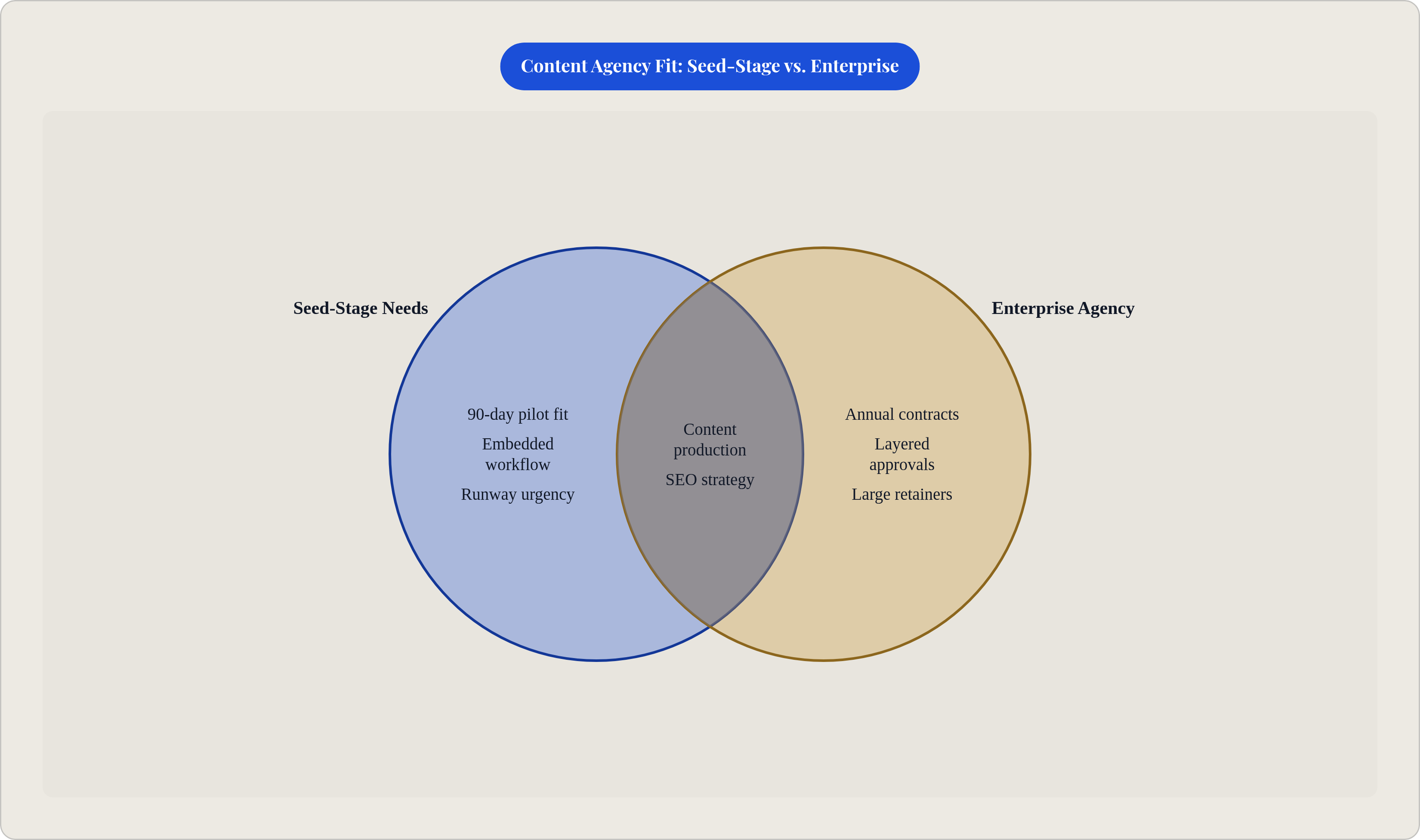
Enterprise agencies are built for enterprise clients. Large retainers, annual contracts, minimum project sizes that assume you have a fully staffed marketing function. That is a structural mismatch for a seed-stage company that needs to validate the engagement before betting on it.
The right agency for your stage understands that the engagement needs to prove ROI quickly enough to justify renewal. It should not require a leap of faith measured in annual contract value.
How the agency market actually breaks down — and where the traps are
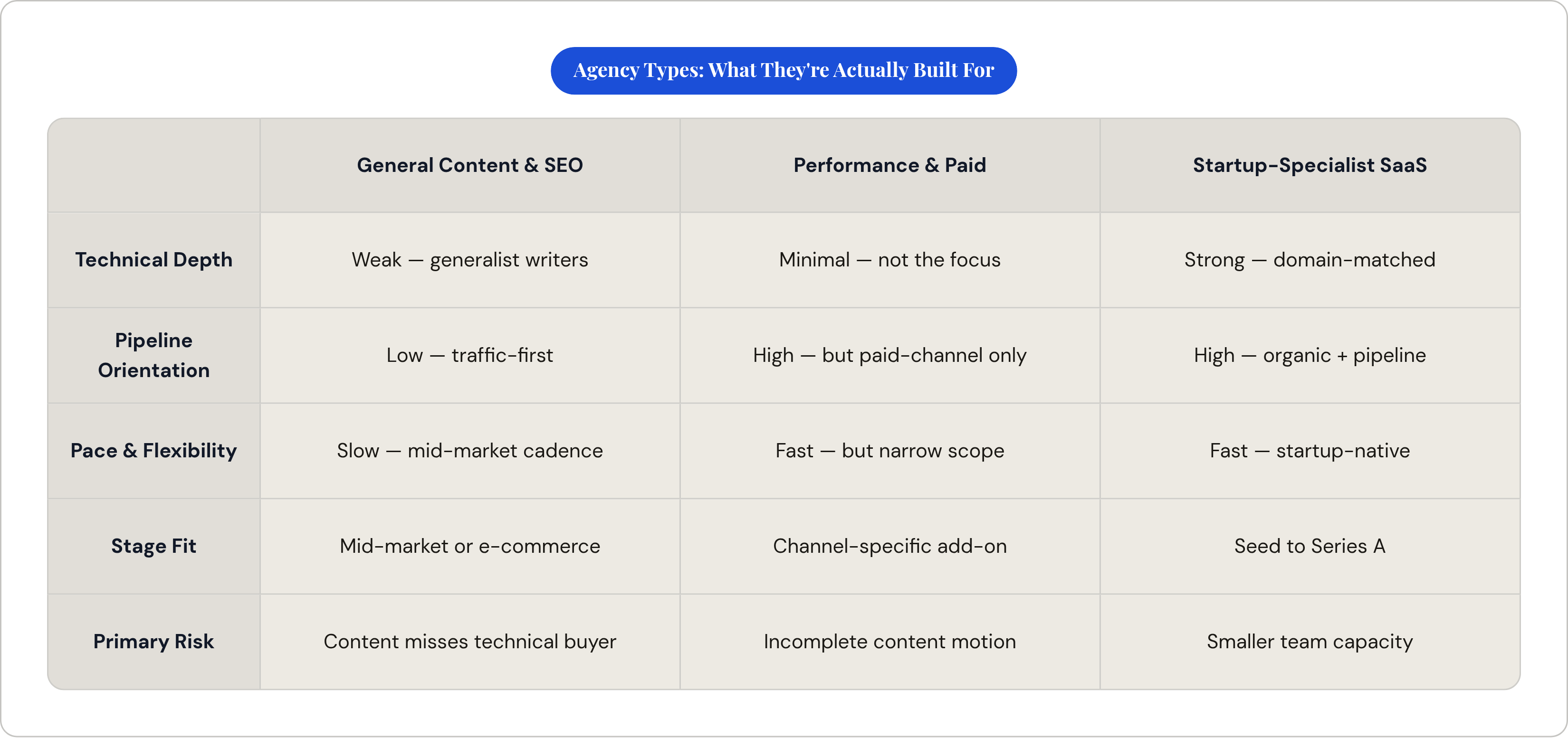
The agency market runs from budget social-media shops to full-service enterprise retainers, with genuinely nothing in between that is obvious from the outside. Most of what shows up in "top agency" roundup articles is built for neither a seed-stage budget nor a technical B2B product. Here is a more honest map.
General content and SEO agencies. Strong on mechanics. Weak on technical depth and startup pace. Usually calibrated for mid-market companies or e-commerce, not early-stage B2B.
Performance and paid acquisition agencies. Pipeline-oriented, but often light on organic content strategy. Useful for specific channels. Not a complete content motion on their own.
Startup-specialist and SaaS-focused agencies. Designed for the stage. Smaller teams, faster turnaround, pricing built around seed-stage budgets. This is the category worth evaluating seriously.
The traps are worth naming, because founders fall into them repeatedly and they are mostly avoidable.
Hiring a well-known agency whose case studies are all Series B or enterprise clients. The workflow, the expectations, and the pricing are calibrated for a different company. You will pay for infrastructure you do not need and get a process that moves too slowly to matter.
Choosing based on portfolio aesthetics. Good-looking content and pipeline-driving content are genuinely different things. Ask for evidence of pipeline outcomes in a comparable vertical, not examples of posts you personally found interesting.
Signing an annual contract before validating fit. A 90-day pilot is the appropriate first commitment. Anything longer before you have seen real output is a bet you should not make.
Treating content as separate from positioning. Agencies that skip your ICP definition and messaging architecture and move straight to production will produce content that misses the buyer. Nine times out of ten, generic execution is a positioning problem wearing a content problem's clothes.
Agencies that appear frequently in the SaaS and tech startup space — and what they are actually built for
Read each of these against the criteria from the previous section. This is not a ranking.
Animalz is known for editorial quality and depth. They do well with B2B companies where the goal is building a distinctive, credible voice with a sophisticated buyer audience. If trust-building with a discerning reader is your primary content goal, they are worth evaluating.
Optimist sits at the intersection of storytelling and SEO. Their work for Glide is a frequently cited example of turning a blog program into a meaningful source of qualified traffic for an earlier-stage company. A reasonable fit if organic search is your primary acquisition channel and you have the patience for that to compound.
MADX Digital is positioned around organic growth for B2B SaaS with a startup-friendly pricing structure. They are noted for understanding both conventional SEO and how AI-powered search is changing buyer behavior, which matters more than it did two years ago. More accessible at seed stage than some larger agencies.
Skale is built specifically for SaaS startups targeting high-intent organic acquisition. They combine technical SEO, content strategy, and link building with an explicit pipeline focus. Worth considering for companies in competitive SaaS categories trying to reduce dependence on paid acquisition over time.
Omniscient Digital was founded by alumni of HubSpot and Shopify and plays a longer strategic game that integrates SEO into broader marketing infrastructure. Their pricing sits at the higher end of the startup-agency range. Better suited to companies approaching or past product-market fit with a larger content budget.
NoGood puts a heavy emphasis on data, analytics, and measurable growth. A fit for founders who want reporting transparency and clear attribution. They also cover growth marketing more broadly beyond content alone.
Draft.dev focuses specifically on developer and technical audiences. They operate a large network of vetted writers with genuine engineering backgrounds. If your ICP is developers or highly technical buyers and content accuracy is non-negotiable, Draft.dev was built for exactly that problem.
Growth Division is UK-based and exclusively startup-focused, with a track record in qualified lead generation for early-stage companies. Their work with Weavr is often cited as evidence of their ability to drive meaningful pipeline growth. Worth considering if lead volume is your primary content goal.
Pier is a hands-on fractional marketing team built specifically for seed-stage B2B founders. Most agencies serve startups as one segment among many. Pier takes only a small number of clients at a time, embeds directly into the founder's workflow via Slack, and handles strategy and execution across positioning, SEO, content, email, paid ads, and funnels. Built for founders who have raised early capital but cannot yet justify a full-time marketing hire, it covers the full motion rather than handing off a strategy deck and stepping back.
What to ask before signing — and how to structure the engagement
Questions worth asking
"Show me work you have produced for a company in my category with a comparable audience." Not just a vertical match. A buyer-sophistication match. A developer-facing security tool and a mid-market HR platform are both SaaS. They are not comparable references.
"How do you define success for the first 90 days, and what metrics will you report against?" A pipeline-oriented agency answers this in terms of qualified traffic, MQLs, or conversion rates. Not publish volume.
"How does your team stay current on our product and our ICP?" This answer tells you whether the agency embeds or operates at arm's length. There is a significant difference between "we have an onboarding questionnaire" and "we're in your Slack and we join your weekly sales sync." Both agencies will say they are aligned with your business. Only one of those answers describes a process that actually keeps them that way.
"What does your onboarding process look like, and how quickly can you produce first deliverables?" Pace compatibility matters more than most founders realize until they are two months in waiting on a strategy document.
Red flags in the response
- Success defined entirely in traffic or domain authority terms
- Case studies that are exclusively enterprise or post-Series B companies
- No clear explanation of how content connects to pipeline
- Minimum contract lengths that exceed a reasonable pilot period
How to structure the first engagement
Start with a project or a 90-day pilot before committing to a long retainer. Define two or three specific deliverables that can actually be measured. A piece that will appear in outbound sequences. A landing page anchored to the ICP's primary pain point. A piece targeting a high-intent keyword in the actual buying journey.
Agree on reporting cadence and the exact metrics that will determine whether the engagement continues. If the agency cannot commit to that structure, you have learned something important before you have signed anything.
One more thing on positioning. An agency cannot produce useful content without engaging seriously with who the buyer is and what problem the product solves. If the agency skips that conversation and moves straight to production, the content will be generic regardless of how polished it looks. And polished generic content is still money leaving your runway with nothing coming back.
When the right answer is an embedded partner rather than a traditional agency
The traditional agency model was designed for a company that already has an in-house marketing team. Strategy gets delivered, execution gets handed off, and someone on the client side manages the relationship and integrates the output into the business. It works because someone internal is connecting agency work to business reality every day.
At seed stage, that person does not exist. The founder is both the client and the only one who can translate product decisions into content decisions. A model that requires a marketing manager to function is a model that will break.
What embedded actually looks like
The agency sits inside your workflow rather than adjacent to it. Real-time access to product updates, sales feedback, and shifts in how your ICP is actually responding to your pitch. Not to a six-week-old intake document. Strategy and execution stay in the same conversation with the same people, which sounds obvious until you have experienced an agency that operates like a vendor instead of a collaborator.
Reporting is tied to investor-grade metrics from day one. CAC, pipeline velocity, MQL-to-customer conversion. Because those are the numbers that determine whether you raise your next round. A partner who is tracking against different numbers is, practically speaking, tracking against the wrong company.
The practical goal of this model is to reach an inflection point: a functioning, measurable marketing engine that a future marketing hire can actually inherit. Something with a documented strategy and evidence that it works. Not a folder of published posts with no clear line back to revenue.
Choosing an agency at seed stage is a bet. The question is whether external expertise can compress the time between "we have early traction" and "we have the growth story that closes a Series A." The right partner moves that timeline forward. The wrong one keeps the content calendar full while the runway shortens.