Growth Marketing Agencies Versus Performance Marketing Agencies
Performance agencies drive clicks; growth agencies own what happens after.

A performance agency operates at the top. The click, the impression, the lead form. Their job is to get someone to raise their hand, and they're genuinely good at it.
A growth agency operates everywhere the click goes after that.
That includes:
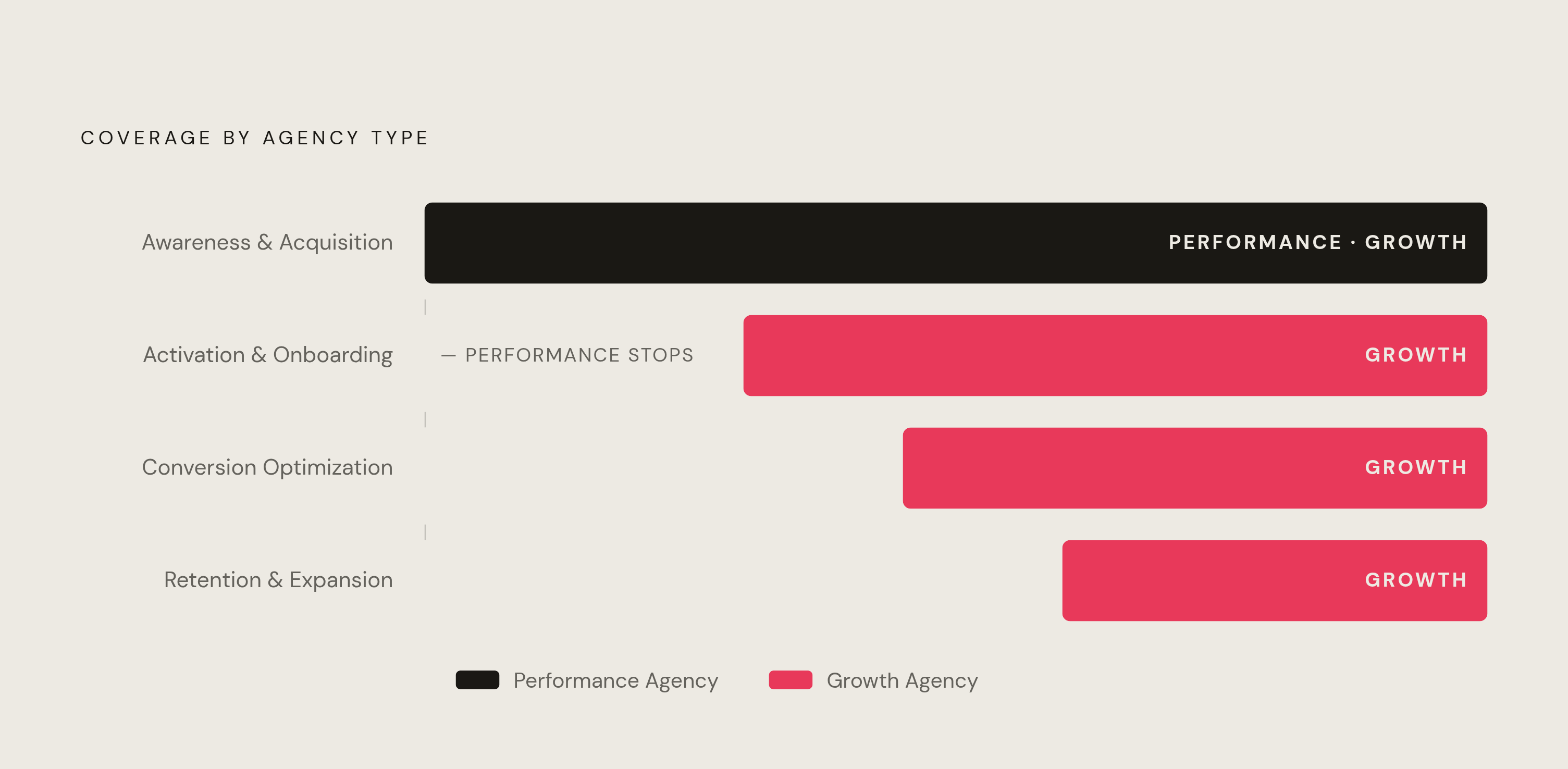
- Awareness and acquisition. Both agency types live here.
- Activation and onboarding. Growth agency only.
- Conversion optimization. Growth agency only.
- Retention and expansion. Growth agency only. This is where net revenue retention (NRR) actually gets built.
The value gap isn't at the top of the funnel. It's at every handoff point below it. The space between a clicked ad and a completed signup. Between a completed signup and a paying customer. Between a paying customer and an expanded account. That's where revenue either compounds or quietly bleeds out, and most founders don't find out which one it is until the runway is already half gone.
A performance agency hands off at the click. Job technically done. A growth agency owns what happens next. Which means they're the ones who notice when a paid campaign is driving solid click-through rates but the landing page isn't converting and there's no follow-up sequence in place. In that scenario, a performance agency reports a win. CPC is on target. A growth agency calls it a leak.
Growth marketing is genuinely harder to scope because the work is cross-functional and the handoffs are messy. Running a campaign is a contained project. Owning the full funnel means sitting inside product, sales, and marketing simultaneously, which is not how most agencies are structured, staffed, or priced. That's also why fewer of them actually do it well.
The decision rule for knowing which type of agency your situation calls for
This is simpler than most people make it.
Choose a performance agency when your funnel already converts, messaging and positioning are validated, and the only real constraint is acquisition cost and volume. You've confirmed the funnel works. You just need more people moving through it.
Choose a growth agency when revenue is flat despite reasonable traffic. Leads come in and go quiet. Trial signups don't convert. Customers churn faster than the projections assumed. In those cases, the problem isn't the ads. It's somewhere downstream, and a performance agency is not built to find it.
If you're not sure where the leak is: default to the growth agency. A performance agency can't diagnose what it doesn't measure.
Before you hire either type, answer these three questions honestly:
- Is traffic converting on your site? If not, more clicks won't fix it.
- Do you have a documented ICP and a repeatable sales narrative? If not, paid spend scales the wrong message.
- Are existing customers expanding or churning? NRR below 100% is a retention problem, not an acquisition problem.
A performance agency hired before you've worked through those questions will optimize a broken funnel faster. More spend flowing into the same leaky system. The pressure increases. The leak doesn't close.
Why seed-stage founders are almost always in growth agency territory
At seed stage, you are almost certainly still working out your ICP, pricing, and messaging. That's normal. But it also means the funnel isn't stable yet, and optimizing acquisition efficiency on an unstable funnel isn't a growth strategy. It's an expensive test with no control group.
The goal by the end of seed is a go-to-market motion that exists somewhere beyond your own head. A codified ICP. A documented narrative. Patterns extracted from early wins and losses that someone other than you could actually act on.
Performance marketing amplifies whatever message is already in the market. If that message is still fuzzy, paid spend scales the confusion. More people see something that doesn't land. CAC creeps up. Conversion stays flat. You blame the agency. The agency blames the creative. Neither of you looks at the actual problem.
Growth marketing at seed stage is diagnostic as much as it is executional. The job is to figure out what's working in the funnel before committing budget to scale it. That sequencing matters more than most founders realize until it's too late to redo it.
The runway math is what makes this genuinely consequential. Seed-stage companies typically have twelve to eighteen months to show customer traction before the next raise. Spending a meaningful chunk of that window optimizing the wrong layer isn't something you can fix in the final quarter. By then, the story is already written.
Channel guidance backs this up too. Under early ARR milestones, the highest-leverage plays are founder brand, LinkedIn presence, and product-led growth loops. Paid acquisition optimization is exactly what a performance agency is built to deliver. Hiring one before the positioning and funnel infrastructure exist to support it is a common and expensive version of putting the cart before the horse.
How unclear ICP and positioning undermine both agency types
An ICP is not "enterprises and midsize companies that use software." That's a description of a market. An ICP is a specific, measurable profile of the companies for whom your product creates the most value and who stick around longest.
The distance between those two definitions is where most early-stage marketing budgets disappear.
Teams with a documented, scored ICP report higher win rates and shorter sales cycles. The mechanism isn't mysterious. When you know exactly who you're selling to, every part of the funnel gets sharper. Ads are more targeted. Landing pages are more specific. Sales conversations move faster. Onboarding is more relevant. Retention improves because the right people bought for the right reasons.
A vague ICP is the hidden root cause behind high CAC, low conversion, and bloated ad spend. Those problems look like execution failures. They're actually upstream positioning failures. No agency can fix a problem that lives one layer above the funnel they're managing.
Positioning failure is also the most expensive kind because it disguises itself as other things. Long sales cycles. Low inbound conversion. Discounting pressure. Stalled pipeline. You'll try a dozen tactical fixes before anyone checks whether the message itself is actually landing.
There's another dynamic most founders don't account for. Buyers spend a small fraction of their total purchase journey in direct contact with you. Most of it happens in internal meetings you were never invited to. If your champion can't relay your value proposition clearly to a buying committee without you in the room, the deal is already in trouble before your agency's campaign gets anywhere near it.
What this means for agency selection is pretty direct. A growth agency that starts with ICP and positioning work is structurally different from one that starts with channel setup. One finds the leak before spending on acquisition. The other just fills the leaky bucket faster.
What growth agencies actually deliver that performance agencies don't
Here's what each type actually produces.
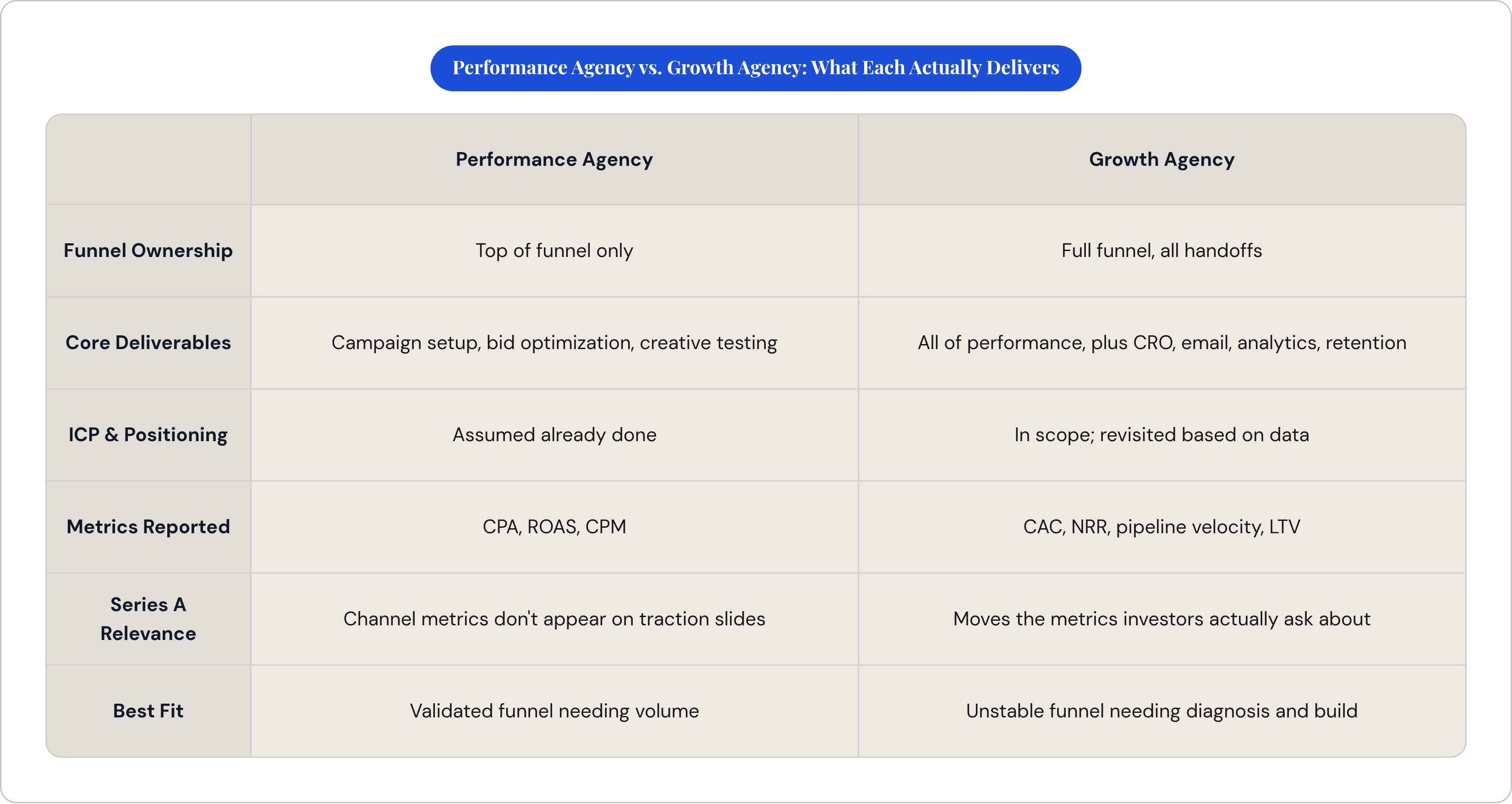
Performance agency deliverables:
- Campaign setup and management
- Bid optimization
- Creative testing at the ad level
- Channel-level reporting: ROAS, CPA, CPM
Growth agency deliverables (which include everything above, plus):
- Positioning and messaging refinement based on conversion data
- Landing page and conversion rate optimization
- Email and nurture sequence architecture tied to pipeline stages
- Analytics infrastructure: attribution, funnel tracking, CAC and LTV measurement
- Cross-channel strategy, meaning which channels to test and in what order based on your stage and ICP
- Retention signals: identifying early churn indicators and activation gaps
The cross-functional layer is where growth agencies actually earn their fee. A performance agency reports that cost-per-lead is on target. A growth agency asks why those leads aren't converting downstream, then traces it back to a messaging gap or a broken onboarding step. That's a fundamentally different kind of work, and it's worth being clear-eyed about the fact that most agencies aren't set up to do it.
There's also a delivery mode difference worth being honest about. An agency that hands you a strategy deck is a different thing from one that stays inside your workflow. At seed stage, the full-funnel engine doesn't exist yet. It needs to be built, not outlined. The agency that's in your Slack, knows your product roadmap, and is executing across positioning, paid, and email simultaneously is building the engine. The one that emails you a slide deck once a month is describing one.
Those are not the same engagement. They shouldn't be priced the same, and they won't produce the same results.
The investor traction metrics that reveal which funnel layer your agency was working
Series A benchmarks have gotten tighter. Median revenue at Series A reached roughly $2.5 million in 2025, meaningfully higher than it was just a few years ago. Investors have converged on specific thresholds across revenue, retention, and efficiency, and they're not particularly patient with founders who show up without a clean read on the numbers.
The metrics that actually come up in those conversations:
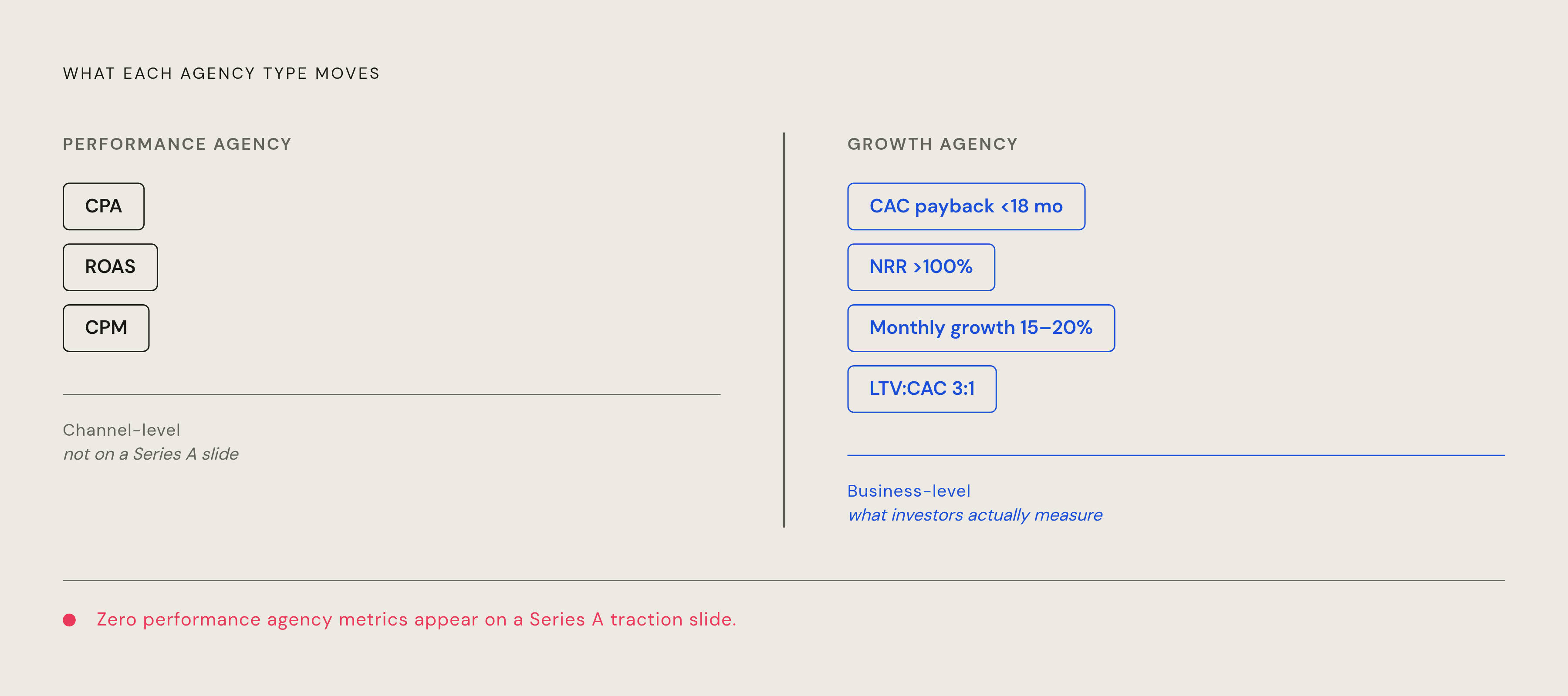
- NRR above 100%
- CAC payback under 18 months
- Monthly growth in the 15 to 20 percent range
- A 3:1 LTV to CAC ratio as a rough threshold for getting a second meeting
CAC payback above 18 months, NRR below 100%, or decelerating ARR growth are the specific numbers that end most Series A conversations early. Not slow. Early.
Now look at what each agency type actually moves.
Performance agencies move channel-level metrics: CPA, ROAS, CPM. None of those appear on a Series A traction slide.
Growth agencies move the metrics that do appear: CAC, pipeline velocity, activation rates, NRR. Because they own the full funnel that produces them.
The average gap between a meaningful seed round and a Series A has stretched to roughly two years. That's enough runway to build a marketing engine that compounds. It is not enough runway to spend the first half on the wrong agency type and expect to recover in the back half. The growth story your pitch tells is built from the metrics your marketing engine produced over the previous eighteen months. Not from channel-level ad performance. Investors can tell the difference, and they do.
How to evaluate whether an agency claiming to do growth marketing actually does
The label is not self-certifying. Plenty of agencies that call themselves growth shops report exclusively on Meta ROAS and Google CPA. The way to tell the difference is to ask what they measure, not what they call themselves.
Questions worth asking in any agency pitch conversation:
- What does your onboarding process include before you touch a paid channel?
- How do you figure out where the funnel is leaking before recommending a channel mix?
- Does your reporting cover channel KPIs, or business-level metrics like CAC and pipeline velocity?
- How do you handle ICP and positioning work? Is that in scope, or do you assume it's already done?
- Can you walk me through a case where you found a conversion or retention problem and changed the strategy because of it?
Signs you're actually looking at a performance agency with a growth label:
- Onboarding starts with account access and campaign setup, not a discovery session or funnel audit.
- Reporting templates are organized by channel, not by funnel stage or business outcome.
- CRO, email, and analytics are sold as add-ons rather than included in the core engagement.
- There's no process for revisiting positioning or ICP based on what campaigns reveal.
For seed-stage founders specifically, the right agency is one that can sit inside your workflow, understand your product, and execute across positioning, content, paid, and email at the same time. The full-funnel engine doesn't exist yet. It has to be built by one team that can see all the pieces simultaneously, not handed off to specialists who each own one slice and report to different dashboards.
You're not optimizing a machine at seed stage. You're building one. Hire accordingly.