Boutique Startup Agencies Versus Large Agency Networks
Boutique agencies beat big networks for seed-stage founders seeking speed and direct senior access.

Large agencies exist to solve large problems. Multi-market campaign rollouts. Massive media buys. Simultaneous production pipelines running across creative, paid, PR, and analytics all at once. These are genuine capabilities, and they are genuinely hard to build.
The organizational structure reflects that ambition. Hundreds or thousands of people, organized into specialized units, each owning a slice of a complex whole. When the problem requires that kind of breadth, this is the right machine.
A few scenarios where large agencies actually fit:
- Standardizing a campaign across many markets at the same time
- Running large media buys that require real buying power and platform relationships
- Managing multiple simultaneous production teams across different functions
- Clients with the budget and volume to justify that level of infrastructure
The problem is not the model. The problem is when someone who needs a different machine tries to buy this one anyway.
How Large Agency Economics Work Against Founders at This Stage
Here is the thing nobody brings up in the pitch meeting.
The senior strategists who walk you through a polished deck and ask smart questions about your positioning? They are often not the people who will actually do your work. Large agencies are staffed in layers. Senior talent wins accounts. Junior talent executes them. This is not negligence. It is just how the model works. You have probably seen something like this before: you hire a contractor based on the portfolio of the owner, and then someone you have never met shows up at your door.
So a seed-stage founder ends up paying senior-tier rates and receiving junior-tier execution. That is already a bad trade. But it compounds.
The retainer you sign covers infrastructure you will never touch. Sprawling offices, management layers, enterprise-grade toolsets built for clients running eight-figure campaigns. That overhead is baked into your invoice whether or not any of it comes near your account.
Then there is the attention problem. Your account is competing for senior bandwidth against a Fortune 500 brand with ten times your budget. You will not win that competition. The best people in the building follow the biggest contracts. Nobody has to say this out loud for it to be true. It is just the natural consequence of how those businesses are structured.
And the rhythm is off. Large agencies are built for proactive management at scale. Their review cadences often run quarterly. But at seed stage, you need to make channel and message decisions in weeks. A quarterly check-in is not a feedback loop. By the time it arrives, you have already made three decisions without it, and at least one of them was probably wrong.
You end up paying for overhead, seniority, and infrastructure you never receive, while missing the speed and direct access you actually need.
What Boutique Agencies Are Actually Built to Do — and Why That Structure Matters
Here is something the industry does not advertise loudly: boutique agencies are the norm, not the niche alternative. According to SparkToro's State of Digital Agencies 2024, two-thirds of all agencies have ten people or fewer. Small is the norm. Large is the exception that gets all the press.
The structural difference that matters most is where decision-making authority lives. In a boutique, it stays close to the work. Agency founders and senior practitioners are often directly involved in client accounts, not just in pitch meetings. When something needs to change, the person who changes it is usually the same person who made the original call. That is a fundamentally different dynamic than routing a request through an account manager who then talks to a strategist who then talks to someone on the execution team.
That creates speed as a structural outcome, not a differentiator they lead with in a proposal.
There is also a built-in accountability mechanism in how boutiques grow. Per SparkToro's 2024 data, referrals from past and existing clients are the dominant source of new business for boutique agencies. A shop that grows by referral cannot coast on brand prestige or a recognizable client roster. They have to keep producing results for the clients they have, or the pipeline dries up. It is a simple feedback loop, but it is a real one.
Boutique pricing also tends to be more transparent, without the overhead pass-through that inflates large agency costs.
What boutiques trade away is real, though. They are not equipped for massive media buys, multi-market simultaneous production, or deep in-house specialization across every function at once. The fit breaks down when the work genuinely requires that kind of scale. Any boutique worth trusting will tell you that before you sign anything.
What Seed-Stage Founders Actually Need from a Marketing Partner
The seed-stage problem is not awareness at scale. It is finding and converting a narrow ideal customer profile with limited time and limited runway, and then figuring out how to repeat that motion. That is the whole thing.
Most seed-stage founders are running disconnected tactics, doing some version of founder-led sales, and genuinely unsure which channels actually reach the people they are trying to sell to. They do not need a campaign. They need an engine.
The runway constraint makes this urgent. Twelve to eighteen months is a typical window to show customer traction before the next fundraise. Every quarter that produces no signal is a quarter you do not get back.
What this stage actually requires from a marketing partner:
- Direct access to senior judgment. Someone who can translate your product and positioning into a coherent go-to-market motion. Not a junior team executing a brief handed down from a strategist you met once during the pitch.
- Speed of iteration. Channel tests need pass/fail answers in weeks. Quarters are too slow.
- Embedded execution. Strategy that stays connected to the actual work. Not a deck that gets filed away after a kickoff call.
- Investor-ready metrics from day one. CAC, pipeline velocity, MQL-to-customer conversion. Built into the engagement from the start, not scrambled together three weeks before a fundraise.
- Flexibility to pivot. If the primary channel is failing to produce qualified pipeline, your partner needs to shift without running it through an approval chain first.
Any agency that leads with content volume or media spend before asking about your ICP is scaling a broken message. Keep walking.
None of those requirements map to the strengths of a large agency network. They map pretty cleanly to what a boutique built for this stage is structured to deliver.
Where Each Model Fits — and Where It Breaks
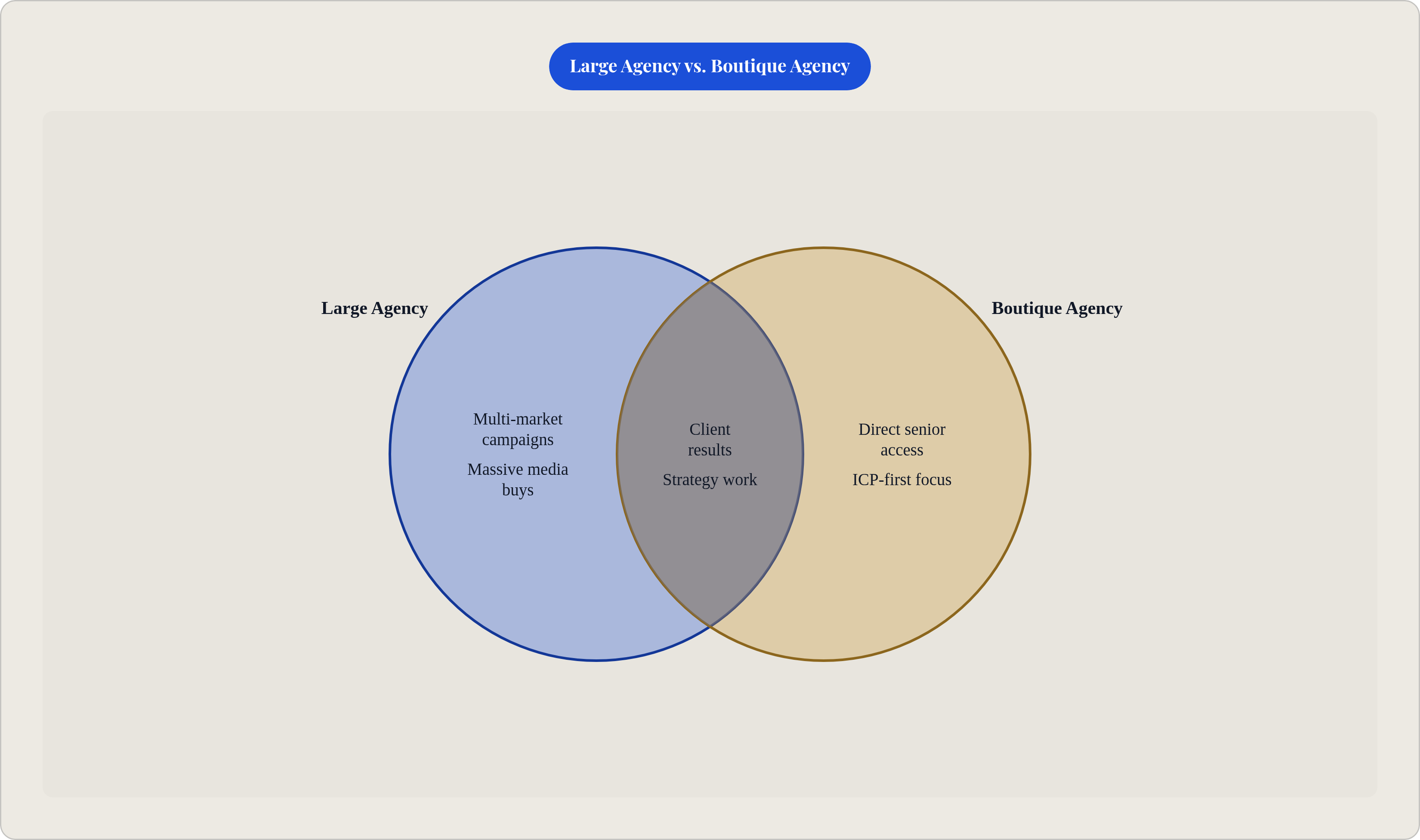
This is the simple version.
Large agency makes sense when:
- You need to standardize campaigns across many markets at the same time
- Media buying scale and established platform relationships are genuinely required
- Multiple simultaneous production teams are necessary for the scope of work
- Your budget comfortably covers enterprise-tier retainers and the infrastructure that comes with them
Boutique agency makes sense when:
- You need to find and convert a narrow ICP before you scale anything
- Speed of iteration and direct senior access matter more than breadth of in-house specialization
- You need someone embedded in the work, not a vendor managing a brief from a distance
- Your budget needs to produce measurable pipeline outcomes, not cover overhead
One more thing worth asking about directly: boutiques and independent practitioners adopt AI production tools faster than large agencies constrained by legacy workflows and approval layers. That compresses timelines and costs in ways that matter at this stage. This pattern is not guaranteed across every shop, but it is a real one.
Campaign's 2023 reporting also noted that boutiques are increasingly winning larger accounts, as clients of all sizes start prioritizing senior attention over brand name recognition. Make of that what you will.
For seed-stage founders specifically, the decision almost always points in the same direction. Not because boutiques are universally superior. Because the problem you are trying to solve is a boutique-scale problem.
What to Actually Evaluate When Choosing a Boutique Agency at This Stage
Start with the most important question, which has nothing to do with their service list.
Who is actually doing the work, and what does day-to-day access to them look like?
That question alone will disqualify a lot of shops quickly.
From there, a few things worth pressing on:
ICP-first orientation. Ask any prospective agency partner who their work is built for. Can they name the stage and buyer type they serve best? Research from The Starr Conspiracy reviewing agency positioning found that only a minority of agencies publish a documented ICP. The ones who can answer this question clearly are the ones who have already thought about fit before you showed up. That matters.
Execution depth, not strategy theater. The right partner can describe how they operate inside a client's workflow. What they build, what they measure, how they iterate. Not just which frameworks they use. Frameworks are not a deliverable. Anyone can name a framework.
Metric discipline from day one. Ask whether investor-relevant metrics like CAC, pipeline velocity, and conversion rates are built into the engagement from the start, or treated as a retrospective exercise. If it is the latter, you will be scrambling before your next fundraise. That is a bad place to be having that conversation.
Relevant track record. Experience with companies at a similar stage, similar average contract value, and similar go-to-market motion is more predictive than total years in business or the number of logos on a website. A long track record with enterprise clients tells you almost nothing about whether they can help you.
Pier is one example of what this model looks like in practice. It is purpose-built for seed-stage B2B founders, embedded directly in client workflows through Slack and product roadmap access, and executes across positioning, SEO, content, email, paid acquisition, and conversion. The explicit goal is building the traction story that closes a Series A.
The selection question is ultimately pretty simple. Does this agency understand the problem a seed-stage founder is actually trying to solve, and is the way they work structured to solve it? Or are they a generalist shop that happens to take startup clients when the pipeline is thin?
At seed stage, picking the wrong one is expensive in ways that show up long before you run out of money.