Proof of Demand Before Product Launch
Validate buyer urgency through founder outreach before you ever launch.
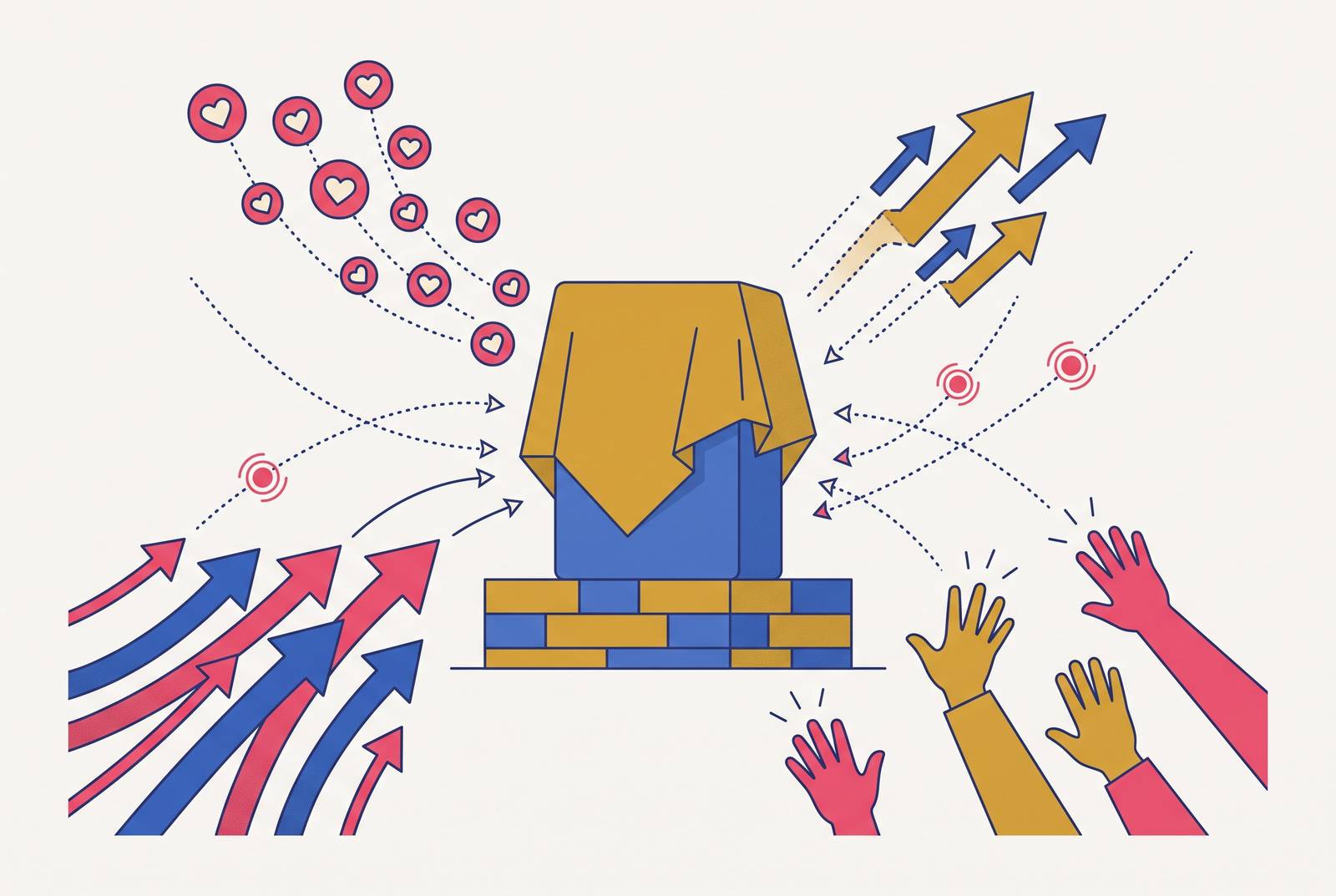
Most seed-stage B2B launches fail because the founder treats the launch itself as the research phase, waiting for the market to show up and prove the idea right on launch day. The pattern looks the same almost every time: build in private for months, announce publicly on a Tuesday, then wait for replies that never come. No pre-existing signal was collected. No warm audience was built. No evidence of pull existed before the "go live" button got pressed, so the launch has nothing to amplify. It's a megaphone with nothing plugged into it.
What's left behind is a collection of hopes dressed up as strategy: a landing page, a folder of warm intros, and a founder who can't answer who's actually buying, what problem they're paying to solve, or which channel reaches them. Asking that founder to name a growth channel to prioritize produces only silence. Without pre-launch demand signals, there's no way to tell investors a believable growth story, no way to pick a channel with confidence, and no way to separate genuine buyer interest from the polite nodding that happens on every sales call ever recorded.
The usual rebuttal is that the product will speak for itself once people try it. The right people never showed up in the first place, so that holds only until someone actually tries it.
What proof of demand means
Proof of demand is evidence, gathered before launch, that a specific group of people will trade something of real value, time, money, or a signed commitment, for the thing being built. It's the opposite of waiting around.
This is separate from product-market fit: PMF gets recognized after the fact, once customers are already using the product and the usage data tells the story. Proof of demand is collected before a single customer can even sign up. It's a design requirement for the pre-launch phase, not a grade given afterward.
The test for whether proof of demand exists is directional: is the market pulling the product toward itself, or is the founder pushing the product at a market that hasn't asked for it? Waitlist signups with no money or commitment attached don't count. Social media likes that never turn into an actual conversation don't count. Verbal enthusiasm on an exploratory call, the kind where every prospect says "this is so needed," doesn't count either, because free enthusiasm costs the prospect nothing.
What does count: a prospect booking a demo unprompted after reading something the founder wrote. A signed letter of intent or pilot agreement before the product fully exists. A reply rate on founder outbound that shows the problem framing is landing with the right people. The same question appears again in a community, worded almost identically to what the product solves. It is the real work.
Naming the buyer and the problem before any demand signal is worth collecting
None of those signals mean anything without knowing, specifically, who is being watched and what problem they need solved urgently enough to pay for it. An undefined ideal customer profile doesn't produce weak evidence, it produces no evidence at all, just noise that feels like progress.
A usable ICP names people, not categories like "fintech" or "mid-market. A usable ICP names the company profile, names the buyer's actual title, and names the trigger event that makes the problem worth a budget line right now. That last piece carries more weight than most founders give it. A new finance leader starting their first 90 days, a company that just raised a round, a platform migration forced by a vendor's price hike, a regulatory deadline six weeks out: these are what turn a problem from "mildly annoying" into "we need to fix this by Friday."
Even inside a two-person customer company, a B2B seed product is usually selling to four different people wearing different hats: the economic buyer who controls the budget and cares about the financial outcome, the technical evaluator who checks whether this thing will actually work without breaking something, the champion who carries the internal case because they feel the daily pain firsthand, and the end user who has to live with the new workflow. Missing one of the four means a deal that looked closed quietly stalls.
Knowing who doesn't qualify matters just as much as knowing who does. A written go-to-market plan, even a short one, forces three decisions a founder can't skip: which companies and buyers actually qualify, what business pain creates urgency to buy, and what a prospect needs to do this week, not eventually, to show real interest.
Skipping this step produces results like one particular two-person AI tooling company that said yes to every warm intro and launched across every channel at once. Activity went up. Calls got booked. Nothing repeatable came out the other end, because the infrastructure was running, it just wasn't pointed anywhere. Positioning built around an outcome beats positioning built around a category every time it's tested. "Resolve 40% of routine IT tickets autonomously" tells a buyer what they'd be getting. "AI-powered IT automation platform" tells them nothing they couldn't guess from ten other landing pages.
Founder-led outbound as the first instrument for testing whether demand exists
Once the buyer and the trigger are named, the fastest way to test whether any of it is real is for the founder to send the messages personally. At the seed stage, manual outreach from the founder is the single most reliable instrument available for finding out if demand exists.
The channels that matter here are plain: direct, personal outreach through a couple of simple channels, sent by the founder, one at a time. Not SDRs. Not an automated sequence blasted to a thousand contacts. Not a broad campaign designed to look busy. The founder sending these messages personally learns things no dashboard will ever show: how prospects describe the problem in their own words, which objections come up over and over, which phrases make someone sit up and reply.
Hiring SDRs at this stage hands an unproven message to the least experienced people in the building, and if the test fails after that, it's unclear whether the market doesn't exist or the message was just never any good to begin with. The message needs to survive contact with real prospects before it's handed to anyone else to repeat.
A clean outbound test produces three things: the reply rate, which tells the founder whether the problem framing is landing; the specific objections raised, which matter more than a positive reply because they expose what the pitch is missing; and the pattern of which titles respond versus which go quiet, which points toward where the pain actually sits inside the organization. The signal to watch for is a reply that uses the prospect's own words to describe the problem the product solves, because that's the sentence that gets reused later in the launch copy. Run the win/loss review after the very first outbound conversation, not after the tenth closed deal. Each one teaches something about whether the message fits the market before any product ever reaches the prospect's hands.
Letters of intent and pilot commitments as the strongest pre-launch evidence
A prospect willing to sign a letter of intent or pay for a pilot before the product fully ships is handing over a different category of evidence entirely, nothing like an engagement metric. It's proof the market will trade something of real value for the solution, not just attention for a few seconds.
The operating rule for B2B startups holds up well here: an LOI or a paid pilot is the strongest pre-launch demand signal available, because a prospect who won't say yes to a prototype won't say yes to the finished product either. If the "yes" can't survive the unfinished version, it won't survive the finished one.
An LOI tells an investor things a waitlist simply cannot. A named organization looked at the problem and decided it was worth a real commercial conversation. The founder's ICP definition was accurate enough to locate an actual buyer, not a hypothetical one. The pitch held up through a buying conversation, not just a friendly product demo where nobody has to commit to anything.
The common complaint is that LOIs are hard to get. They're hard to get when the ICP is vague and the problem framing is mushy. When the trigger event and the buyer's specific pain are named precisely, asking for a commitment becomes the next logical step in the outbound conversation already underway, not an awkward separate ask tacked on at the end. An early pilot, scoped around one measurable outcome the buyer actually cares about rather than a tour of every feature, produces a result the founder can carry into every conversation that follows. The three to five reference customers willing to take a call for the founder don't appear by accident. They're the downstream product of this whole process, and they're what turns a launch into something people talk about instead of a cold announcement nobody was waiting for.
Content and community presence as demand signals that surface inbound pull
Outbound tests whether a message works when pushed at someone. Content and community presence test whether the market moves toward the product on its own, with nobody pushing. When a founder publishes something that pulls in unprompted questions, bookmarks, and replies from people who fit the ICP, that's demand evidence of its own kind, separate from anything outbound can produce.
The mechanism is simple enough. Content published where the ICP already spends time (LinkedIn, a niche Slack community, an industry forum, a relevant Reddit thread) puts the exact words the market uses to describe its own problem on the page. Tracking how often people ask some version of "how do I solve X without Y" inside the product's category is its own kind of market thermometer. That question appearing repeatedly means a market that's ready for a specialized answer and hasn't found one yet.
Notion's early growth is the reference case here: content and community activity built a category around the product well before most people could see the product itself. What to publish before launch: opinions that name the problem directly and invite pushback, because disagreement in the replies is a signal too. Frameworks or small tools given away for free that attract exactly the buyer who'd pay for a fuller version. Anonymized stories pulled from early conversations that let someone in the ICP recognize their own situation on the page. When the same question keeps appearing in the same community and the founder's post keeps getting shared as the answer, a category is forming around the product before the product has even launched. Showing up well in AI search summaries and generative answer engines matters here too, since that's increasingly where the ICP's early research happens before a single human conversation ever starts.
Using a waitlist or pre-launch email list as a demand-testing instrument, not a vanity metric
A waitlist only counts as proof when the people on it did something that cost them a little effort to get there, and when the founder can sort them by problem, role, and urgency. Otherwise it's a list of people who were mildly curious for four seconds, not a list of buyers.
Building a waitlist page and sending targeted traffic to it through communities or narrow paid campaigns is a legitimate way to test demand, but only if that traffic is actually the ICP and not just anyone scrolling by. The fake-door test works the same way: promote a capability that doesn't exist yet and see whether the right people click through and ask for access. A click is weaker evidence than an LOI, sure, but a pattern of clicks from the right titles responding to the right pain point still means something.
A waitlist subscriber counts as a real signal, not a vanity number, when they came from a channel aimed at a named ICP, when they answered a question or two on the signup form (role, company size, what they use today), and when they opened and replied to the first email sent their way. A short list of serious people beats a long list of lukewarm ones, because relevance is easier to hold onto, feedback comes back faster, and early email exchanges double as a way to test offers and book calls. Size isn't the thing that makes a list useful. Quality is.
The pre-launch email sequence itself is a demand instrument, not a newsletter. A short run of emails sent before the product exists, built around the problem rather than the product, tests whether the ICP opens, replies, forwards, or does none of those things, and silence is informative in its own right. Every reply that uses a prospect's own words to describe their problem is raw material for the launch message, and it should get collected and sorted long before a single word of that message gets written.
Translating pre-launch signals into the positioning that makes a launch land
Everything gathered up to this point, the phrases prospects use, the objections that kept surfacing, the titles that replied, the problems that turned into signed LOIs, is the actual raw material for the one-liner that makes a launch click for the right buyer on first read.
Outcome-led messaging beats a category label because it names the result and names the villain, speaking directly to someone who has lived the problem. One useful exercise, from Paul Sullivan: write the one-liner, then write a second line defining who the product is explicitly not for. That second line does more work than it looks like it should, because it forces real positioning decisions early and lets the wrong-fit visitor rule themselves out on the page without ever needing a call.
The signals map onto the message directly. Phrases that kept repeating in prospect replies become headline language. The objection that came up most in outbound becomes the thing the launch page answers before anyone has to ask. The outcome that mattered most to the people who signed LOIs becomes the hero metric at the top of the page. The title that replied, and the title that went quiet, becomes the explicit sentence on the page naming who this is for.
A launch message built this way checks itself. When a prospect reads the page and says "this is exactly my problem," that reaction is itself a demand signal, proof the positioning worked before a single conversion was ever logged. Before going wide, the positioning statement should go in front of three to five people from the ICP who were never part of the outbound sequence. If they understand immediately who it's for and what it solves, the message is ready. If they start asking clarifying questions, it needs another pass.
The metrics that tell a founder whether pre-launch demand proof is sufficient to launch
A founder is ready to launch once the demand signals gathered so far add up to a coherent story about who's pulling the product and why, a story solid enough to survive a five-minute conversation with an investor without needing a slide deck to prop it up.
The minimum stack before a B2B seed launch looks like three things: a reply rate from personalized outbound confirming the problem framing lands with the right titles, a pre-launch email list sorted by role and urgency with open and reply behavior showing a genuinely high-intent audience, and a positioning statement tested on ICP contacts outside the outbound sequence who recognized their own problem immediately.
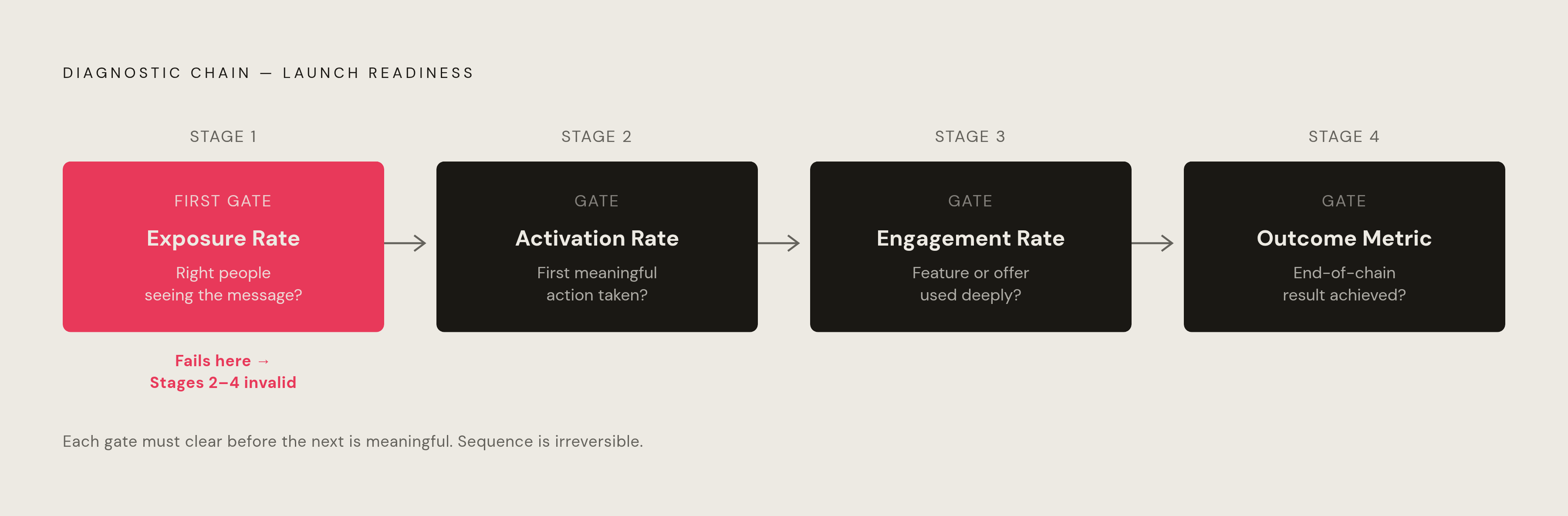
Four numbers diagnose readiness in order, and each one only matters if the one before it checks out. Exposure rate asks whether the right people are even seeing the message. Activation rate asks whether exposed people take the first meaningful action. Engagement rate measures how they interact with the specific feature or offer. The outcome metric sits at the end of the chain. A broken number early in that sequence makes everything downstream meaningless, no matter how good it looks in isolation.
Investors read momentum as a rate of change, not a snapshot, and the demand proof built before launch becomes the baseline that slope gets measured against. A launch that starts from a documented foundation can show a curve steepening from week one. A launch without one starts from zero every single time, no matter how good the product is.
What investors find genuinely legible: LOIs, reference customers willing to get on a call, and a dataset of reply rates from founder outbound. What doesn't count as readiness, no matter how good it feels to ship: a polished launch page, a Product Hunt listing, a press release, a content calendar queued up for the month. All of that amplifies demand that already exists. None of it creates demand where there wasn't any to begin with.
The practical test is this: if the launch announcement got deleted tomorrow, would there be any evidence left that someone, somewhere, actually wants this? If the honest answer is no, the pre-launch work isn't finished yet, no matter how close the launch date looks on the calendar.