Content Marketing Strategy for Fundraising Founders
How to use content marketing to generate buyer demand and investor credibility simultaneously.

A seed-stage founder’s content marketing strategy has two jobs. It must generate buyer demand and establish credibility with investors before the first meeting. The strongest approach serves both audiences with the same work, starting with validated positioning, building content for buyers evaluating solutions, and measuring the results in units that belong on a traction slide.
Why investors research you before you pitch them, and what they find
Investors now research founders and markets through Perplexity, ChatGPT, and Gemini before an introductory call. That means the first impression may form before the founder has a chance to explain the business. The deck is not always the opening act. An investor can arrive with a view of the problem, the available solutions, and whether the founder seems to understand either.
A founder may write for the buyer searching for a solution without considering the investor researching the same problem space. Yet blog posts, founder LinkedIn content, and SEO topic clusters form part of the material AI search engines draw on. The audience changes, but the underlying evidence overlaps. A clear explanation of a buyer’s problem can establish both commercial relevance and the founder’s command of the subject.
Topical authority therefore has a role beyond attracting visitors. When a company surfaces as a credible player in relevant searches, an investor encounters evidence of its expertise before receiving a pitch. Alongside traction, it is a way to make the company’s understanding of its market visible beyond a slide titled “The Problem.
Content needs to answer questions that show buyer intent and how well the company knows its market. Boasts written for investors alongside articles written for buyers do not serve both groups in the same piece.
The structural reason seed-stage content is different from Series A content
Funding stage determines what content can realistically accomplish more than company age or headcount does. It shapes the available budget, the buyer trust already in place, and the time left for content and SEO to compound before the next raise. A seed-stage founder cannot assume those conditions resemble a Series A company’s. The calendar may look identical. The room for waiting does not.
At seed, the central question is whether a message resonates with a real buyer. That response provides evidence that the target buyer exists and recognizes the problem the company claims to solve. Traffic alone cannot establish either point. An article can draw readers who have no plans to buy, giving the founder attention but little evidence of demand.
This is why an awareness-first strategy can look productive while failing its fundraising purpose. The company publishes content that teaches people about broad topics and sees activity, but still has no clear link to commercial traction. The dashboard gets busier. The argument stays thin. With twelve to eighteen months of runway, time spent collecting the wrong signals is not merely a reporting inconvenience.
Each channel consumes scarce effort, but the combined activity may still leave the founder unable to identify a message that converts. The company lacks concentration long enough to learn what works. A generic content plan tends to miss this distinction because it treats publishing as the goal.
Positioning and ICP definition as the prerequisite that content depends on
Content written before positioning is validated compounds the wrong assumptions. A mistaken ideal customer profile, or ICP, leads to the wrong pain points, which lead to the wrong keywords and ultimately the wrong signals for investors. More publishing puts more of the budget behind spreading the error, even when that budget is mostly the founder’s evenings.
The correction starts with problem-first positioning. A feature explains what the product does, while positioning needs to explain the specific problem it solves for a specific person at a specific moment. That last part is easily lost. Without it, a company can name a plausible audience without explaining why anyone in that audience would act now.
An ICP needs to name the role, company type, stage, and trigger event. Consider a Head of Customer Success at a twenty-to-one-hundred-person B2B SaaS company that just crossed two hundred customers and is drowning in manual churn reporting. The role identifies the person with the problem, while the company type and stage narrow the setting. The trigger makes the need timely. “Customer success teams” is an audience description. The fuller definition gives content something concrete to address.
For founders, the practical work is to validate that description through customer interviews before turning it into a publishing plan. The purpose is to learn how buyers describe the problem, when it becomes urgent, and what they need to understand while evaluating solutions. Its output should be a prioritized set of content topics grounded in real buyer language, with the most urgent buying questions at the front of the queue.
A BOFU-first content architecture that generates both pipeline signals and investor-readable traction
Once those questions are clear, the first content should help buyers who are already weighing solutions. Bottom-of-funnel content, or BOFU content, starts close to a buying decision. That proximity makes conversion events measurable from day one. It gives the work a commercial test from the start.
The first pieces should include comparison pages, alternative pages, pricing guides, and problem-solution articles for buyers who are weighing their options. Comparisons help buyers weigh their options, pricing guides answer questions about cost, and problem-solution articles link a specific pain to a way to solve it. These are useful subjects because the buyer already has a reason to care. Content does not need to spend its entire length persuading someone that a problem exists.
For the investor audience, the value comes from both the substance and the response. A clear answer to a buying question shows how well the company knows its market, and the conversion events it leads to feed the CAC and pipeline velocity metrics that can support a traction slide. Expertise and evidence meet in the same asset. A polished article without buyer response provides only one side of that equation.
Founder-led LinkedIn content should run alongside this work as a channel for sharing it quickly. Founder profiles get far more engagement than brand accounts, and posts about running the company, frank lessons, and ways to frame the problem help show what the founder knows. The founder’s voice supplies context that a product page cannot always provide. Connecting those posts to the same buyer problems keeps the feed from becoming a separate publishing business with its own appetite for time.
Mental Momentum’s founder-led marketing research offers an 80-15-5 ratio that works as a practical calendar heuristic. Allocate eighty percent to educational value, fifteen percent to personal operational narrative, and five percent to direct promotion. Teaching builds buyer trust and AI citation authority, while accounts of running the company show how the founder thinks about the problem.
How to sequence content investment across the seed runway without spreading thin
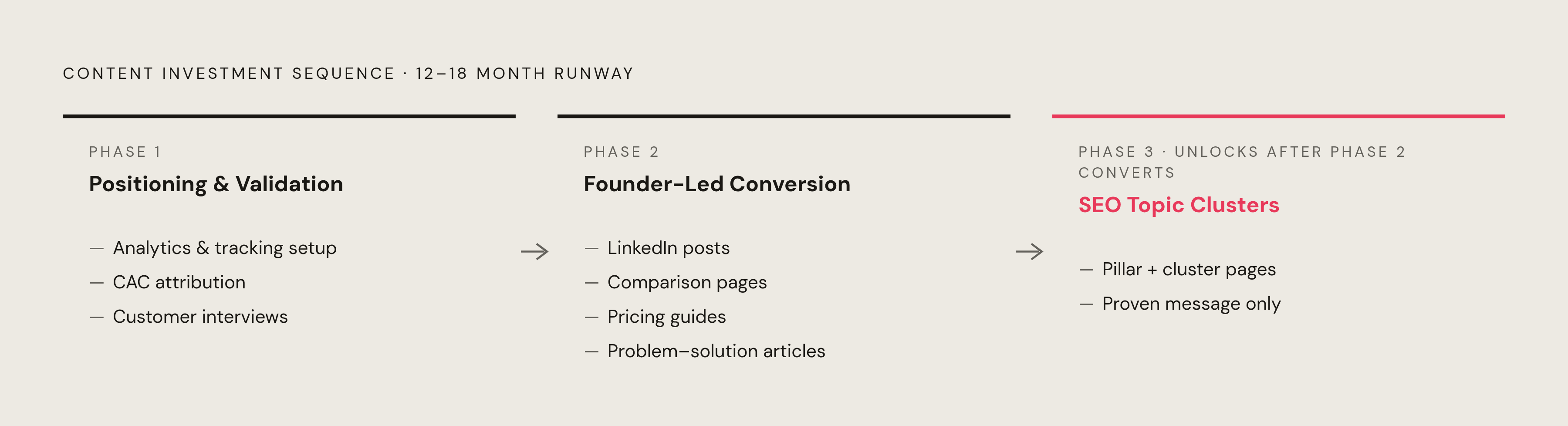
Across twelve to eighteen months of runway, the sequence should follow evidence rather than an urge to occupy every available channel. Phase 1 is positioning validation and customer interviews. The job is to identify the buyer, the trigger, and the language that will guide the first content. This is also when analytics setup, conversion event tracking, and CAC attribution by channel belong, so the first published work can produce usable evidence.
Phase 2 adds founder-led LinkedIn and a small set of BOFU blog posts. The posts address the evaluation questions uncovered in interviews, while the founder’s distribution gives those ideas a route to an audience. Scope stays deliberately narrow. The aim is to find a message that converts.
Once one message is proven to convert, Phase 3 layers in SEO topic clusters. The company can then cover more topics tied to a problem and buyer definition that have proved worth spending more on. The order is the safeguard. Expanding before that proof risks spreading an untested message across more pages, while expanding after it gives the larger content effort a commercial anchor.
The concentration principle applies to channels as well as topics. High-growth startups that master one channel before expanding are far more likely to attribute traction to that discipline than peers spreading resources across several channels at once. LinkedIn distribution and a small BOFU library need not become an excuse to launch every other format that appears in a marketing playbook.
AI workflow tools make that focused plan less demanding to operate. A two-person founding team using AI for drafting, repurposing, and scheduling can produce the output of a small marketing department in five to ten hours per week of operator time. The bandwidth objection is therefore weaker in 2026 than it was three years ago. But cheaper output does not make unvalidated positioning more accurate. With production less constrained, the next question is what the work produces beyond more work.
The metrics that connect content activity to the traction slide investors actually read
Content becomes fundraising infrastructure when its outputs are measured in the units investors use. Those include customer acquisition cost, or CAC, pipeline velocity, MQL-to-customer conversion rate, and net revenue retention. A large audience can be useful, but its size does not explain whether the company can turn interest into a business.
For the founder’s dashboard, that means stripping out total website traffic, LinkedIn follower count, total signups, app downloads, and total impressions as headline measures of traction. The number of demo requests also needs to be shown with a conversion rate. A waiting room full of prospects is not the same thing as revenue.
WaveUp’s pitch deck research says a traction slide should start with one vanity-free metric, such as ARR growth, active user growth, or LOI volume. It then calls for two to three supporting proofs, including retention, logos, and partnerships. Content-sourced pipeline and content-attributed CAC belong among those supporting proofs. Their role is to explain how acquisition contributes to traction.
The emerging “Search Query Report” practice adds a different kind of evidence to due diligence. Founders place documentation in their data rooms showing that their brand surfaces authoritatively in AI-powered search for relevant keywords. This makes topical authority visible rather than merely asserted. It can signal to Series A investors that acquisition cost will stay low as the company scales. Search visibility and measured customer acquisition answer related but distinct questions.
Analytics, conversion tracking, and channel-level CAC attribution are Phase 1 foundation work. Retrofitting them leaves the founder trying to explain results without the measurement built to support the explanation. The test of the strategy is straightforward. When fundraising begins, the content should have produced evidence about who buys, how they convert, and what acquisition costs, in addition to a folder of published articles.