What Counts as Traction for Seed and Series A Fundraising
Seed and Series A investors grade completely different evidence of business viability.

Picture two founders at the same demo day. One has a huge pile of signups and a chart that looks like a ski jump. The other has 60 paying customers and a spreadsheet full of retention numbers nobody outside the company has ever seen. Six months later, the ski jump founder can't raise a dime, and the spreadsheet founder closes a Series A. The word "traction" got used to describe both of their pitches, and that's exactly the problem: it isn't one standard, it's two, and they don't overlap nearly as much as founders assume.
Seed investors and Series A investors are not grading the same test. What earns a seed check can actively disqualify a company a year later, and what a Series A partner wants to see would have been a strange, premature ask at seed. The gap between those two definitions has also gotten wider on its own, structurally. CRV's analysis puts median Series A revenue at $2.5M in 2025, a bar that keeps climbing regardless of which way the broader funding market swings in any given quarter. None of this is a story about fundraising getting generically "harder." It's a story about two distinct proof-of-concept regimes, stacked one after the other, each demanding its own kind of evidence. Founders who build evidence for the wrong regime burn runway proving things nobody at their current stage is scoring them on, then show up to the next round empty-handed on the metrics that actually matter there.
What the seed stage is asking founders to prove
At seed, nobody is buying a finished business. Investors are buying a credible early signal, something that says this product creates real dependency for a specific type of customer, and this team can learn fast enough to find product-market fit before the cash runs out. That's the whole transaction.
Qualitative judgment still carries most of the weight at this stage. CRV's seed framework puts founder conviction, team quality, and market opportunity ahead of clean unit economics, which become meaningful only later, once there's enough revenue to measure them against. Polish matters less than whether the people running the company seem to understand what they're building and why.
Retention surprises most first-time founders, and it cuts against almost everything they've been told about growth. CRV's framework is blunt about it: a company with a small user base and flat retention by week eight beats a company with ten times the signups and a cliff at week two. Investors are watching for a shape, sometimes called the "smile curve," where early drop-off stabilizes. A huge spike in signups followed by a crash looks like a launch. A small, steady group of users who keep coming back looks like a business.
There's a second filter that trips founders up just as often: who, exactly, is doing the using. CRV notes that customers who are friends, former coworkers, or family don't prove the value proposition works for the actual addressable market. Paid acquisition can buy signups. It can't buy organic referrals, so when real strangers start recommending the product on their own, that carries more evidential weight than almost anything money can manufacture.
Pre-revenue, waitlist conversion and letters of intent do real work as stand-ins for sales. They show that target customers are willing to act, sign, commit, not merely nod along in a user interview. And founders are allowed to be uncertain about their own positioning at this stage. Repositioning frequently is normal, even expected, because what's being evaluated is learning speed, not a finished go-to-market thesis carved in stone.
Deep tech runs on a different clock entirely. Founder Institute's benchmarks substitute strong leadership, proof-of-concept technical work, and strong IP for revenue, because commercialization in those categories simply takes longer than a seed round's timeline allows. A biotech or hard-science company with zero revenue and strong IP is on schedule, not behind.
What ties all of this together is that seed traction is mostly qualitative: behavioral signal, organic demand, early retention shape. None of it is the kind of thing you can drop into a spreadsheet and defend line by line, which is what changes at Series A.
What Series A investors require
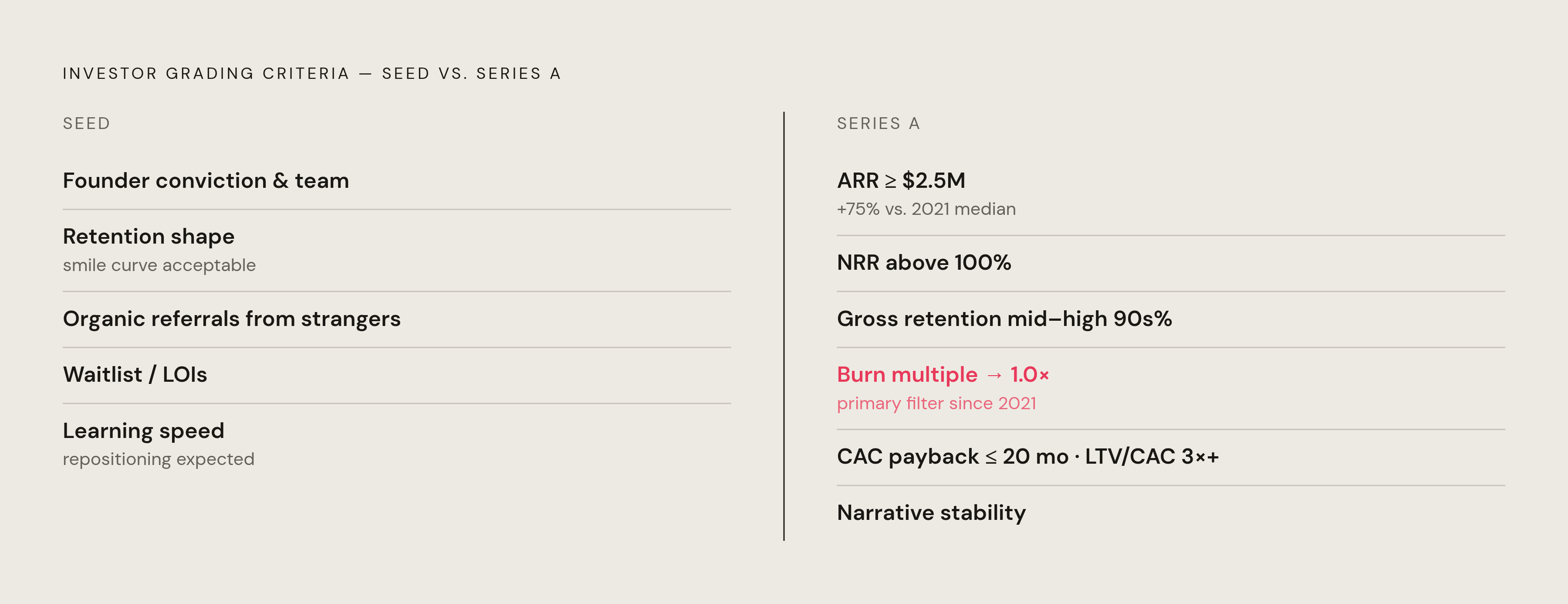
Series A investors are asking whether there's a revenue machine that scales, and the evidence they want is quantified, sustained, and comes at them from multiple angles at once.
Start with the headline number, because it's the one everyone fixates on, and then immediately complicate it, because the number alone tells you almost nothing. CRV's 2026 framework puts median Series A ARR at its 2025 level, roughly 75% higher than in 2021, with the real bar for many companies landing at several million dollars or more before a check gets signed. Investors pull apart customer concentration, contract structure, and how much of that ARR is renewal revenue versus new logos walking in the door. Two companies can post identical ARR and get completely different receptions, because one of them built it on five enterprise contracts that renew once a year and the other built it on a thousand tiny accounts that churn every quarter.
Net revenue retention above the breakeven point is the single clearest proof that existing customers expand their spend on their own, without the company having to go find new logos to cover the gap. CRV reports median NRR for B2B SaaS companies in its tracked ARR range sitting just above the breakeven point, with top performers pushing meaningfully higher. Gross revenue retention tells a related but separate story: strip out expansion revenue entirely, cap it at full retention, and you get a pure measure of whether customers stick around at all. CRV's data places median gross retention for private B2B SaaS in the high-80s to low-90s percentage range, and the companies that actually raise strong Series A rounds run in the mid-to-high 90s instead.
The metric that best captures how much the capital-efficiency bar has shifted is burn multiple: net cash burned divided by net new ARR. CRV's framework treats this as a primary filter now, not a secondary one. Exceptional companies run well below average on this number. Solid companies occupy a middle band. Anything well above that starts raising real concerns in a partner meeting. By the time a company reaches Series A, investors expect that multiple to be in strong territory, and the best-performing companies rank near the top of that range. This single number is, in a lot of ways, the whole 2021-to-now story compressed into one ratio: growth used to be enough on its own, and now growth has to come cheap.
CAC payback and LTV/CAC round out the quantitative picture. CRV reports CAC payback periods for private SaaS typically running around 20 months, with LTV/CAC needing to clear 3:1 as a baseline, and the companies that actually win term sheets clearing that floor by a wide margin.
A company that strings together strong month-over-month growth for six consecutive months or more reads as far more fundable than one that posted a huge single month followed by a flat stretch. Investors are trying to buy a repeatable engine, not a lucky quarter they happened to catch at the right moment.
AI companies are a genuine exception to a lot of this, with their own emerging standards around usage and deployment that don't map cleanly onto traditional SaaS benchmarks. For everyone else, there's one more soft signal investors are reading closely: narrative stability. Constant repositioning, which was perfectly normal at seed, reads as a red flag at Series A. It suggests the founding team still hasn't converged on who the customer is or what's actually driving growth.
These numbers appear only when the underlying systems are built well before a pitch, not assembled in the weeks beforehand. Hitting them requires building the underlying systems, contracts, cohort tracking, sales processes, that produce these figures in a form investors can verify and project forward. That's an operational build, not a spreadsheet exercise, and it's the subject of the rest of this piece.
The conversion cliff between seed and Series A
Fewer companies are making it from seed to Series A than used to, and the founders who stall out aren't simply underperforming. Many of them are running a playbook that used to work and no longer does.
The misread sits right at the start: a lot of founders still treat the seed round as runway to go find product-market fit, open-ended, exploratory, figure-it-out-as-you-go. Kruze Consulting's 2026 analysis describes a narrower current expectation: tightly scoped capital use aimed at hitting specific ARR milestones, validating one or two repeatable go-to-market motions, or proving out unit economics. The money is buying a defined set of proof points, on a clock.
Two forces collided to create this squeeze. During the 2020-2021 boom, seed got easy enough to raise that plenty of companies got funded who were never going to be Series A material in the first place, boom-era pricing papering over gaps that would normally have sunk a pitch. At the same time, Series A investors raised their own bar, swapping growth rate for capital efficiency as the primary filter sitting at the top of their checklist. Those two shifts together mean the seed round is no longer a reliable predictor of what comes next.
Kruze Consulting's read on the 2026 environment makes the shape of this concrete: fewer seed deals overall, but larger checks concentrating on teams that already show strong early revenue or usage signals. The middle is thinning out. A founder with an average, middle-of-the-pack set of metrics has a harder path now than that same founder would have had a few years back, not an easier one.
The reframe that actually helps: a seed round was never 12 months of exploratory runway. It's the foundation of a 20-plus-month evidence-building program, one that has to culminate in the specific, quantified proof points described above, net revenue retention, burn multiple, consistent month-over-month growth, before the Series A conversation even starts. Once that's clear, the seed round's actual job description comes into focus. It's the first phase of a build that has a very specific deliverable at the end of it.
Sequencing the build from seed close to Series A readiness
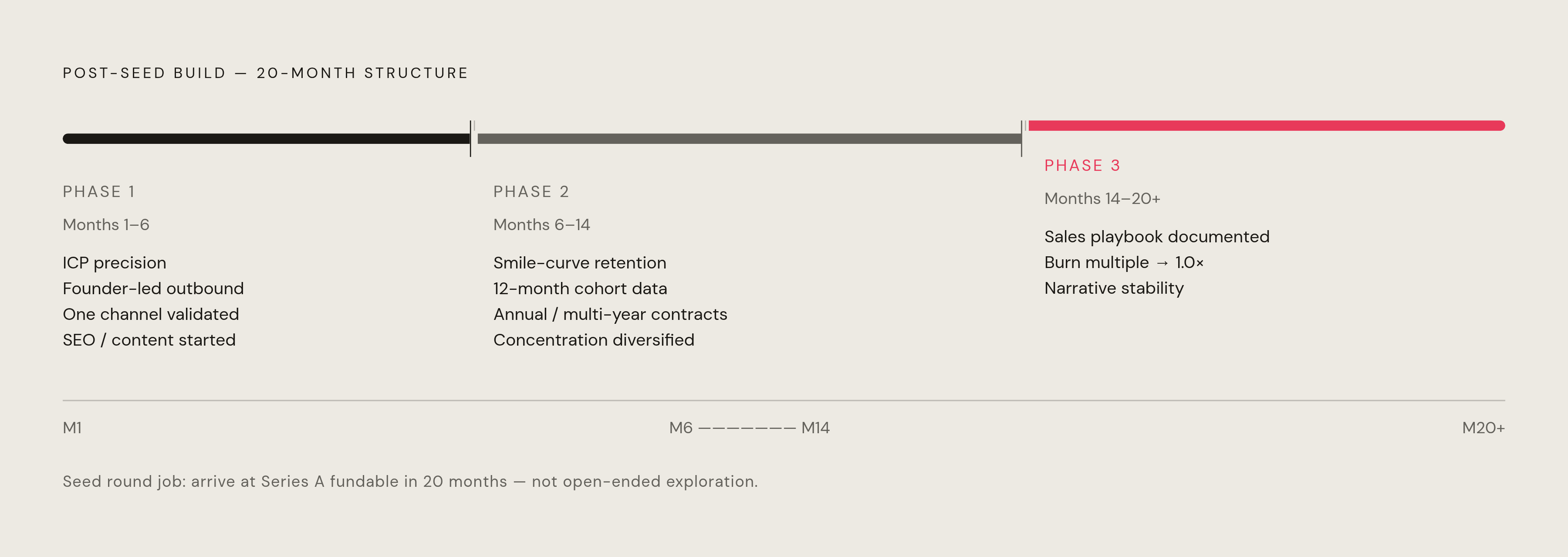
Getting from seed traction to Series A readiness doesn't mean doing more of the same thing, harder. It means running a deliberate sequence of proof points, each one built to answer the next investor's next question before anyone has to ask it out loud.
Phase one, months one through six post-seed, is about ICP precision and channel validation. Everything downstream, every metric an investor will eventually scrutinize, traces back to whether the company knows exactly who its customer is. A vague ideal customer profile produces scattered pipeline, inflated customer acquisition costs, and retention data so noisy that no pattern ever becomes legible to an outside investor. Founder-led outbound is the right primary motion during this window: it generates direct, unfiltered customer signal, keeps acquisition costs low, and produces the kind of conversation data that sharpens positioning long before paid channels enter the picture. Channel discipline matters as much as channel choice. Testing five channels at once with a small budget spread thin across all of them produces noise, not signal. One channel, validated all the way to conversion, is a real, fundable proof point. Five half-tested channels are not. Content and SEO work started in this window compounds quietly in the background, building a defensible organic acquisition base well before Series A due diligence begins, and it happens to be the activity most likely to generate the organic referral pattern investors read as genuine product-market fit.
Phase two, months six through fourteen, is about retention depth and revenue quality. The retention curve functions as the product's report card during this stretch, and the goal is that same "smile curve" from the seed section, early churn settling into steady long-term usage, which CRV treats as the clearest behavioral proof that a product has found people who actually need it. Logo retention and net revenue retention need to be tracked starting with the very first paying customer, not reconstructed retroactively once the Series A process kicks off, because Founder Institute's benchmarks tie Series A SaaS readiness to having a full 12 months of cohort data already in hand. Contract decisions made in this window, annual versus month-to-month, whether multi-year options get offered, directly shape the revenue quality investors will evaluate later. CRV notes that annual and multi-year contracts cut down on revenue forecast volatility, which is what an investor underwriting future growth wants to see. A deliberately diversified customer base built during this phase also heads off the concentration risk that occurs whenever one account represents an outsized share of total ARR.
Phase three, months fourteen through twenty and beyond, is about repeatability and capital efficiency. The goal here is proving the revenue engine runs without the founder personally pushing every deal across the line, a documented sales motion, a working content or inbound funnel, unit economics that hold up under scrutiny. Burn multiple should be trending toward 1.0x by this point, the level CRV associates with strong company performance, and getting there requires tracking net new ARR against cash burned starting early in the seed period rather than backfilling the math right before the Series A pitch deck goes out. When a founder eventually hands off sales to a first hire, that handoff should come with a documented playbook built from the founder's own closed deals. A new sales hire needs a process to execute, not an open-ended instruction to go invent one from scratch. And narrative stability, by this phase, has become an asset rather than an accident: a positioning statement that hasn't needed to change in months is itself a piece of evidence that the team finally understands who it's selling to.