Pitch Deck Structure and Slide Order for Seed Rounds
Arrange your seed pitch deck by investor questions, not founder instincts, to earn the meeting.

A seed pitch deck earns a meeting when its slide order follows investor questions. That means establishing the problem, showing early proof, and making a clear ask, with each slide answering the doubt raised by the last. The deck is a screening document. Even a gripping origin story cannot do a retention curve’s job.
Why investors screen decks the way they do, and what that means for slide order
Investors decide whether to take a meeting from the deck alone. Most of that decision happens in under four minutes. They are looking for investable ingredients. The round closes later, after due diligence and time spent building a relationship. For now, the deck needs to give them a reason to keep talking.
That screening follows three questions in order. Is the problem real? Is the market big enough? Can this team execute? These are questions about risk, so an answer offered before its context creates extra work for the reader. Describing a product cannot show why it matters if the customer’s problem is still unclear.
Out-of-order answers therefore read as confusion. The investor must hold an unsupported claim in mind while hunting for the evidence that makes it credible. That is a poor bargain in a short skim. The sequence of investor questions is the template. Founders who ignore it are building for themselves.
How founder instinct and investor logic pull the deck in opposite directions
Founders naturally tell the story in the order they lived it. First came the team, then the product, then a clearer understanding of the problem and market. Results and funding needs come at the end. That chronology feels honest because it follows the work. But it makes investors wait for the evidence they need to decide whether the work is worth funding.
Imagine a fictional deck that opens with team biographies, follows with a mission, and spends its next slides explaining the product. Only afterward does it name the customer’s pain. Team credibility has no problem to attach to, while the product forces the reader to reverse-engineer who might buy it.
Other ordering mistakes follow the same instinct. Showing market size before timing leaves investors with an idea of the opportunity but no sense of why it matters now, and an unclear ask at the end leaves the round itself unexplained. Moving the same content into investor order lets evidence answer objections before they form. A better font cannot save it that way.
The seed-stage slide sequence that mirrors investor screening logic
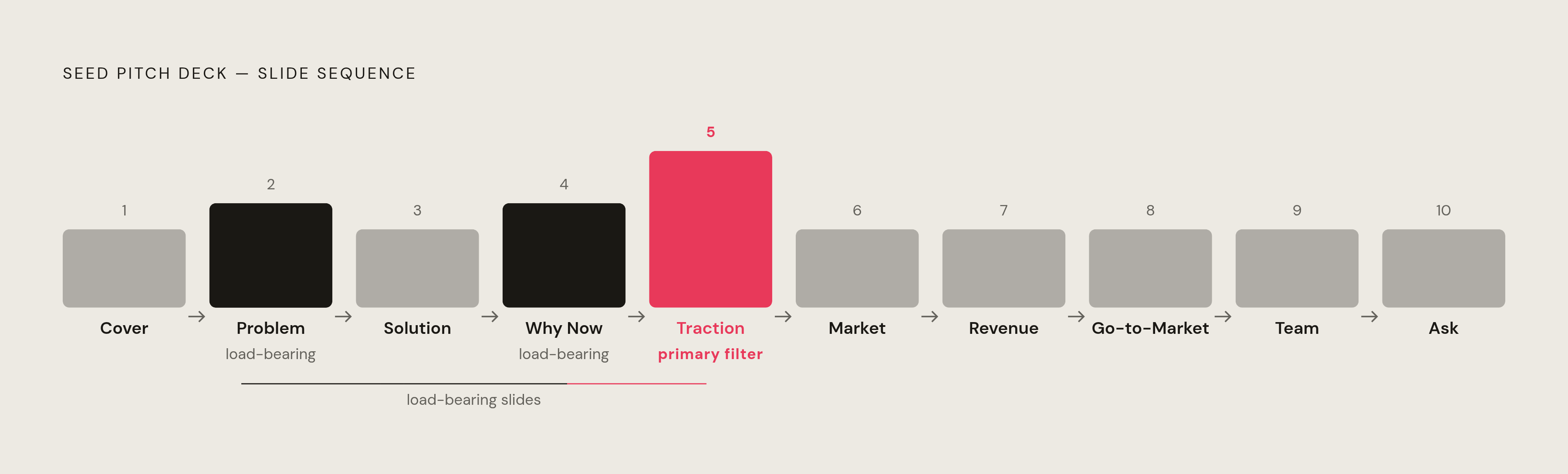
To fix this, build a main deck of 10 to 13 slides around the questions investors ask about risk. A compact sequence starts with the cover, then Problem, Solution, Why Now, and Traction. Problem establishes the need before Solution explains the response. Why Now gives that response urgency. Traction then shows whether the case holds up when customers try the product.
After traction, Market establishes the opportunity’s scale, a revenue model slide explains how the company makes money, and Go-to-Market shows how it reaches buyers. Team follows once the reader understands the work that needs doing. The Ask closes with the resources and milestone.
Traction belongs on slide five, earlier than slide eight or nine. At seed, evidence that the solution works is the primary screen, so market and acquisition claims need that foundation. The send file must make traction, team, and ask understandable without narration. The live-room file can rely on the founder to supply context as the conversation progresses. These are different reading conditions, even when the underlying case stays the same.
The three slides that determine whether the deck survives the first skim
Problem, Why Now, and Traction are the load-bearing slides. To diagnose the first, ask whether it names a specific persona, a measurable cost or frequency of pain, and the workaround that fails them today. “Companies struggle with X” describes a category. Customer interviews go here because they show that the founder has talked to people in the market. Analyst reports cannot take the place of knowing what someone actually does when the problem hits.
Why Now must explain what changed this year. A regulation that just passed, a platform shift that lowered infrastructure cost, or behavior that has already changed can supply that trigger. “AI just got good enough” does not, unless the slide explains the specific change. A growing market does not explain why now is the right time, either. Without a concrete trigger, the investor may see a company that is too early or a feature without a compelling reason to become a business.
Traction faces the toughest scrutiny at seed. Investors now ask questions they once saved for Series A, so a placeholder gives them a reason to pass. Use one chart with one metric that predicts revenue, such as revenue growth, a retention curve, or active users with stable engagement. Five axes make the investor look for an exit without delivering five times the proof.
Real traction is measurable, recurring, and unsubsidized. A Product Hunt spike is not the same as monthly actives with stable retention, while signed letters of intent from named B2B companies offer stronger pre-revenue evidence than an undifferentiated email waitlist. Efficiency also shapes how investors read growth. The burn multiple, net burn divided by net new ARR, helps show whether growth is being purchased at an unsustainable rate. Traction is the hinge on which the remaining slides gain or lose credibility.
What the GTM and ask slides must prove at seed specifically
The GTM slide should show what has been learned about acquiring customers. “Expand to enterprise next year” names a destination without a route. A stronger example is “outbound to Series A-stage VP Sales at 50-to-200-rep SaaS companies; twelve paid pilots closed this way”. One claims ambition, while the other identifies a buyer, a channel, and a result.
That specificity begins with the ideal customer profile, or ICP. At seed, founder-led prospecting should make a narrow target visible, including one to two industries, one headcount range, and one title. The B2B sequence starts with segment and buyer committee, then positioning, then channel. Name the first channel with evidence of working before the second. Otherwise, a channel plan can disguise an unresolved question about who buys.
The motion also needs a name, whether product-led, sales-led, or hybrid, because it shapes hiring, pricing, and the unit economics investors will evaluate at Series A. Hiring eight AEs before choosing the motion is payroll awaiting a theory. A credible slide shows the founder discovering repeatability.
The ask turns those lessons into a funding plan. It needs the amount, use of funds in three buckets, the milestone the raise will reach, and the runway it covers. An 18-to-24-month milestone helps investors judge whether the amount fits what the company says it will achieve. That milestone should represent the Series A threshold. Although the spending is prospective, its logic must rest on what the company has already learned, so investors can argue the plan.
How the deck must change depending on what stage of seed you are actually at
Pre-seed and seed use similar slide names to sell different kinds of confidence. At pre-seed, investors are buying team and insight. At seed, they expect early signs that the solution works and customers return. A pre-seed company should keep its claims in line with what little evidence it has.
The comparison is clearest slide by slide. Insight at pre-seed does the heavy lifting that Traction does at seed, revealing what the founder sees that others do not and why the problem is now solvable. Team should therefore take up more of the story at pre-seed. At seed, traction moves to slide five as the primary filter, with retention quality taking precedence over raw user counts. Downloads show that people are interested, but only their return shows demand.
GTM and the revenue model also become more specific at seed because the founder should have begun discovering what works. At pre-seed, spend less time on detailed hiring plans, five-year P&L projections, and long product roadmaps. Precision is useful only when there is something underneath it. Across both stages, however, the problem must remain specific, Why Now must explain a concrete change, and the ask must anchor the raise to a milestone.
Building the marketing and traction story that makes the deck defensible in the room
Strong traction, GTM, and market slides depend on work that precedes deck construction. The operational sequence is to nail ICP and positioning, validate them through customer interviews, and run outbound for near-term pipeline while building content for long-term organic growth. Spreading effort across five channels at once produces no meaningful progress on any of them. More activity is not automatically more evidence. The deck can surface a working early marketing engine, but it cannot manufacture one.
Founder-led outbound is a legitimate first channel. Founder-sent outreach sees roughly 20 to 30 percent higher reply rates than SDR-sent outreach on the same lists, so a working channel does not require a sales team. But reply rates alone are not the full investor story. CAC, pipeline velocity, and MQL-to-customer conversion need to be tracked from the start because investors use them to evaluate Series A readiness. Reconstructing them for fundraising is not a substitute for running the business with them.
Retention needs the same discipline from the outset. Net revenue retention shows the quality beneath raw growth and is the single number most predictive of whether a seed company can graduate to a Series A conversation. Founder-led marketing, meanwhile, is how the work starts. The deck implicitly shows how far the business has moved toward a system someone else can run. That transition gives the hiring plan context it cannot create for itself.
Where proof points are missing, embedded execution support can be more useful than another strategy document. A partner inside the workflow can understand the product roadmap and build and measure channel performance in real time. AI-powered workflows can also multiply a small team’s output. A discovery conversation can yield tagged transcripts, positioning signals, and content. Those outputs become investor-grade only when someone guides the work toward what the deck needs to prove.
The practical checklist for auditing a seed deck before it goes to investors
Give someone outside the company four minutes with the deck. Can they explain what the company does, what it has proven, and what it is raising without prompting? Then audit the order. Does Problem name the persona, the cost or how often the problem hits, and the workaround that failed? Does Why Now identify a concrete change?
Next, check whether Traction appears by slide five with one chart and one metric that predicts revenue. Claims of “growing fast” or “strong interest” require a measurable, recurring, and unsubsidized signal. Does GTM name a channel with evidence? Does Team follow product and traction, where its credentials have context? The ask must specify the amount, three spending buckets, runway, and an evaluable 18-to-24-month milestone.
For the cold-send test, read only the slide titles in order. They should tell the story without the body copy. Keep the main deck at 10 to 13 slides, with the full financial model, cap table, customer case studies, and product roadmap in an appendix for the room. If the audit exposes a missing validated channel, retention curve, or specific customer count, build that evidence before sending.