How to Build a Startup Marketing Stack From Scratch
Sequence your ICP, positioning, and channels before buying any tools.

Most early-stage marketing stacks fail for one reason: founders buy tools before they've answered the questions those tools depend on. A CRM, a paid ads account, an SEO platform, none of that matters if nobody has figured out who the product is for or why anyone should care.
Startup marketing is a discipline distinct from enterprise marketing. Big companies optimize channels that already work. Startups have to find out what works in the first place, usually while carrying zero brand recognition, no confirmed product-market fit, and a runway clock that doesn't pause for reflection. None of those three constraints, zero brand recognition, uncertain product-market fit, and existential time pressure, exist at an established company. That's why copying the enterprise playbook, or worse, copying the stack some other startup swears by, tends to produce noise instead of pipeline.
The damage from buying tools too early isn't just wasted subscription fees, either. A tool bought before ICP clarity locks in the wrong behavior, and once a team has built workflows, dashboards and habits around the wrong customer profile, unwinding it costs more time and money than getting it right the first time would have.
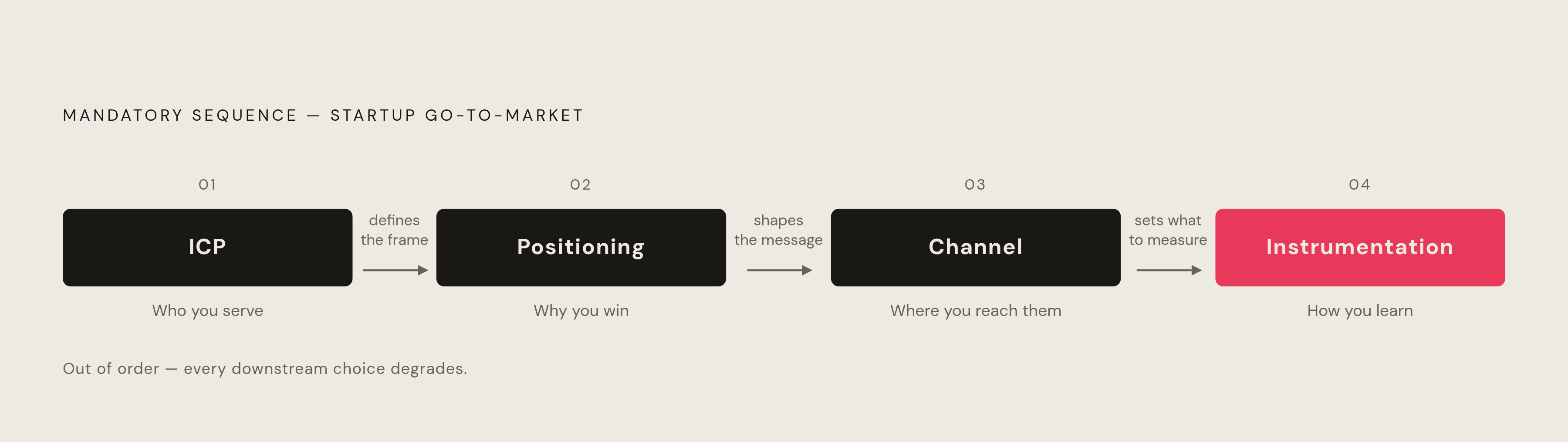
Sequencing fixes it, not shopping. ICP comes first, then positioning, then the channel decision, then the instrumentation that measures it all. Each step depends on the one before it, so doing them out of order degrades every choice downstream. That's the frame for everything that follows in this piece.
What the 2026 environment changed about building a stack
Three forces in 2026 have made channel-first, generic marketing more expensive and less effective than it used to be, and together they turn disciplined sequencing from a nice-to-have into a genuine competitive edge.
AI-generated content has flooded every text channel available. Generic content is now functionally invisible, and the only way out of that flood is specificity, which starts with a precise ICP, not with publishing more.
Search itself has changed shape, too. A majority of Google searches now end without anyone clicking a link, because AI Overviews, featured snippets and knowledge panels answer the question right there on the results page. Building a content engine before positioning is locked in means publishing into a channel that swallows undifferentiated content whole, no click, no visit, no lead.
There's an upside buried in this shift, though. AI-referred visitors convert at a meaningfully higher rate than traditional organic visitors. Catching that traffic isn't a matter of chasing a new algorithm trick. It requires content built around a precise, known ICP, the exact thing most startups skip.
Together, these forces don't punish startups for moving slowly, they punish startups for building their stack in the wrong order.
Validating product-market fit before any stack decision
Before any tool gets bought or any channel gets chosen, founders need a signal that product-market fit is real enough to justify spending real money on growth. Without that signal, every channel decision is a bet placed on a target that's still moving.
At this stage, marketing is a learning function, and the goal is speed to learning rather than speed to scale. The tool for measuring that is the Sean Ellis test: survey users with a single question, how would they feel if they could no longer use the product, and count how many say "very disappointed." A threshold of 40% or more clears the bar for growth investment. Below that number, paid channels and content investment aren't justified yet.
What to do at this stage instead: 10–15 personalized outreaches a day, 50 cold emails a week, and participation in the communities where the ICP gathers. Hearing directly why people say yes, why they say no, and the specific words they use to describe their own problem matters more than any of that.
Skip the marketer hire. Skip the paid ads account. Skip SEO and content entirely, because all three assume a stable ICP and validated messaging that doesn't exist yet at this stage. Every one of those founder-led conversations becomes raw material for the ICP and positioning work that comes next, which makes this stage the foundation of the stack rather than a detour from building it. As Y Combinator's Gustav Alstring put it, startups don't take off by themselves; founders have to manually recruit their first customers.
Building an ICP specific enough to drive decisions
An ICP earns its keep only when it works as a filter. "Startup founders" isn't an ICP, it's a category with millions of people in it, and a profile that vague functions the same as having no profile at all.
Separate the target market from the ICP early, because they're not the same thing. The target market is everyone who could conceivably buy the product. The ICP is the narrower group who should buy it, the group a company is uniquely positioned to help. Chasing the full addressable market instead dilutes the messaging, the product roadmap, and sales focus.
Firmographics alone (job title, company size, industry) don't cut it anymore. What matters more is what a company is doing right now and how ready it is to buy this month. Most B2B teams end up targeting the right title, at the wrong company, at the wrong moment, with the wrong message. B2B contact and company data decays at somewhere around 22.5% a year or more, so an ICP written once and filed away goes stale fast. Treat it as a living document, revisited on a schedule.
Write the ideal customer as a single paragraph, covering role, company stage, company size, budget, the specific pain they're dealing with, what they've already tried that failed, and what success looks like to them. A stranger reading that paragraph once should know exactly who's being described.
None of that should come from guesswork. Validate it with evidence: talk to a real number of customers and prospects before committing to any channel, check search console data to see which queries actually bring people to the site, and look at which existing customers closed fast, adopted without friction, renewed, and referred others. The patterns inside that cohort define the real ICP. A batch of fifteen to twenty discovery interviews before picking channels or writing a word of messaging tightens the ICP enough that every decision after it moves faster.
One more thing gets missed constantly: B2B purchases usually involve four or more decision-makers spread across different departments. Most B2B purchases involve four or more decision-makers from different departments, so an ICP built around a single end user ignores the other people who get a vote before the deal closes.
Translating ICP into positioning that passes the five-second test
Positioning is what turns ICP clarity into words that actually move a buyer to act. Without it, even the right channel and the right audience produce the wrong result, because nobody understands what's being offered fast enough to care.
Run everything through the five-second test. A stranger should understand what the product does and who it's for after reading the positioning statement exactly once. If it takes a paragraph of explanation to land, the positioning needs work.
A formula helps here: for [ICP] who [pain point], [product] is a [category] that [key benefit], unlike [alternative], because [differentiator]. That single sentence should end up driving the website copy, the content topics, the ad messaging and the sales conversations, so get it right before any of those get built.
The gap between weak and strong positioning usually comes down to specificity. "Companies struggling with sales productivity" is vague enough to mean nothing. "Companies where reps spend less than 30% of their time actually selling, buried in admin work and CRM updates" names the exact pain, in the buyer's own words, pulled straight from the founder-led conversations at the pre-PMF stage. That specificity doesn't come from a brainstorm. It comes from listening.
Outcomes beat features every time. "Reduce CRM data cleaning from a full working day each week to a matter of minutes" says something concrete and measurable. "Advanced AI-powered data hygiene" says nothing a buyer can picture.
Because most B2B deals involve several decision-makers across departments, one universal message won't land with all of them. Positioning needs to extend into a messaging ladder, with different proof points for the economic buyer, the day-to-day user, and the IT or legal reviewer who has to sign off. And positioning isn't a document to write once and forget. Revisit it whenever the ICP data refreshes and whenever sales conversations surface new language buyers are using to describe the problem.
Choosing the right GTM motion before picking any channel
The go-to-market motion decision comes before the channel decision. The go-to-market motion determines which channels even make sense, which metrics matter, and what the entire revenue infrastructure needs to look like. Picking channels before resolving this is building on ground that hasn't set yet.
Three motions cover most cases. Product-led growth fits low contract value, fast time-to-value and self-serve activation, where the product does the selling on its own. Sales-led growth fits high contract value, a complex buying committee and a longer sales cycle, where a human relationship is what actually closes the deal. Hybrid fits situations with mixed signals on deal size, or a product that benefits from self-serve onboarding on one end and a human-assisted close on the other.
This isn't a decision to make lightly, because reversing it is expensive. PLG demands product instrumentation, in-product activation flows and constant free-to-paid conversion optimization. SLG demands outbound infrastructure, a working CRM and sales enablement material. Building the wrong one doesn't just underperform, it burns runway that a seed-stage company doesn't have to spare.
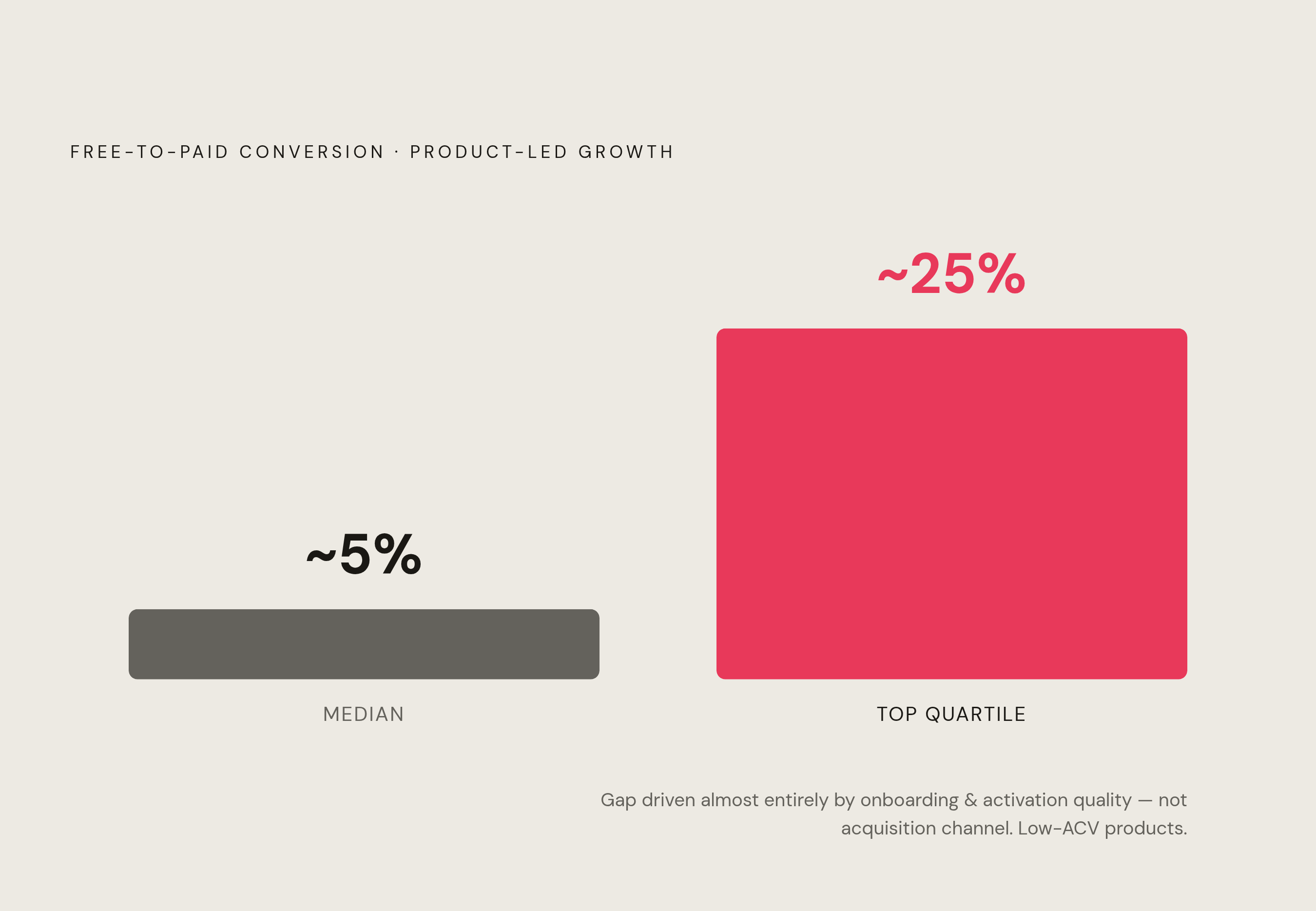
The gap between average and excellent execution inside PLG is enormous. Median free-to-paid conversion across PLG companies is in the single digits, while top-quartile performers convert roughly a quarter of users on low-ACV products. That gap is almost entirely about onboarding and activation quality, not about which channel brought the user in.
The motion also decides which numbers matter to investors. PLG companies lead conversations with activation rate and free-to-paid conversion. SLG companies lead with pipeline velocity and CAC payback.
Committing to a single primary channel for ninety days
Spreading effort across five channels at shallow depth performs worse than running one channel with real depth, and the ninety-day commitment is the discipline that turns a channel guess into an actual signal.
The most common failure: founders run five to eight channels at once, doing all of them halfway, and none of them ever gets deep enough to produce a signal worth trusting. Everything looks busy. Nothing actually works, because nothing got the attention it needed to work.
Paid channels carry a particular trap. Andrew Chen has documented that many of the biggest startup collapses trace back to getting hooked on paid marketing while founders fooled themselves about their real CAC. As spend scales, paid gets more expensive and harder to track accurately, never the reverse.
Running one channel deeply produces better results than running five channels at shallow depth, and the ninety-day commitment turns channel selection into channel signal. Pick one primary channel. Set a pass or fail threshold in week one, before any spending starts. Run it for ninety straight days; only add a second channel once the first is showing real leading indicators, reply rates, click-through rates, engagement that's actually moving.
Picking that first channel isn't a coin flip. Map where the ICP already goes looking for solutions, score each option on reach, cost per qualified touch, and how long the cycle runs, then cut anything that can't be tested properly with the budget on hand.
For most B2B seed-stage startups, the answer to which channel goes first is consistent: content, SEO and GEO together, as one primary channel. It's treated as non-negotiable because, unlike most channels, it compounds over time. Secondary channels only get added once that primary channel is producing pipeline that repeats. Content marketing generates about three times more leads than outbound, at meaningfully lower cost, a figure that traces back to the Content Marketing Institute.
Building the content and SEO layer that compounds over time
Content and SEO only compound when they're built on top of a validated ICP and optimized for both traditional search and AI answer engines at the same time. Doing one without the other means leaving the highest-converting traffic sitting on the table, unclaimed.
The scale of the opportunity is bigger than it looks from the outside. B2B buyers complete roughly seventy percent of their journey before talking to sales, so at seed stage, content is the sales team for most of the funnel.
The mistake that undoes all of it: investing in SEO or a content engine before the ICP and messaging are stable. Articles built on a shaky foundation end up ranking for the wrong audience, or ranking fine and converting nobody, which wastes both cash and the compounding time that content is supposed to earn back.
Structure matters more than volume. Build around two to three core topics, each anchored by a pillar page with ten to twenty supporting articles underneath it. That cluster structure is what builds real entity authority with Google, rather than a pile of disconnected posts that never add up to anything.
Every piece published in 2026 needs to work double duty: optimized for traditional SEO and for AI answer engines (AEO and GEO) at the same time. AI Overviews now show up across a large share of Google queries, and AI-referred visitors convert at a noticeably higher rate than regular organic traffic, yet most competitors still aren't optimizing for it, leaving that gap open as an opening for now.
Cadence matters less than precision. Two or three pieces a week, each one dual-optimized for SEO and GEO, beats daily publishing of generic content in an AI-flooded channel environment. Slower and sharper wins over faster and forgettable, especially in a channel where forgettable content doesn't even get remembered long enough to be ignored.