CAC vs CPA and Why the Difference Matters for Startups
CPA tracks campaigns; CAC tracks whether your business can actually survive its growth.

CPA and CAC both measure what it costs to get someone to pay attention to you. That's about where the similarity ends. CPA tells you if a campaign is working; CAC tells you if the business is working. Mixing the two up is how seed-stage founders end up standing in front of a board deck that quietly doesn't add up, and it's the most avoidable mistake on this list.
What each metric is actually built to answer
CPA answers a narrow question: is this campaign, ad set, or channel converting efficiently enough to keep running? It's a scoreboard for a single game.
CAC answers a bigger question, and the honest version of that question is "can this company survive its own growth?" Does the business acquire customers at a cost the lifetime value of those customers can actually justify?
The org chart tends to mirror this split, whether anyone planned it that way or not. A paid-acquisition manager lives inside CPA every day, tweaking bids and swapping out creative. The CEO and the board live inside CAC every quarter, staring at a number that either supports the growth story or quietly undermines it.
Here's the part that trips people up: a campaign can post a great CPA while CAC is broken underneath it. If sales headcount, tooling, and content production are expensive, shaving a few dollars off campaign-level CPA barely moves the business-level number. It's like bragging about your car's gas mileage while ignoring that you're leasing three cars you never drive.
The reverse happens too, and it's just as misleading. A single channel can run a rough CPA while blended CAC still looks healthy, because organic and referral are quietly doing the heavy lifting somewhere else in the mix.
Attribution has made CPA blurrier than it used to be, and that's the part most dashboards won't admit. Platform-reported CPA carries more uncertainty than it once did, and treating any single dashboard number as a definitive receipt has become harder to justify. Teams that take this seriously look beyond the dashboard number rather than treating it as gospel. So founders who only track CPA are flying with one instrument: they know if a campaign is cheap, but they have no idea if the business is efficient.
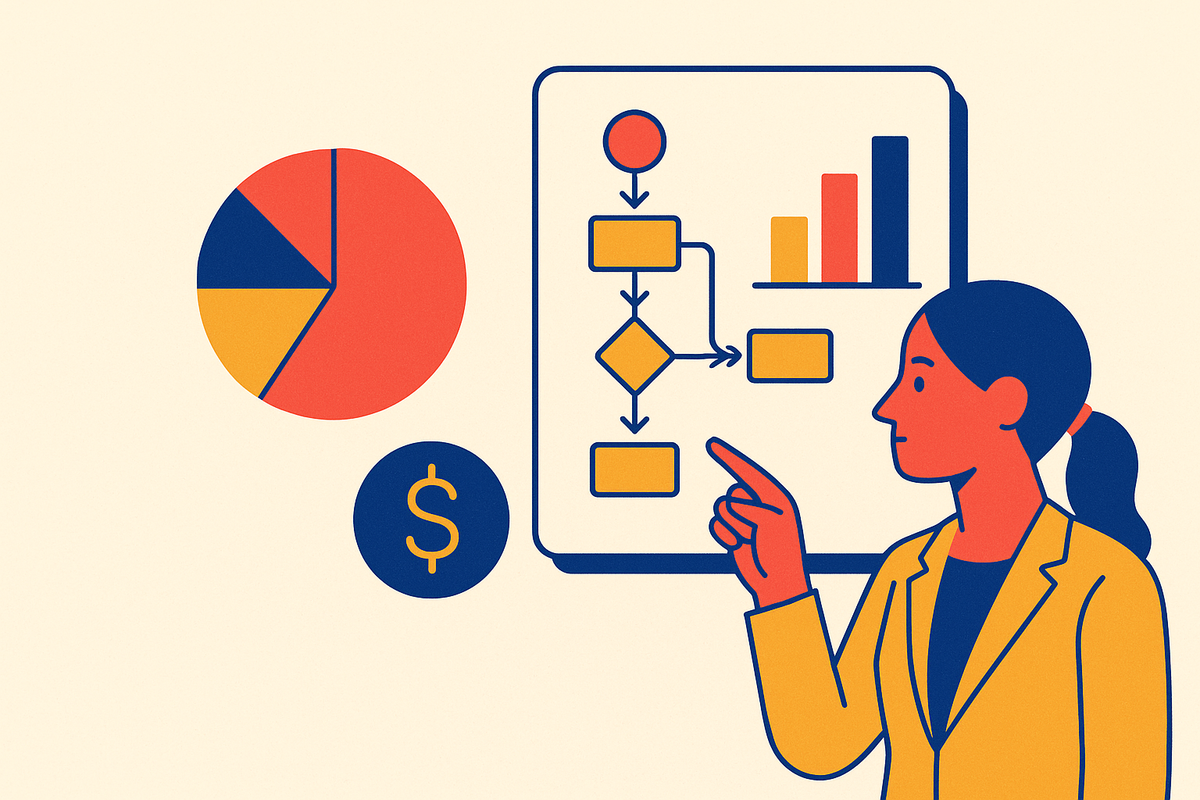
Picture a founder, called Dana here, three years into her first startup, standing at a whiteboard with two dials labeled CPA and CAC. She used to think they were the same dial wired to two different lightbulbs. Then a board member asked her, flatly, "If your CPA is this good, why is your runway shrinking?" Dana didn't have an answer that day, but she has one now, and it's the same answer this whole piece is built around: a cheap campaign and a healthy company are separate claims.
The moment confusing the two becomes expensive
Here's the classic version of the mistake. A founder sees a low CPA on a paid channel, scales the budget, and tells the team (and maybe the board) that acquisition cost is down. Nobody's counting the sales hours behind each conversion, or the onboarding cost, or the tooling stacked underneath it.
CAC balloons quietly while CPA sits there looking flat and innocent. Nobody notices until a board meeting or a fundraising conversation drags the full unit economics into the light, and at that point it isn't a small correction. It's a reckoning.
A second version is sneakier, because it looks like progress right up until it doesn't. Someone optimizes CPA so hard they cheapen the action itself, lowering friction on a free trial until conversion volume spikes and CPA drops. Reported "customers" go up while actual paying customers and their lifetime value quietly go down. Call it the acquisition equivalent of grading on a curve so generous that everyone passes and nobody actually learned anything.
At seed stage, one blind spot deserves to be named directly, because almost nobody names it: founder time. Founder-led sales hours are a real acquisition cost, and leaving them out of CAC makes the number look artificially lean, like a diet that doesn't count anything eaten standing up at the counter.
Quick riddle for anyone who's sat through a board meeting: what do a magician and a founder reporting CAC without founder time have in common? Both are hoping you don't notice what's happening just offstage.
The real damage sits in the decisions stacked on top of the mislabeled metric: hiring another paid-acquisition specialist, cutting content investment, declaring a channel "efficient" based on the wrong number. Those decisions compound quietly for months. Unwinding them a year later costs a lot more than getting the metric right in month one would have.
How investors read CAC when they look at a board deck
Investors give little weight to CPA. They have limited visibility into campaign-level performance and little reason to focus on it. What they scrutinize is CAC, measured against LTV and payback period, full stop.
The standard framework: investors weigh LTV:CAC ratio carefully, and a number that looks thin relative to industry norms is rarely enough to support a Series A commitment. CAC payback period (how many months of gross profit it takes to recover what was spent acquiring a customer) gets weighted just as heavily, because it's a cash flow signal, not a vanity metric. Payback stretching well past a year raises flags about capital efficiency no matter how fast the top line is growing.
A startup growing revenue fast while CAC payback deteriorates is telling investors something uncomfortable: growth is getting more expensive to sustain. That invites the obvious follow-up question, which is what happens once the paid channels get even more competitive than they already are.
Sophisticated investors want CAC and LTV broken out by cohort, not blended into one comforting average. Blended numbers are good at hiding things: a shift in channel mix, or early churn in a recent cohort that hasn't shown up in the aggregate yet.
LTV itself has to be built on gross profit, not revenue. Revenue-based LTV inflates the ratio, and it falls apart the moment an investor stress-tests the model, which is exactly the moment trust matters most.
The winning narrative rests on velocity and efficiency together: a smaller startup growing fast with strong unit economics beats a bigger, slower one with weaker ratios. And one caution gets skipped too often. Calculating LTV:CAC before product-market fit produces numbers that look precise and mean almost nothing, since acquisition still runs through founders and the channels aren't scalable yet. It's math performed on quicksand, dressed up to look like bedrock.
Why acquisition costs are rising and what that does to the CPA-CAC gap
Digital ad costs have climbed substantially across B2B channels in recent years. Paid search, paid social, programmatic, all of it, as more competitors bid on the same narrow audiences.
Privacy regulation and signal loss have made targeting less precise, and that tends to push CPA up even when nobody's touched the campaign strategy. The platform still reports a tidy number, though it carries more uncertainty baked into it than it used to.
Market saturation adds another layer, and it's the one founders notice last. Buyers in crowded SaaS categories see more competing messages, take longer to decide, and need more touchpoints before they'll sign anything. That stretches the sales cycle and pushes CAC upward, even when the CPA on any single channel looks perfectly under control.
The gap between reported CPA and actual CAC widens as a company grows, almost mechanically. More sales headcount, more tooling, more content production, all of it lands in CAC, none of it shows up in CPA. For B2B SaaS specifically, the efficiency of new customer acquisition has faced sustained pressure in recent years, as rising sales and marketing costs have made each new dollar of ARR harder to generate cheaply.
The takeaway is uncomfortable but simple. A founder watching only CPA can feel like acquisition is fine while the real cost per customer drifts steadily in the wrong direction, unnoticed, like a slow leak in a tire nobody's checked in months.
How channel choice changes both metrics — and the relationship between them
Paid search converts fast and produces a clean, measurable CPA, since it's catching people at the highest-intent moment possible. But rising ad costs have pushed paid CAC in B2B up considerably, and the payback math only gets harder as the budget grows.
Organic search and content run on a different clock entirely. The "spend" is content production and time, which most attribution models assign to CAC slowly or vaguely. Even so, organic-sourced leads tend to arrive further along in their own research, and the quality of those conversions tends to be structurally better, not just cheaper on paper.
Referral and partner channels typically produce among the lowest CAC of any acquisition source in B2B. The tradeoff is volume: referrals are hard to scale on command, and the pipeline they produce is far less predictable than a paid channel with a budget dial.
LinkedIn and paid social bring visibility and help at the top of the funnel, but B2B ad costs on these platforms have climbed considerably. Paid social CAC can blow past the sustainable threshold for SMB-priced products unless conversion rates are unusually strong, which they usually aren't.
Worth noting: organic visitors arrive pre-qualified by their own research, which tends to support stronger downstream conversion rates than paid traffic produces. That compresses the sales cycle and lowers fully-loaded CAC, even when the content investment behind it looks expensive sitting on its own line item.
At seed stage, the evidence points one direction: depth over breadth. Focus hard on one or two channels before spreading thin across five. Running more channels does not reliably produce faster growth; execution depth is what actually drives efficiency, and chasing channel count is a distraction dressed up as strategy. The channel decision, in the end, comes down to CAC. A cheap CPA in a channel that drags in expensive sales overhead or attracts customers who churn fast can produce a worse CAC than a pricier CPA in a channel where customers close quickly and stick around.
What to track at seed stage, and in what order
Start with CPA. It's the only acquisition metric a seed-stage startup can measure reliably before it has enough customers to compute a stable CAC, and it's genuinely useful for figuring out which channels and creatives convert at all.
Build toward CAC as soon as a repeatable sales motion shows up. That means totaling actual spend, not just ad spend, divided by new customers acquired, and it means including founder time, agency or contractor fees, and tooling costs. Leave those out and the number reads as fiction dressed up as data.
Bring in CAC payback period once gross margin data is reliable. It turns the abstract CAC figure into a cash flow signal and surfaces whether the business can sustain its own growth or needs a continuous drip of outside capital just to keep the engine running.
Keep blended CAC and channel-specific CPA in separate lanes, because collapsing them together is the trap this whole piece is about. Blended CAC belongs in the investor narrative and the internal planning model. Channel CPA is what the team uses to make weekly campaign calls, and the two shouldn't be swapped for each other just because they both start with "C."
Skip the LTV:CAC calculation before product-market fit, no matter how tempting the spreadsheet looks. Before PMF, churn is unstable, acquisition still runs through the founders, and channels aren't scalable yet, so the ratio will mislead more than it informs. Worse, it can push a team toward budget or hiring decisions that don't hold up once real customers start behaving unpredictably.
After PMF hits, the job shifts. Stop optimizing CPA and start optimizing the relationship between CAC and LTV. That's the move from tactical campaign management to strategic growth, and it's precisely the evidence investors want walking into a Series A conversation.
Reporting hygiene matters more than most founders expect, and it costs nothing but discipline. Show the full cost stack. Break it out by cohort wherever possible. Compute LTV on gross profit, not revenue. Be explicit about what's included and what isn't, because an investor who has to ask "what's actually in your CAC?" has already started doubting the rest of the deck.
Building this measurement infrastructure early, rather than retrofitting it once the fundraising clock is already running, is what separates the founders who walk into a board meeting with a clean story from the ones scrambling to reconstruct one the night before.